
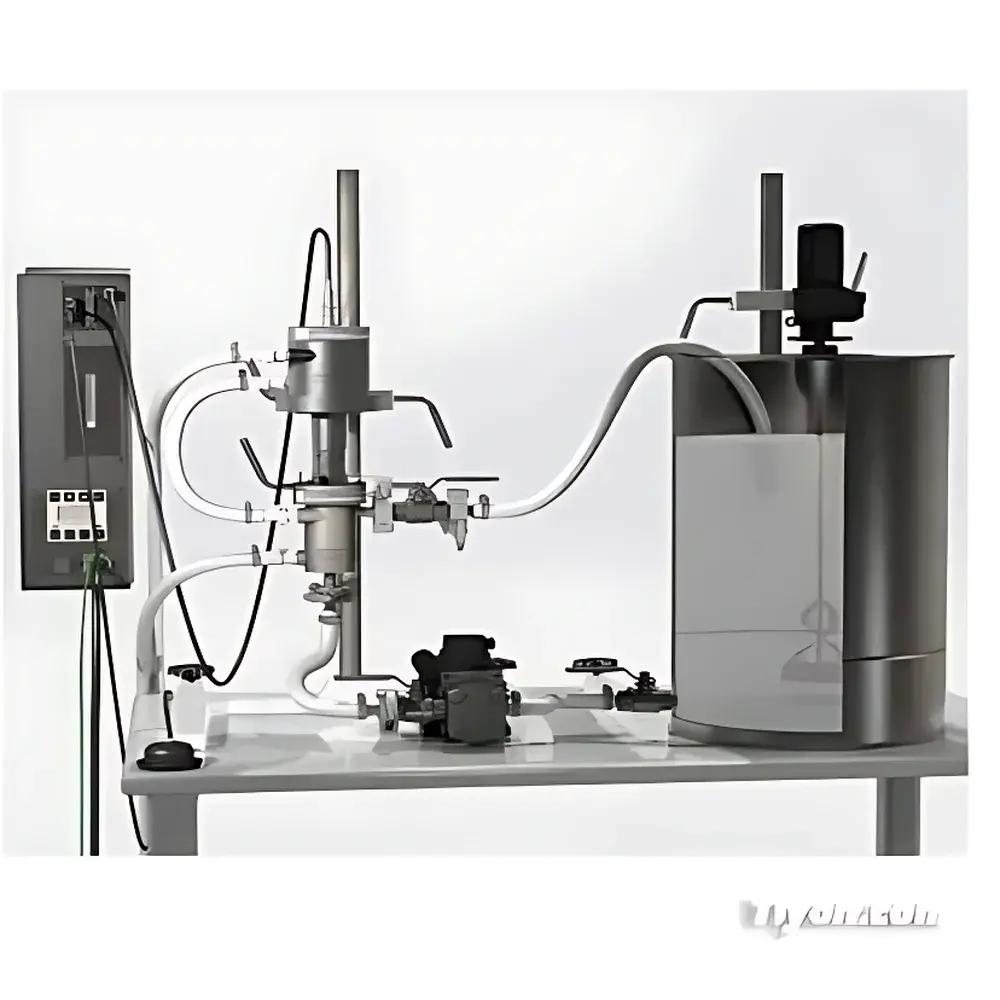
ISM BSP-1200 Ultrasonic Liquid Extraction System
| Brand | ISM |
|---|---|
| Origin | USA |
| Manufacturer Type | Authorized Distributor |
| Product Origin | Imported |
| Model | BSP-1200 |
| Ultrasonic Power | 1200 W |
| Ultrasonic Frequency | 20 kHz (±1 kHz) |
| Maximum Heating Power | 600 W |
| Temperature Range | −20 °C to 200 °C |
| Chamber Capacity | 500 mL – Unlimited (flow-through mode) |
| Horn Type | Half-Wave BarbellHorn® (HBH, 32 mm tip diameter) |
| Max Amplitude | 93 µm |
| Cooling | Integrated Circulating Water Chiller (SWCT-1200) |
| Wetted Materials | 304 Stainless Steel (reactor chamber), Grade 5 Titanium (Ti6Al4V, horn), Buna-N or PTFE gaskets, Buna-N O-rings |
| Noise Level | 103–106 dB(A) at 0.6 m |
| Compliance | FDA-compliant wetted materials, GLP-ready operation |
Overview
The ISM BSP-1200 Ultrasonic Liquid Extraction System is an industrial-grade, benchtop-to-pilot-scale ultrasonic processor engineered for high-intensity, continuous-flow extraction, homogenization, emulsification, and nanomaterial synthesis. It operates on the principle of acoustic cavitation—generating controlled microbubble collapse within liquids under high-amplitude, low-frequency (20 kHz) ultrasound—to induce intense localized shear, thermal gradients, and mass transfer enhancement. Unlike conventional batch sonicators, the BSP-1200 integrates a half-wave BarbellHorn® (HBH) transducer with a purpose-built flow-through reactor chamber, enabling scalable, reproducible processing from 500 mL up to unlimited volumes in continuous mode. Its 1200 W nominal output power—delivered at precisely stabilized 20 kHz with real-time frequency locking—ensures consistent energy delivery across variable load conditions, critical for process development aligned with QbD (Quality by Design) frameworks.
Key Features
- High-Amplitude BarbellHorn® Technology: Patented half-wave HBH probe (32 mm tip, Ti6Al4V) delivers up to 93 µm peak-to-peak amplitude—among the highest in class—enabling efficient cell lysis, particle deagglomeration, and solvent-free extraction without probe erosion or thermal runaway.
- True Flow-Through Architecture: Stainless steel (304 SS) reaction chamber features 1/2″ sanitary tri-clamp ports, integrated cooling jacket, and quick-disconnect valves—designed for seamless integration into closed-loop recirculation systems or inline production lines.
- Intelligent Power Management: Real-time resonant frequency tracking, automatic impedance compensation, and fine-grained amplitude control (20–100% in 1% increments) ensure stable cavitation intensity regardless of sample viscosity, temperature, or volume changes.
- Thermal Control Integration: Built-in 600 W heating element and coupled SWCT-1200 circulating chiller (−20 °C to +200 °C operating range) allow precise thermal management during exothermic or endothermic processes—essential for thermolabile compound recovery and crystallization control.
- Regulatory-Ready Construction: All fluid-contact surfaces comply with USP Class VI and FDA 21 CFR 177.2600 requirements: Ti6Al4V horn, 304 SS chamber, PTFE/Buna-N seals, and NSF-certified elastomers support GMP/GLP environments and pharmaceutical process validation.
Sample Compatibility & Compliance
The BSP-1200 accommodates diverse matrices—including aqueous suspensions, organic solvents (e.g., ethanol, ethyl acetate), viscous plant extracts, polymer solutions, and biological lysates—without requiring solvent switching or probe replacement. Its wide temperature window (−20 °C to 200 °C) supports cryogenic extraction (e.g., anthocyanin stabilization) and high-T hydrolysis (e.g., lignin depolymerization). The system meets ISO 13849-1 for functional safety, conforms to IEC 61000-6-3 (EMC) and IEC 61000-6-4 standards, and provides full audit trail capability when paired with ISM’s optional LabControl™ software—supporting 21 CFR Part 11 compliance for electronic records and signatures in regulated labs.
Software & Data Management
Optional LabControl™ v4.2 software enables remote operation, parameter logging (power, frequency, amplitude, temperature, flow rate), and SOP-driven method execution. All operational data—including timestamped event logs, alarm history, and calibration metadata—are stored in encrypted SQLite databases with configurable export (CSV, PDF, XML). The software supports user role-based access control (RBAC), electronic signature workflows, and automated report generation compliant with ISO/IEC 17025 and ASTM E2500-22 for analytical instrument qualification.
Applications
- Pharmaceutical: Active pharmaceutical ingredient (API) nanosuspension preparation via top-down crystallization; lipid nanoparticle (LNP) formulation; enzymatic reaction acceleration.
- Natural Products: High-yield, low-temperature extraction of polyphenols, terpenes, and alkaloids from botanical matrices—reducing thermal degradation vs. Soxhlet methods.
- Materials Science: Graphene oxide exfoliation, metal-organic framework (MOF) dispersion, carbon nanotube debundling.
- Food & Beverage: Cold pasteurization validation studies, juice cloud stabilization, allergen reduction in dairy streams.
- Environmental: Accelerated leaching of heavy metals from soil/sediment samples per EPA Method 3050B and ASTM D5510.
FAQ
What is the difference between HBH and FBH horn configurations?
The Half-Wave BarbellHorn® (HBH) maximizes amplitude (93 µm) and is optimized for flow-through applications requiring high shear and cavitation density. The Full-Wave BarbellHorn® (FBH, 35 mm) offers broader near-field distribution and is preferred for batch-mode homogenization of volumes ≤2 L.
Can the BSP-1200 be integrated into an existing PLC-controlled production line?
Yes—via optional 0–10 V analog I/O or Modbus RTU RS-485 interface, enabling external start/stop, amplitude modulation, and real-time parameter feedback to SCADA or MES platforms.
Is validation documentation available for GMP use?
ISM provides IQ/OQ protocols, factory calibration certificates (NIST-traceable power and temperature sensors), and material compliance dossiers—fully customizable for client-specific PQ execution.
What maintenance intervals are recommended?
Horn tip inspection every 200 h of operation; chiller coolant replacement annually; ultrasonic generator internal cleaning every 2 years (per ISM Service Bulletin SB-BSP-1200-07).



