
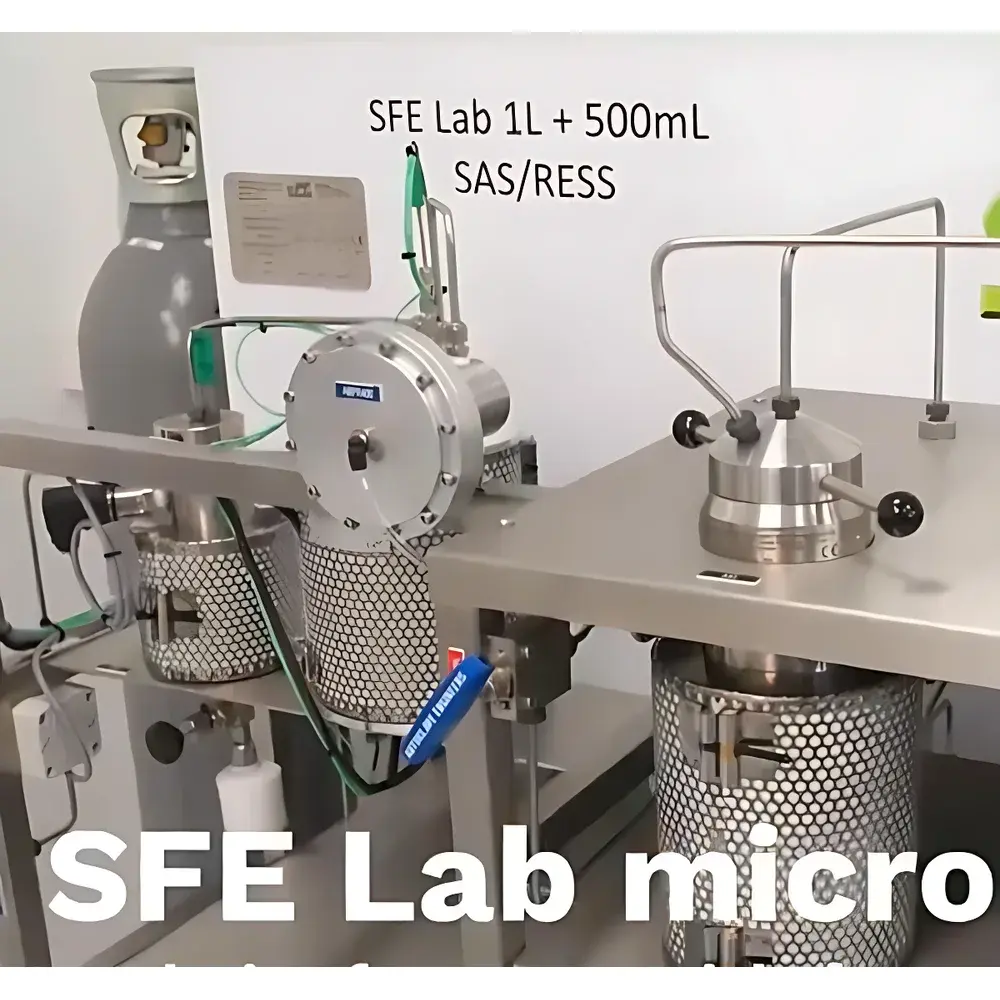
SFE LAB SFE SAS/RESS Supercritical Anti-Solvent Nanoparticle Production System
| Brand | SFE / SFE PROCESS |
|---|---|
| Origin | France |
| Manufacturer Type | Authorized Distributor |
| Origin Category | Imported |
| Model | SFE SAS/RESS |
| Price Range | USD 210,000 – 280,000 (FOB Le Havre) |
| Max Temperature | 150 °C |
| Channels | 1 |
| Extraction Volumes | 1 L & 500 mL |
| Max Pressure | 1000 bar |
| Max CO₂ Mass Flow Rate | 70 g/min |
| Primary Application | Nanoparticle Synthesis via Supercritical Anti-Solvent (SAS) and Rapid Expansion of Supercritical Solutions (RESS) Processes |
| Co-solvent Pump | Integrated |
| Solvent Recovery | Yes |
| CO₂ Recovery | Yes |
| Spray Nozzle Vessels | Dual (500 mL & 1 L) |
| Automatic Venting Valve Bank | Yes |
| Precision Mass Flow Control | Coriolis-based |
| Control Architecture | PLC with HMI, Recipe Management, Remote Monitoring Capability, Unattended Operation Support |
Overview
The SFE LAB SFE SAS/RESS Supercritical Anti-Solvent Nanoparticle Production System is an engineered platform for the controlled synthesis of nanostructured solid particles using supercritical carbon dioxide (scCO₂) as an anti-solvent or expansion medium. Unlike conventional precipitation techniques, SAS leverages the tunable solvent power of scCO₂ to induce rapid supersaturation of solute-laden organic solutions—typically dissolved in acetone, ethanol, or ethyl acetate—resulting in nucleation-driven formation of monodisperse nanoparticles with narrow size distribution (typically 20–500 nm). The system operates on the principle of co-injection: a high-pressure organic solution stream and a separately metered scCO₂ stream converge within a precisely temperature- and pressure-regulated precipitation chamber, where thermodynamic instability triggers instantaneous phase separation and particle formation. Complementing SAS, the integrated RESS (Rapid Expansion of Supercritical Solutions) mode enables direct processing of solutes soluble in scCO₂—such as certain lipids, steroids, or small-molecule APIs—by adiabatic expansion through a capillary nozzle into ambient conditions. This dual-mode architecture provides researchers with experimental flexibility across diverse material classes while maintaining full traceability and process repeatability.
Key Features
- Dual-volume precipitation vessels (1 L and 500 mL) with interchangeable, viewable sapphire windows for real-time observation of nucleation dynamics and particle agglomeration behavior
- Coriolis-type mass flow controllers for independent, high-accuracy regulation of both organic solvent and scCO₂ streams (±0.5% FS repeatability)
- Integrated co-solvent pump capable of delivering polar modifiers (e.g., methanol, ethanol) at pressures up to 350 bar to extend solubility windows for polar active pharmaceutical ingredients (APIs)
- Automated venting valve bank with programmable sequence logic for safe, stepwise depressurization and inert gas purging between batches
- PLC-based control system compliant with IEC 61131-3 standards, supporting recipe storage, version-controlled parameter sets, and time-stamped audit logs
- Full scCO₂ and organic solvent recovery loop: >95% CO₂ recirculation efficiency; solvent condensation at −20 °C with gravimetric yield tracking
- Robust stainless-steel 316 construction throughout wetted parts; ASME B31.3-compliant pressure boundary design validated to 1.5× maximum operating pressure
Sample Compatibility & Compliance
The system accommodates a broad spectrum of thermolabile and oxidation-sensitive materials, including but not limited to: poorly water-soluble APIs (e.g., ibuprofen, griseofulvin), biodegradable polyesters (PLGA, PCL), natural polymers (chitosan, gelatin), metal–organic frameworks (MOFs), and catalytic nanocomposites (e.g., Pt/C, TiO₂). All process-critical components meet ISO 13485:2016 design controls for medical device-related R&D environments. For regulated pharmaceutical development, the system supports 21 CFR Part 11 compliance through electronic signature enforcement, audit trail generation (including operator ID, timestamp, parameter change history), and data integrity safeguards per ALCOA+ principles. Optional IQ/OQ documentation packages are available for GMP-aligned installation and operational qualification under EU Annex 15 and USP <1058> guidelines.
Software & Data Management
The embedded HMI interface runs on a real-time Linux OS with deterministic task scheduling. Process data—including pressure (0–1000 bar, ±0.1 bar), temperature (ambient to 150 °C, ±0.3 °C), mass flow rates, and vessel weight change—is acquired at 10 Hz and stored locally in encrypted SQLite databases with SHA-256 hashing. Export formats include CSV, HDF5, and ASTM E2500-compliant XML for integration with LIMS or ELN platforms (e.g., LabVantage, Benchling). Remote access is enabled via TLS 1.3-secured web interface with role-based permissions (Admin, Operator, Viewer). All firmware updates undergo cryptographic signature verification prior to deployment.
Applications
- Preformulation studies of nanosuspensions for oral, pulmonary, and parenteral delivery
- Stabilization of amorphous solid dispersions without thermal degradation
- Encapsulation of peptides and oligonucleotides in biodegradable nanocarriers
- Continuous-flow nanoparticle synthesis for scale-up feasibility assessment
- Surface functionalization of nanoparticles via in situ co-precipitation with surfactants or targeting ligands
- Production of catalyst nanoparticles with controlled crystallinity and surface area (BET 50–300 m²/g)
FAQ
What is the difference between SAS and RESS modes on this system?
SAS is used for solutes insoluble in scCO₂ but soluble in organic solvents; RESS applies to solutes directly soluble in scCO₂. The system switches modes via hardware reconfiguration and software-defined parameter profiles.
Can the system be validated for GMP manufacturing use?
While designed for laboratory-scale R&D, it supports full IQ/OQ/PQ execution per ASTM E2500 and EU GMP Annex 15 when configured with optional validation services and documentation packages.
Is CO₂ recycling mandatory, or can it be vented?
Both configurations are supported. The standard loop includes a high-efficiency CO₂ liquefaction unit; vent-only operation requires separate exhaust scrubbing per local environmental regulations.
What safety certifications does the system hold?
CE marking per PED 2014/68/EU, ATEX Zone 2 compliance for electrical enclosures, and conformity to EN ISO 13850 for emergency stop functionality.
How is particle size distribution monitored during operation?
In-line laser diffraction (optional add-on) or offline SEM/TEM analysis of collected samples; no real-time optical monitoring is built-in, preserving system pressure integrity.
Related Products



