
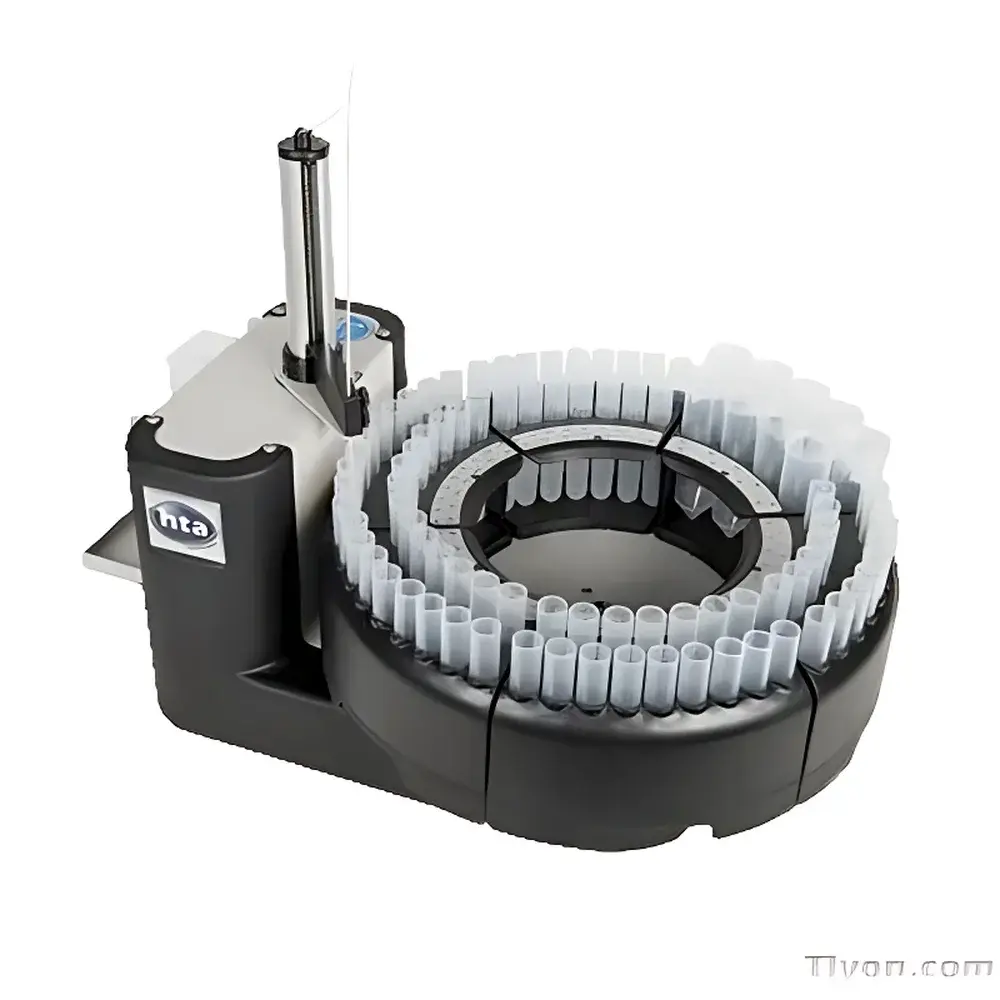
HTA HT1000I Spectroscopic Multifunctional Autosampler
| Brand | HTA (Italy) |
|---|---|
| Origin | Italy |
| Model | HT1000I |
| Instrument Type | Multifunctional Autosampler |
| Max Sample Capacity | 96-position rack |
| Minimum Sample Volume | 10 µL |
| Quantitative Loop Volume | 10–50 µL |
| Positioning Accuracy | <0.3 mm |
| Motion Mechanism | Rotary Carousel |
| Needle Wash Mode | Internal & External Rinse |
| Repeat Injection Capability | Unlimited Sequential Injections |
Overview
The HTA HT1000I Spectroscopic Multifunctional Autosampler is an engineered solution for high-precision, low-contamination sample introduction in elemental analysis laboratories. Designed specifically for coupling with inductively coupled plasma optical emission spectrometry (ICP-OES), ICP mass spectrometry (ICP-MS), microwave plasma atomic emission spectrometry (MP-AES), and flame atomic absorption spectrometry (FAAS), the HT1000I employs a short-path, inert-flow architecture to minimize sample residence time, reduce memory effects, and enhance analytical reproducibility. Its core operational principle relies on programmable depth-controlled probe insertion, precise rotary carousel positioning, and dual-stage needle rinsing—ensuring robust performance across diverse matrix types without manual intervention. The system integrates seamlessly into existing spectroscopic workflows while maintaining strict compliance with laboratory space constraints and operational efficiency targets.
Key Features
- Compact rotary carousel design accommodating up to 96 samples in standardized racks—optimized for standard laboratory footprints without compromising throughput.
- Sub-millimeter positioning accuracy (<0.3 mm) enabled by high-resolution optical encoders, eliminating time-based drift common in stepper-motor-driven systems.
- Dual-path rinse mechanism: simultaneous internal and external needle washing using dedicated wash pumps and solvent paths to prevent cross-contamination between samples.
- Short fluidic path length—approximately 0.5 m shorter than typical competitive systems—reducing rinse time, argon consumption, and dwell time in nebulizer chambers or spray chambers.
- ARM-based embedded controller supporting real-time algorithms for automatic calibration, pressure compensation, and fault recovery—minimizing downtime and operator dependency.
- Modular rack system: six removable sample trays, each configurable for multiple tube formats (e.g., 13 mm × 100 mm, 16 mm × 150 mm); rack identification via mechanical coding prevents misplacement during offline preparation.
Sample Compatibility & Compliance
The HT1000I supports aqueous, organic, and diluted acid matrices commonly encountered in environmental, geochemical, clinical, and metallurgical applications. It is compatible with standard ICP-OES/MS autosampler interfaces—including peristaltic pump connections, pneumatic nebulizer couplings, and direct injection modules—and conforms to ISO/IEC 17025 requirements for automated sample handling traceability. While not certified as standalone GLP/GMP equipment, its firmware supports audit-ready logging of injection sequences, wash cycles, and error events—facilitating alignment with FDA 21 CFR Part 11 when integrated into validated instrument control environments.
Software & Data Management
The HT1000I operates via both local keypad interface and host software integration. Integrated keyboard enables rapid setup of priming, end-of-session wash, and parameter configuration without PC dependency. For routine operation, it communicates natively with major vendor platforms including Thermo Fisher iCAP Series, Agilent 5110/5900 ICP-OES, PerkinElmer Avio/NexION, and Shimadzu AA-7000/8000 series through RS-232, USB virtual COM, or Ethernet TCP/IP protocols. Four status LEDs provide at-a-glance indication of power, communication link, carousel motion, and active rinse cycle. All sequence logs—including timestamped injection records, rinse counts, and positional errors—are exportable in CSV format for LIMS integration or QA documentation.
Applications
- Routine multi-element quantification in environmental water testing (EPA Methods 200.7, 200.8, 6020B).
- High-throughput screening of geological digests and ore leachates in exploration labs.
- Trace metal analysis in pharmaceutical excipients per USP /.
- Quality control of semiconductor-grade acids and ultrapure reagents.
- Long-duration unattended operation for stability-indicating assays requiring repeated injections over extended periods.
FAQ
Is the HT1000I compatible with ICP-MS systems requiring ultra-low background operation?
Yes—the inert fluidic path, dual-rinse capability, and minimal dead volume design support sub-ppt detection limits when paired with appropriate sample introduction hardware.
Can the autosampler be recalibrated in-house without service tools?
Yes—embedded auto-calibration routines are accessible via the front-panel interface and require no external utilities or proprietary software.
What tube formats does the carousel accept?
Standard configurations include 12 × 75 mm, 13 × 100 mm, 16 × 150 mm, and 18 × 150 mm vials; custom tray inserts are available upon request.
Does the system support variable injection volumes within a single sequence?
Yes—loop volume selection (10–50 µL) and aspiration depth are programmable per sample position via host software or sequence file.
How is maintenance tracked and scheduled?
The system logs cumulative rinse cycles, motor actuations, and error flags; recommended preventive maintenance intervals are outlined in the technical manual based on operational hours and sample load profiles.




