
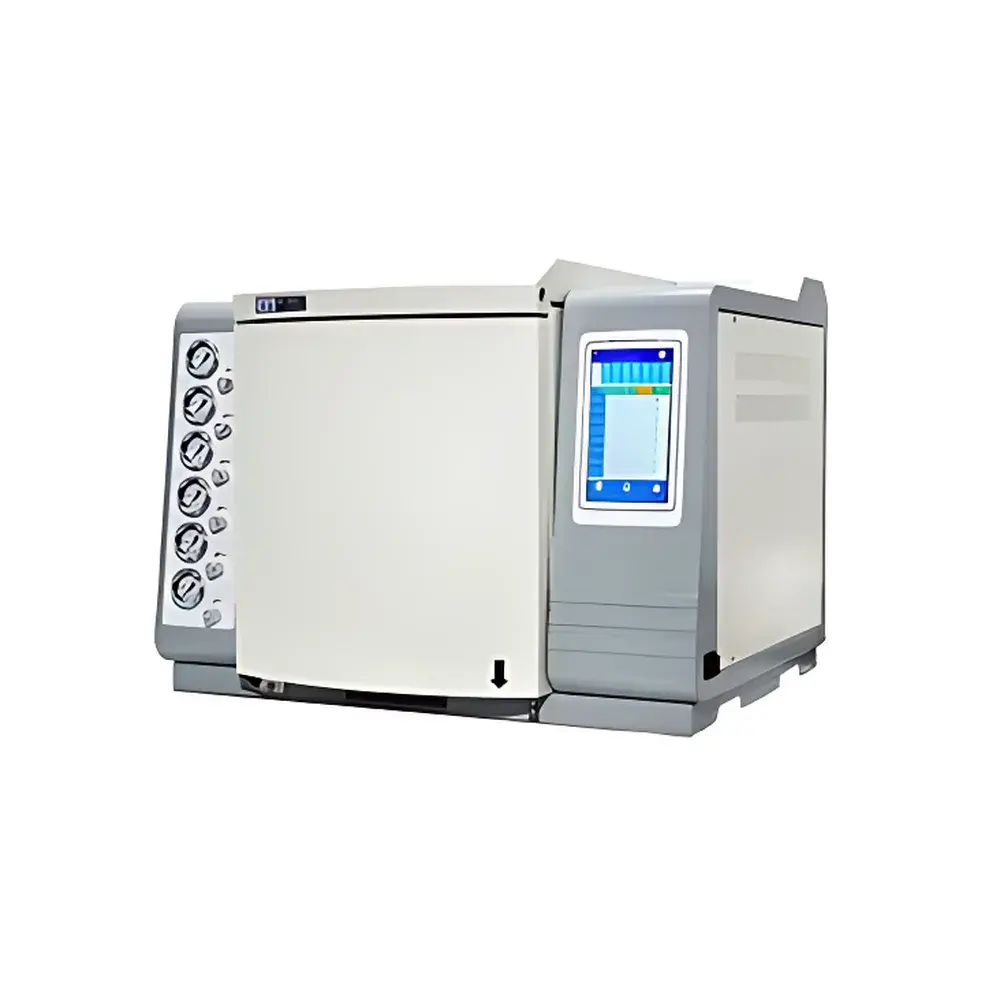
Zhongkehuifen GC-7820 Dedicated Gas Analysis System
| Brand | Zhongkehuifen |
|---|---|
| Origin | Beijing, China |
| Model | GC-7820 Dedicated Gas Analysis System |
| Instrument Type | Laboratory Gas Chromatograph |
| Application Field | High-Purity Gas Analysis |
| Temperature Control Range | Ambient + 3 °C to 450 °C |
| Oven Ramp Rate | 0.1–40 °C/min |
| Cooling Rate | ~8 min (450 °C to 50 °C) |
| Carrier Gas Flow Range & Control | 0–1200 mL/min |
| Carrier Gas Pressure Range & Control | 0–970 kPa |
| Injector Maximum Operating Temperature | 450 °C |
| Injector Pressure Setting Range | 0–970 kPa |
| Injector Total Flow Setting Range | 0–1200 mL/min |
| Configuration | Multidimensional GC with Dual-10-Port Valves, Dual-6-Port Valves, Four Analytical Columns (including Two Pre-columns), Triple Detectors (Dual TCD + FID) |
| Data Interface | Digital Output via Ethernet |
| Software | Dedicated Tri-Channel Workstation (Windows 2000/XP/8 Compatible) |
| Compliance Context | Designed for GLP-compliant laboratory environments |
Overview
The Zhongkehuifen GC-7820 Dedicated Gas Analysis System is a multidimensional gas chromatograph engineered specifically for high-purity and industrial gas matrix analysis. It operates on the principle of selective separation via capillary and packed column chromatography, coupled with thermal conductivity (TCD) and flame ionization (FID) detection. The system implements a fully automated, time-programmed valving architecture—featuring two independently actuated 10-port valves and two 6-port valves—to route sample streams across three parallel analytical channels. This configuration enables simultaneous quantification of permanent gases (O₂, N₂, CO, CO₂, CH₄), light hydrocarbons (C₁–C₆), and hydrogen (H₂) in a single injection cycle, without manual intervention or column reconfiguration. Its oven temperature control—spanning ambient + 3 °C to 450 °C with programmable ramp rates from 0.1 to 40 °C/min—ensures precise retention time reproducibility across diverse volatility ranges. The system’s robust thermal management, including rapid cooling (450 °C → 50 °C in ~8 minutes), supports high-throughput laboratory workflows typical in refinery, petrochemical, and energy infrastructure QA/QC labs.
Key Features
- Multidimensional GC architecture with dual 10-port and dual 6-port pneumatically actuated valves for unattended, time-scheduled flow path switching
- Triple-detector configuration: two independent TCDs for permanent gas and hydrogen analysis, plus one FID optimized for hydrocarbon detection (C₁–C₆)
- Four dedicated columns—including two pre-columns and two application-specific analytical columns—configured for orthogonal selectivity and minimal co-elution
- Full digital signal acquisition and Ethernet-based data transmission, eliminating analog noise and supporting remote instrument monitoring
- Injector capable of operation up to 450 °C with independent pressure and total flow control (0–970 kPa / 0–1200 mL/min), ensuring compatibility with high-boiling-point contaminants and trace-level standards
- Temperature-stable oven design with uniform axial and radial temperature distribution, meeting ISO 17025 calibration traceability requirements for retention time precision
Sample Compatibility & Compliance
The GC-7820 Dedicated Gas Analysis System is validated for direct injection of compressed gas samples ranging from ultra-high-purity (99.999%+) to complex industrial matrices—including refinery off-gas, LPG, natural gas, coke oven gas, and flue gas. Its valve/column layout adheres to ASTM D1945 (Analysis of Natural Gas), ASTM D1946 (Analysis of Reformed Gas), and GB/T 13610 (Chinese national standard for gas chromatographic analysis of natural gas). All pneumatic subsystems are calibrated against NIST-traceable pressure and flow standards. When operated with validated tri-channel workstation software under documented SOPs, the system satisfies data integrity expectations aligned with FDA 21 CFR Part 11 for electronic records and signatures—particularly when audit trail logging, user access controls, and electronic signature capture are enabled. It is routinely deployed in laboratories operating under GLP and ISO/IEC 17025 accreditation frameworks.
Software & Data Management
The system integrates a purpose-built tri-channel chromatography workstation compatible with Windows 2000, XP, and Windows 8 platforms. Unlike generic third-party software, this native application manages synchronized acquisition from all three detector channels—including real-time baseline correction, peak integration using tangent skim and valley-to-valley algorithms, and automatic retention time alignment across valves. Raw data files are stored in vendor-neutral .CDF format (compatible with OpenChrom and Chromeleon), while quantitative reports include full metadata: method parameters, valve timing logs, detector gain settings, and calibration curve statistics (R², %RSD of replicates). The Ethernet interface allows secure remote access via TLS-encrypted connections, enabling centralized fleet monitoring and preventive maintenance alerts based on operational hour counters and detector performance drift metrics.
Applications
- Petrochemical process gas monitoring: real-time O₂/N₂/CO/CO₂/CH₄ profiling in catalytic reformer and hydrotreater purge streams
- Liquefied petroleum gas (LPG) specification testing per ASTM D2158 and EN 15320—quantifying propane, butane, isobutane, and propylene
- Natural gas quality assurance: compositional analysis per ISO 6974 series, including inert gas correction and Wobbe index calculation
- Hydrogen purity verification in PEM electrolyzer output and fuel cell feedstock (meets ISO 8573-1 Class 1 requirements for O₂ and H₂O)
- Environmental emissions compliance: continuous monitoring of CO, CO₂, CH₄, and non-methane hydrocarbons in stack gas per EPA Method 18 and ISO 12039
- Industrial gas certification: verification of argon, nitrogen, helium, and oxygen grades per CGA G-1.1 and ISO 8573-1 Annex B
FAQ
What gas matrices can be analyzed without hardware modification?
The system is factory-configured for permanent gases (O₂, N₂, CO, CO₂, CH₄), hydrogen, and C₁–C₆ hydrocarbons. Minor method adjustments—not hardware changes—are required for other light gases (e.g., H₂S, NH₃) using existing TCD/FID channels.
Is the system compliant with FDA 21 CFR Part 11?
Yes—when operated with the validated tri-channel workstation and configured with enabled audit trails, role-based user authentication, and electronic signature workflows, it meets Part 11 technical and procedural requirements.
Can the system be integrated into a LIMS environment?
Yes—via its Ethernet interface and support for ASTM E1381/1394-compliant data export formats (.CSV, .XML, .CDF), enabling seamless ingestion into major LIMS platforms including LabVantage, STARLIMS, and Thermo Fisher SampleManager.
What maintenance intervals are recommended for valves and detectors?
Ten-port valves require cleaning every 6 months under normal use; FID jet inspection and TCD filament resistance checks are advised quarterly. Full preventive maintenance—including oven insulation verification and detector baseline stability assessment—is recommended annually by certified field service engineers.
Does the system support unattended overnight operation?
Yes—its time-programmed valving, auto-shutdown logic, and watchdog timer ensure stable multi-hour sequence execution with alarm-triggered email notifications for pressure loss, temperature deviation, or detector saturation.




