
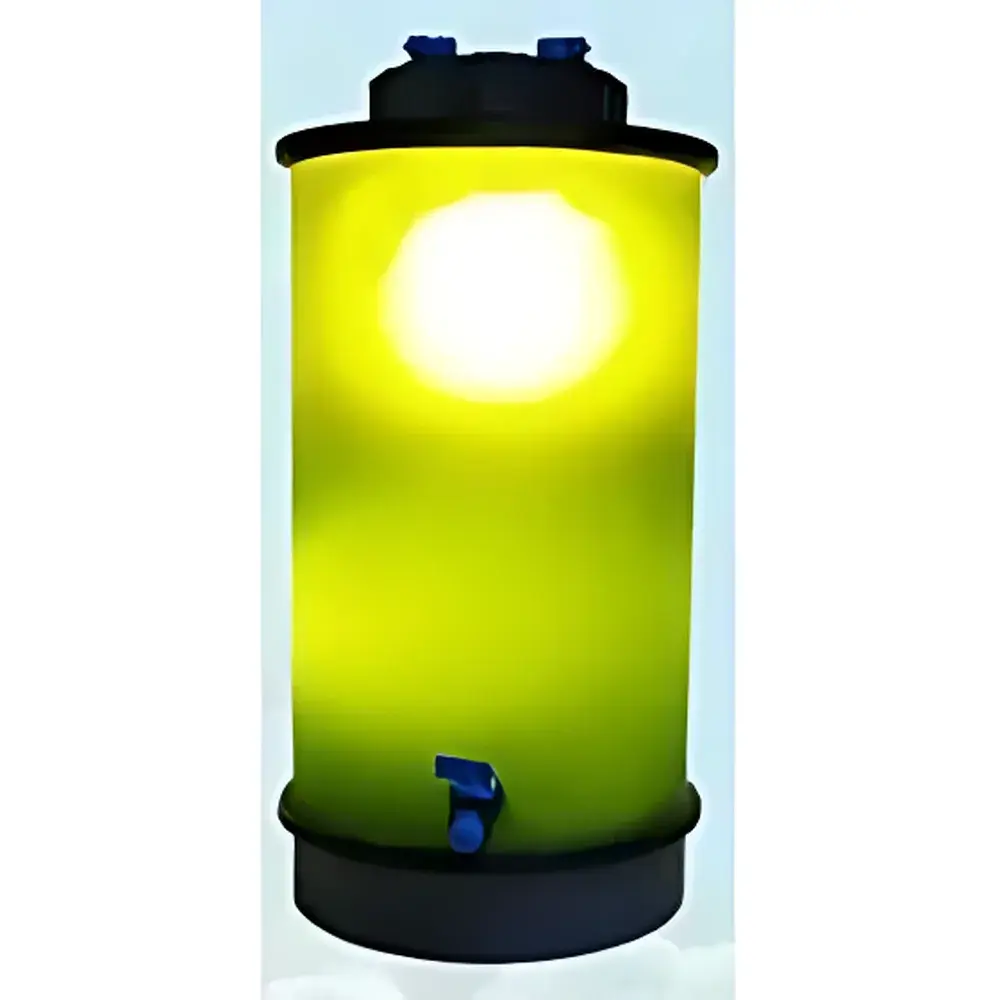
PB250 Algal Photobioreactor
| Origin | Germany |
|---|---|
| Manufacturer Type | Authorized Distributor |
| Origin Category | Imported |
| Model | PB 250 |
| Price Range | USD 2,700 – 6,800 (FOB) |
| Temperature Control Range | 0–40 °C |
| Culture Volume | 12 L |
| Vessel Inner Diameter | 200 mm |
| Vessel Height | 520 mm |
| Controller Dimensions | 220 × 80 × 70 mm |
| Controller Input Voltage/Power | 85–250 VAC / 5 W |
| Daily Medium Exchange Capacity | Up to 30% of Total Volume |
| Illumination | Integrated Adjustable LED Light Unit |
| Mixing | Magnetic Stirring System |
| Aeration | Integrated Air Pump |
| Vessel Material | Optical-Grade Transparent Polymer (UV-Stabilized, Non-Leaching) |
Overview
The PB250 Algal Photobioreactor is a precision-engineered, benchtop-scale photobioreactor system designed for controlled cultivation of microalgae and other photosynthetic planktonic organisms under reproducible laboratory conditions. Built upon the principles of photoautotrophic growth kinetics, it integrates regulated light delivery, temperature-stabilized incubation, gas exchange management, and programmable nutrient dosing into a single compact architecture. Unlike conventional static flasks or non-instrumented growth chambers, the PB250 employs active environmental control—enabling users to maintain consistent photon flux density (PFD), dissolved oxygen saturation, pH stability via CO₂ supplementation, and thermal homogeneity across the culture column. Its modular design conforms to standard biosafety Level 1 (BSL-1) containment practices and supports both batch and semi-continuous operation modes, making it suitable for strain screening, physiological studies, biomass yield optimization, and pre-pilot scale-up trials.
Key Features
- Optically optimized 12 L transparent culture vessel with UV-stabilized, non-leaching polymer construction—ensuring high light transmission (>92% at 400–700 nm) and long-term chemical resistance to algal media components.
- Integrated, dimmable LED illumination unit with spectral tuning capability (default white light, 4500 K CCT; optional narrow-band red/blue configurations available)—delivering uniform irradiance profiles across the vertical culture column.
- High-reliability magnetic stirring system with adjustable speed (0–300 rpm), enabling gentle yet effective suspension of non-motile microalgae without shear-induced cell damage.
- Programmable digital controller (PB250-Ctrl) providing time-scheduled on/off switching for lighting, peristaltic nutrient addition, and air pump activation—with real-time status feedback via LED indicators and non-volatile parameter storage.
- Precision temperature regulation (0–40 °C ±0.3 °C) via Peltier-based heating/cooling module and PID-controlled airflow distribution—minimizing thermal stratification within the vessel.
- Screw-top lid with integrated gas inlet/outlet ports, silicone gasket sealing, and quick-access sampling valve—supporting sterile handling and routine monitoring without culture disruption.
Sample Compatibility & Compliance
The PB250 accommodates a broad spectrum of freshwater and marine microalgal species—including Chlorella vulgaris, Dunaliella salina, Nannochloropsis gaditana, and Scenedesmus obliquus—as well as cyanobacteria such as Synechocystis sp. PCC 6803. Its material composition complies with ISO 10993-5 (cytotoxicity) and USP Class VI standards for biocompatibility. The system meets IEC 61000-6-3 (EMC emissions) and IEC 61010-1 (safety requirements for laboratory equipment). When operated in conjunction with validated SOPs, it supports GLP-compliant data generation for regulatory submissions related to biofuel feedstock characterization, nutraceutical production, or ecotoxicological testing (OECD 201, ISO 8692).
Software & Data Management
While the base PB250 operates via embedded firmware without cloud connectivity, the controller supports optional RS-485 serial interface for integration into centralized lab automation platforms (e.g., LabVIEW, Python-based SCADA). Logged operational parameters—including cumulative light exposure (mol photons·m⁻²), total medium exchange volume, and runtime statistics—are stored locally for up to 30 days. Audit trails for parameter changes comply with FDA 21 CFR Part 11 requirements when paired with third-party electronic lab notebook (ELN) systems supporting digital signature and role-based access control.
Applications
- Physiological response profiling under controlled light–temperature–nutrient gradients (e.g., photoacclimation studies, nitrogen starvation assays).
- High-throughput screening of mutant libraries for enhanced lipid accumulation or pigment synthesis.
- Standardized biomass production for downstream analytical workflows (HPLC, GC-MS, FTIR).
- Educational use in undergraduate and graduate courses on microbial physiology, bioprocess engineering, and sustainable biotechnology.
- Pre-validation of cultivation protocols prior to transfer to larger photobioreactor systems (e.g., flat-panel or tubular reactors).
FAQ
Is the PB250 suitable for axenic cultures?
Yes—provided aseptic techniques are followed during inoculation and maintenance. The sealed vessel design and autoclavable components (lid, sampling valve, tubing) support sterility assurance when used with laminar flow hoods and validated disinfection protocols.
Can CO₂ be directly injected into the culture headspace?
Yes—the dual-port gas manifold allows simultaneous supply of ambient air and enriched CO₂ (0.04–5% v/v) through calibrated mass flow controllers (optional accessory).
What is the expected service life of the LED illumination unit?
Rated for ≥25,000 hours at nominal output, with gradual lumen depreciation (<10% over 12 months under continuous operation). Spectral output remains stable within ±3 nm wavelength shift over lifetime.
Does the system include calibration certificates for temperature or light sensors?
Factory calibration certificates (traceable to NIST standards) are provided for the integrated PT100 temperature sensor and cosine-corrected quantum sensor. On-site recalibration services are available upon request.
Is remote monitoring possible without upgrading hardware?
No native Wi-Fi or Ethernet interface is included; however, analog voltage outputs (0–5 V) for temperature and light intensity are accessible via terminal block for connection to external DAQ systems.




