
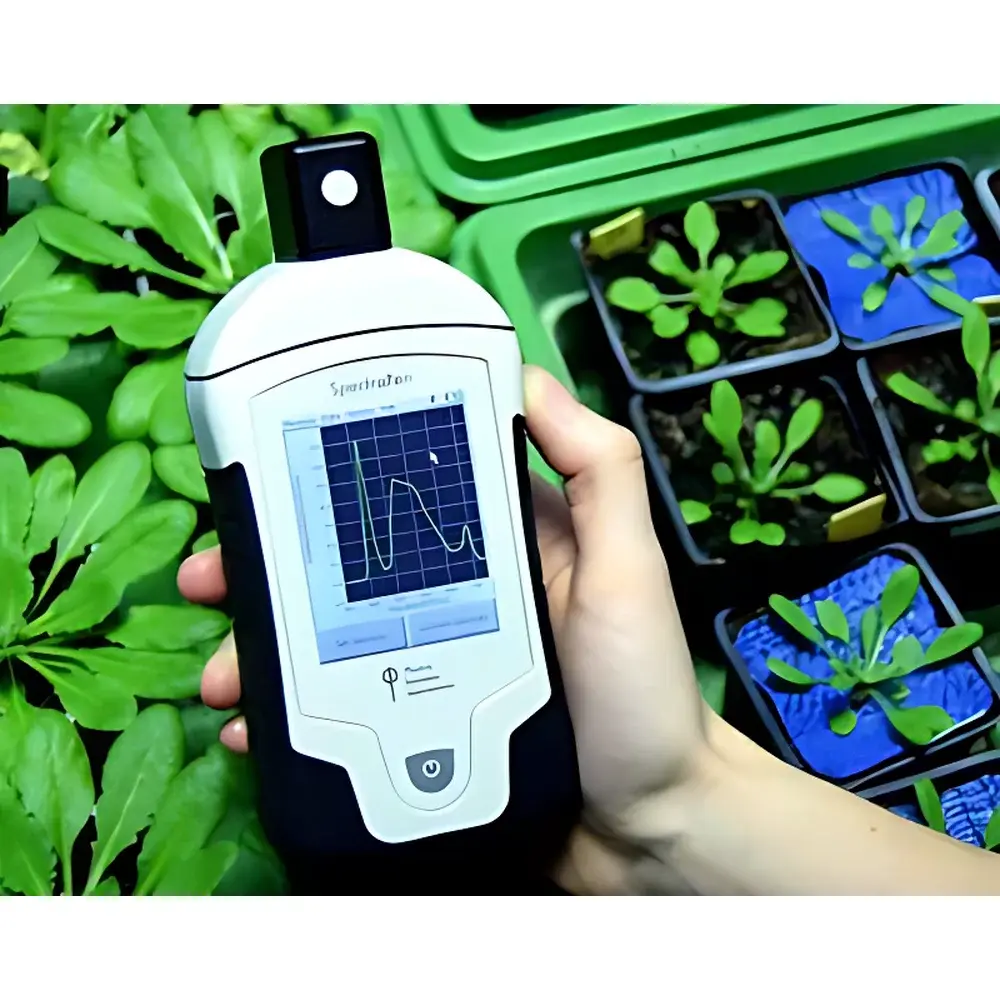
PSI SpectraPen LM510 Handheld Spectroradiometer
| Brand | PSI / Photon Systems Instruments |
|---|---|
| Origin | Czech Republic |
| Model | LM510 |
| Spectral Range | 350–1000 nm |
| Optical Resolution | ~2.5 nm (FWHM) |
| Irradiance Accuracy | ±5% |
| PAR (400–700 nm) Quantification | μmol·m⁻²·s⁻¹ |
| Illuminance | lux (CIE photopic response) |
| Data Storage | Internal flash memory (≥10,000 spectra) |
| Power | Rechargeable Li-ion battery (≥8 h continuous operation) |
| Interface | Capacitive touchscreen + USB-C |
| Calibration | NIST-traceable factory calibration |
| GPS | Integrated |
| Cosine Corrector | Detachable, ISO/CIE-compliant f/2 input optic |
Overview
The PSI SpectraPen LM510 Handheld Spectroradiometer is a field-deployable, high-fidelity optical measurement instrument engineered for quantitative spectral characterization of light sources and ambient irradiance in plant physiology, ecological monitoring, and controlled-environment agriculture. Operating on the principle of linear-array CCD spectroradiometry with thermoelectric stabilization, the LM510 captures full-range spectral irradiance (350–1000 nm) at nominal 2.5 nm optical resolution (FWHM), enabling rigorous photobiological quantification aligned with international radiometric standards. Unlike broadband sensors, the LM510 delivers spectrally resolved data—essential for distinguishing spectral quality effects on photosynthetic efficiency, photomorphogenesis, and non-photochemical quenching. Its compact, ergonomic design integrates a CIE-compliant cosine corrector, built-in GPS geotagging, and real-time on-device computation of biologically relevant metrics—including photosynthetically active radiation (PAR), illuminance (lux), radiant flux (W·m⁻²), and photon flux density (μmol·m⁻²·s⁻¹)—all traceable to NIST-calibrated reference standards.
Key Features
- Full-spectrum acquisition from 350 to 1000 nm with thermally stabilized CCD detector for low-noise, high-reproducibility measurements
- Real-time calculation of multiple photometric and radiometric quantities: spectral irradiance (μW·cm⁻²·nm⁻¹), spectral photon flux density (μmol·m⁻²·s⁻¹·nm⁻¹), integrated PAR (400–700 nm), illuminance (lux), and user-defined band integrals (e.g., UV-A, far-red, R:FR ratio)
- Integrated CIE-standard cosine corrector with f/2 acceptance angle, compliant with ISO 19998:2017 for angular response uniformity
- Capacitive touchscreen interface with intuitive menu navigation, on-device spectral visualization, and immediate export via USB-C
- Embedded GPS module for georeferenced data logging—critical for spatially explicit ecological surveys and longitudinal field studies
- Rechargeable lithium-ion battery supporting ≥8 hours of continuous spectral acquisition and onboard processing under ambient temperature conditions (0–40 °C)
- Internal flash memory storing >10,000 full spectra with timestamp, GPS coordinates, and metadata—no external storage required
Sample Compatibility & Compliance
The SpectraPen LM510 is designed for non-contact, non-destructive measurement of planar or diffuse light fields—including solar irradiance, LED horticultural arrays, fluorescent tubes, and greenhouse transmission profiles. It complies with ISO/CIE guidelines for spectroradiometric measurement geometry and cosine response validation. The instrument’s calibration certificate includes NIST-traceable uncertainty budgets per wavelength bin (k=2), supporting GLP-aligned data integrity requirements. While not FDA-registered as a medical device, its radiometric traceability and audit-ready metadata structure meet foundational expectations for ISO/IEC 17025-accredited laboratories conducting environmental or agronomic research. No sample preparation or consumables are required—operation is fully self-contained.
Software & Data Management
Data acquisition and post-processing are supported by PSI’s proprietary SpectraSoft Suite (Windows/macOS), which enables batch spectral normalization, custom band integration, time-series interpolation, and export to CSV, MATLAB (.mat), or HDF5 formats. The software enforces audit trails for all processing steps—including baseline correction, dark current subtraction, and calibration application—and supports metadata tagging per ASTM E2916-22 (Standard Guide for Validation of Software Used in Computational Science). Raw spectral files retain embedded EXIF-like headers containing GPS coordinates, UTC timestamps, instrument serial number, and calibration epoch—facilitating FAIR (Findable, Accessible, Interoperable, Reusable) data practices. Exported datasets are compatible with third-party platforms including R (photobiology packages), Python (specutils, pandas), and ENVI for hyperspectral correlation analysis.
Applications
- Quantitative assessment of LED spectral composition in vertical farms and growth chambers
- In-field monitoring of solar spectral shifts due to aerosol loading, cloud cover, or canopy filtering
- Validation of lighting compliance with horticultural PAR standards (e.g., ASABE S640.2) and energy efficiency reporting
- Long-term ecological studies tracking seasonal changes in spectral irradiance across gradients (e.g., alpine treeline, forest understory)
- Calibration and verification of broadband quantum sensors and lux meters
- Photobiological safety evaluation of UV-emitting devices per IEC 62471
- Colorimetric analysis (CIE 1931 xy chromaticity, CCT) for horticultural lighting design and quality control
FAQ
What spectral range does the LM510 cover, and how is it calibrated?
The LM510 measures from 350 to 1000 nm with factory calibration traceable to NIST Standard Reference Materials (SRMs), including spectral irradiance standards SRM 2020 and SRM 2030. Each unit ships with a unique calibration certificate specifying wavelength accuracy (±0.3 nm) and irradiance uncertainty (±5% k=2) across the full range.
Can the LM510 measure underwater or in high-humidity environments?
The LM510 is rated IP54 (dust-protected, splash-resistant) and may be used in humid greenhouses or dew-prone field conditions; however, submersion or prolonged condensation exposure is not supported. Optional desiccant caps and hydrophobic lens coatings are available for extended outdoor deployment.
Does the instrument support automated time-lapse measurements?
Yes—via SpectraSoft Suite, users can configure interval-based acquisition (1 s to 24 h intervals) with GPS-tagged timestamps and automatic file naming. On-device scheduling is not supported; triggering requires PC connection or external TTL pulse.
How is PAR calculated, and does it conform to standard definitions?
PAR is computed as the integral of spectral photon flux density (μmol·m⁻²·s⁻¹·nm⁻¹) over 400–700 nm using trapezoidal numerical integration, fully consistent with ISO 17166:2019 and ASABE S640.2 definitions. Weighting follows the McCree action spectrum only upon user-selectable post-processing—not by default.
Is firmware upgradable, and what version control protocol is used?
Firmware updates are distributed quarterly via PSI’s secure customer portal and applied via USB-C. Each release includes SHA-256 checksums, change logs referencing ISO/IEC 12207-compliant development lifecycle documentation, and backward-compatible binary packaging.





