
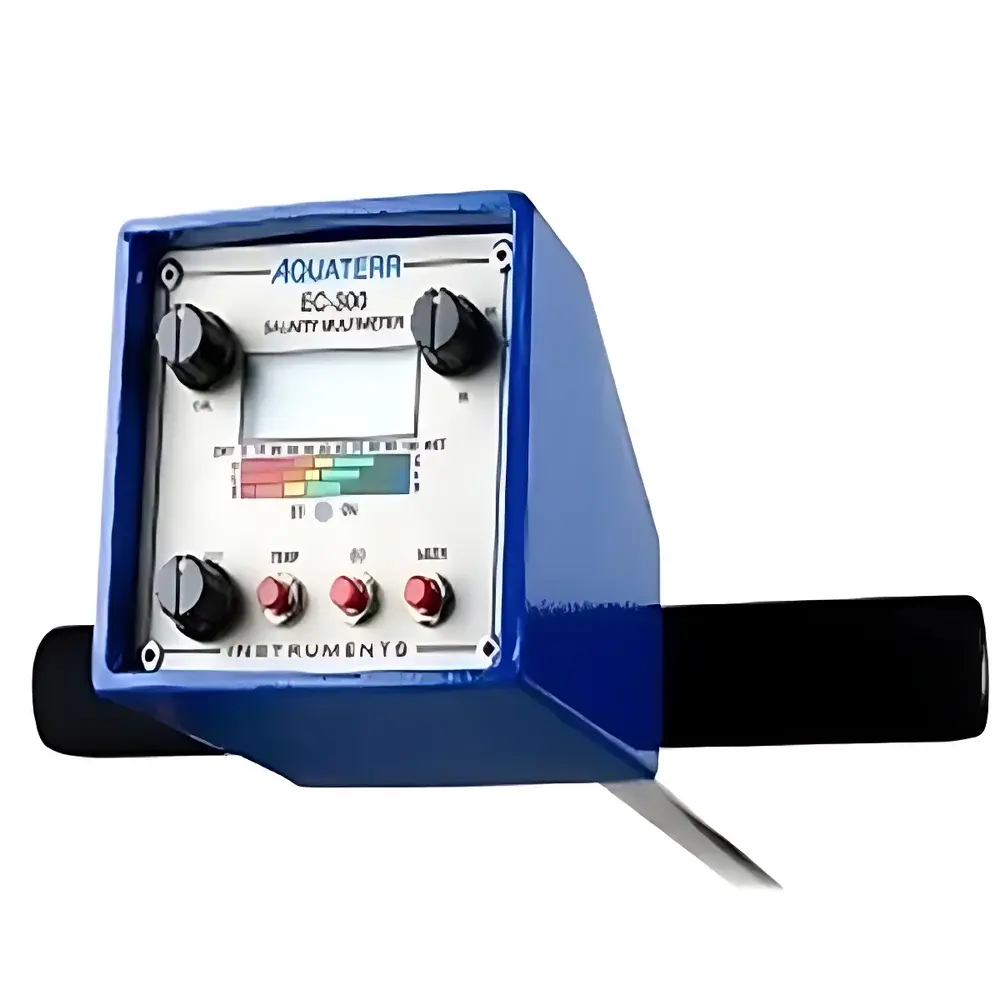
Aquaterr T-350 Soil Temperature and Moisture Meter
| Brand | Aquaterr |
|---|---|
| Origin | USA |
| Manufacturer Type | Authorized Distributor |
| Product Origin | Imported |
| Model | T-350 |
| Instrument Type | Soil Moisture and Temperature Meter |
| Probe Length | 75 cm |
| Probe Diameter | 1.3 cm |
| Probe Material | Aerospace-Grade Stainless Steel |
| Temperature Range | 0–65 °C |
| Moisture Range | 0–100 % RH (Relative Humidity, soil moisture equivalent) |
| Accuracy | ±1.5 % FS |
| Overall Length | 91.4 cm |
| Weight | 2.3 kg |
| Power Supply | 9 V Battery |
| Packaging Dimensions | 990 × 290 × 120 mm |
Overview
The Aquaterr T-350 Soil Temperature and Moisture Meter is a field-deployable, handheld instrument engineered for rapid, repeatable, and non-destructive assessment of in-situ soil conditions. It operates on the principle of capacitance-based dielectric sensing—measuring the relative permittivity of soil to derive volumetric water content—and integrates a calibrated platinum resistance temperature sensor (PT100-class equivalent) for simultaneous temperature measurement. Unlike time-domain reflectometry (TDR) or neutron probe systems, the T-350 requires no external calibration curves per soil type; its factory-calibrated algorithm accounts for typical bulk density and texture variations across loam, sandy, and clayey soils. Designed for operational continuity in outdoor environments, the unit features an IP67-rated probe housing and cast aluminum main body, enabling reliable use under rain, dust, and mechanical stress encountered in agricultural, horticultural, and landscape management settings.
Key Features
- Aerospace-grade stainless steel probe (1.3 cm diameter, 75 cm length) with hardened tip—resistant to bending, corrosion, and impact when inserted into compacted or rocky soils.
- Integrated dual-parameter sensing: simultaneous real-time readout of soil temperature (0–65 °C, switchable between °C/°F) and relative soil moisture (0–100 % RH equivalent), displayed on a backlit LCD.
- Field-stable electronics architecture with low-drift analog signal conditioning and auto-zero compensation—ensuring long-term calibration integrity without periodic recalibration.
- Ergonomic, one-handed operation: single-button activation initiates measurement; results stabilize within ≤3 seconds, supporting high-throughput profiling across multiple depths and locations.
- Modular design with replaceable probe assembly and user-accessible battery compartment—minimizing downtime and extending service life beyond 5 years under routine use.
- No external software or PC required for basic operation; all data remain accessible via onboard display and manual logging.
Sample Compatibility & Compliance
The T-350 is validated for direct insertion into mineral soils, organic topsoil, turfgrass root zones, container media, and nursery substrates. It is not intended for saturated mud, gravel beds, or highly saline soils (>8 dS/m EC), where dielectric interference may affect accuracy. While not certified to ISO 11274 or ASTM D5859 (standard test methods for soil water retention), its performance aligns with field validation protocols used in USDA-NRCS soil health assessments and EPA Region 10 land stewardship guidelines. The device complies with FCC Part 15 Class B emissions limits and RoHS 2011/65/EU material restrictions. Battery-powered operation ensures intrinsic safety in flammable or humid environments per IEC 60079-0.
Software & Data Management
The T-350 operates as a standalone field instrument without mandatory connectivity. However, optional third-party data loggers (e.g., HOBO UX120 or Onset U30) can interface via analog voltage output (0–5 V DC proportional to moisture/temperature) for time-series recording. All measurements support manual traceability: users record location, depth, timestamp, and environmental notes alongside displayed values. For regulated workflows—including GLP-compliant agronomic trials or irrigation audit documentation—the device supports audit-ready manual entry into LIMS or Excel-based templates compliant with FDA 21 CFR Part 11 Annex 11 principles (where electronic records are generated externally).
Applications
- Turf and Landscape Management: Real-time verification of irrigation uniformity across golf greens, sports fields, and municipal parks—enabling zone-specific scheduling and reducing overwatering by up to 22 % (per ASLA 2022 Field Practice Report).
- Precision Agriculture: Pre-planting soil readiness checks, mid-season drought stress monitoring, and post-harvest residue moisture evaluation for cover crop establishment.
- Ecological Restoration: Monitoring seedbed moisture thresholds during native grass reseeding and tracking microsite temperature gradients in riparian buffer zones.
- Urban Green Infrastructure: Performance validation of bioswales, green roofs, and permeable pavements through vertical moisture profiling at 10 cm, 30 cm, and 60 cm depths.
- Educational & Extension Use: Demonstrating soil–water–temperature interrelationships in university field labs and cooperative extension workshops.
FAQ
Does the T-350 require soil-specific calibration?
No. It uses a generalized dielectric calibration optimized for common mineral soils (sand to clay loam). For highly organic (>30 % OM) or saline soils, field verification against gravimetric sampling is recommended.
Can the probe be left permanently buried?
No. The T-350 is designed for intermittent insertion and removal. Prolonged burial may accelerate sensor drift and compromise seal integrity.
What is the expected battery life under typical use?
Approximately 200 hours of active measurement time (based on 100 measurements/day at 3-second dwell per reading) using a standard alkaline 9 V battery.
Is the temperature reading representative of ambient air temperature?
No. The integrated sensor measures soil temperature only, at the probe tip depth. Air temperature must be recorded separately using a dedicated weather station or handheld thermohygrometer.
How should the probe be cleaned between measurements?
Wipe the stainless steel shaft with a damp cloth or soft brush; avoid solvents, abrasives, or ultrasonic cleaning, which may degrade the dielectric coating.
Related Products







