
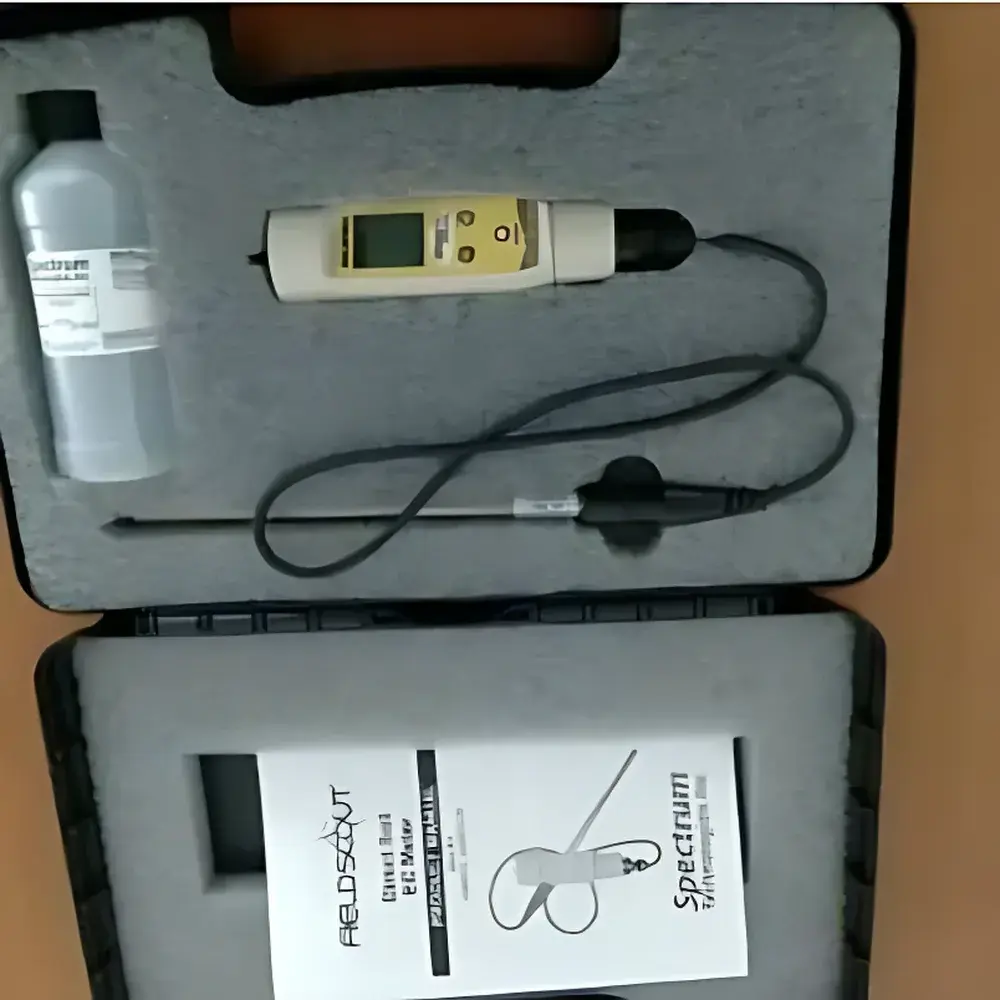
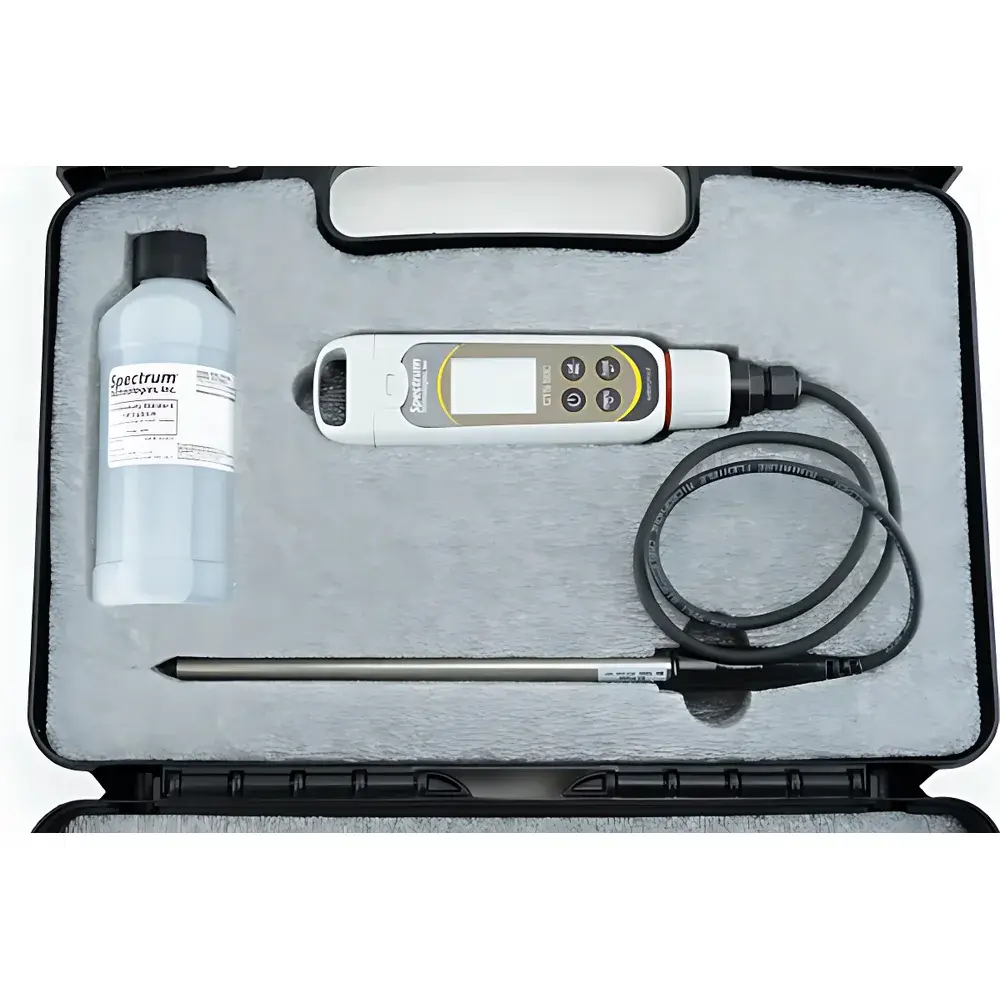
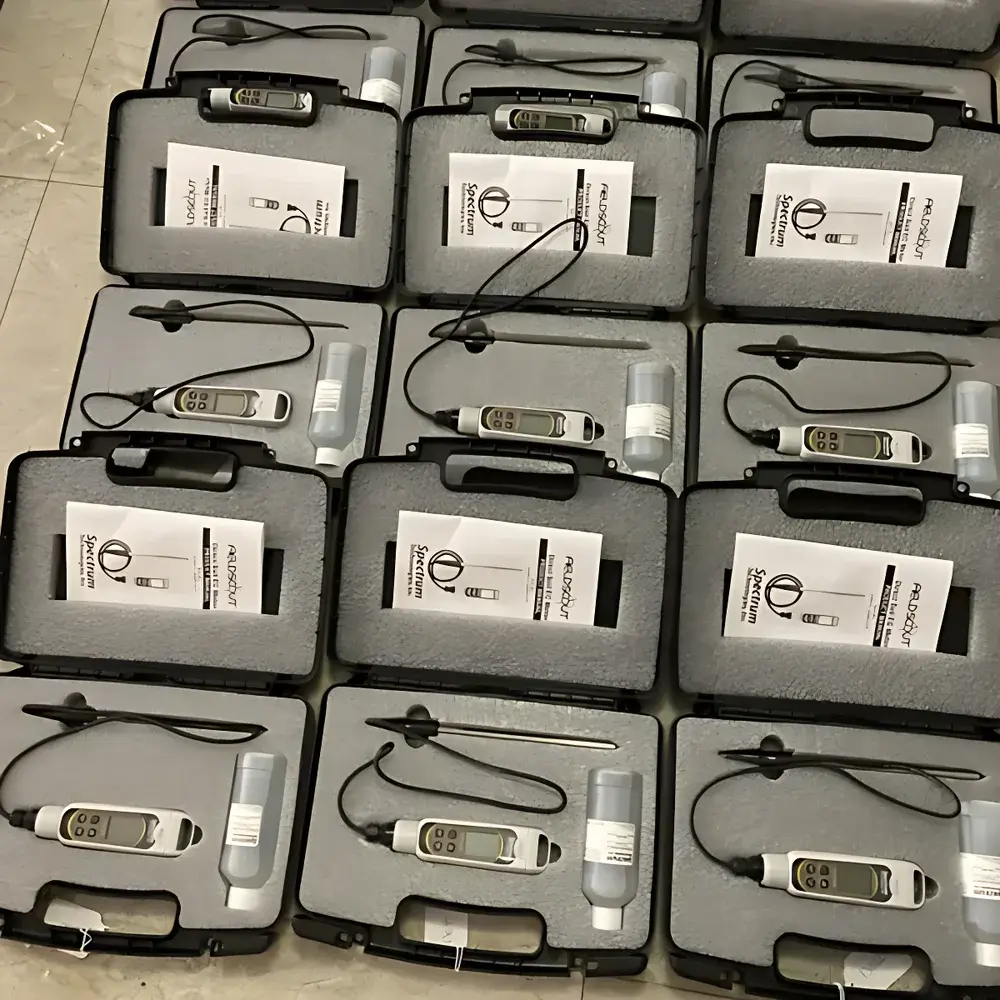
Spectrum Technologies 2266FS Portable Soil Electrical Conductivity Meter
| Brand | Spectrum Technologies |
|---|---|
| Origin | USA |
| Model | 2266FS |
| Measurement Range | 0.00–19.99 mS/cm |
| Temperature Range | –5 to 50 °C (Operating: 0–50 °C) |
| Accuracy | ±2% FS (EC), ±0.5 °C (Temperature) |
| Resolution | 0.01 mS/cm |
| Temperature Compensation | Automatic, 0–50 °C |
| Calibration | Single-point using 1.41 mS/cm standard solution (250 mL) |
| Display | Large LCD |
| Power Supply | 4 × LR44 (1.5 V) batteries |
| Instrument Type | Soil EC & Salinity Analyzer |
| Compliance | Designed for field-deployable, on-site EC measurement per ASTM D2777 and ISO 11265 guidelines |
Overview
The Spectrum Technologies 2266FS Portable Soil Electrical Conductivity Meter is a field-ready, handheld instrument engineered for rapid, in-situ measurement of electrical conductivity (EC) in soil, aqueous solutions, and organic liquid media. Based on the two-electrode conductometric principle, the 2266FS applies a low-frequency AC voltage across its stainless-steel probe electrodes to minimize polarization effects and electrode fouling—ensuring stable readings in heterogeneous, particulate-rich soil matrices. As a direct successor to the 2265FS, the 2266FS retains full mechanical and sensor compatibility with the original probe assembly while integrating an upgraded display module featuring enhanced contrast, backlight-independent readability, and improved low-power firmware architecture. Its design prioritizes operational robustness under variable environmental conditions—enabling consistent EC quantification without laboratory infrastructure or sample extraction.
Key Features
- True field-portable form factor: lightweight (≤320 g), sealed housing rated IP65 for dust and water resistance during outdoor deployment
- Integrated temperature sensor with automatic compensation (0–50 °C), eliminating manual correction and reducing operator error
- Large-format LCD display with high legibility under direct sunlight and low-ambient-light conditions
- Single-point calibration protocol compliant with ISO 11265 Annex B, using standardized 1.41 mS/cm KCl solution (250 mL)
- Low-power electronics optimized for extended field use—typical battery life exceeds 200 hours with LR44 alkaline cells
- Probe geometry engineered for minimal soil disturbance: 12 cm insertion depth, 3.2 mm electrode spacing, and corrosion-resistant 316 stainless steel construction
- No internal memory or data logging—designed for real-time decision support in agronomic scouting and rapid salinity screening
Sample Compatibility & Compliance
The 2266FS supports direct contact measurements in saturated paste extracts, 1:1 and 1:5 soil:water suspensions, irrigation water, nutrient solutions, and compost leachates. It meets functional equivalence to ASTM D2777 (Standard Practice for Determination of Precision and Bias of Applicable Test Methods of Water and Wastewater) for EC field instruments and aligns with ISO 11265:2020 (Soil quality — Determination of electrical conductivity) for routine salinity assessment. While not certified for GLP/GMP-regulated reporting, its traceable calibration procedure and documented accuracy specifications support QA/QC workflows in extension services, university research plots, and commercial greenhouse operations subject to USDA-NRCS or FAO salinity classification frameworks.
Software & Data Management
The 2266FS operates as a standalone analog-digital hybrid instrument with no embedded software, Bluetooth, or USB interface. All measurement data remain unrecorded internally; users must manually transcribe values or pair the device with external digital loggers (e.g., HOBO MX1101 or Onset U12 series) via auxiliary analog output adapters (sold separately). This architecture intentionally avoids FDA 21 CFR Part 11 compliance complexities, making it suitable for non-regulated field surveys where audit trails are not mandated. Calibration records—including date, technician ID, standard lot number, and observed deviation—are maintained externally per institutional SOPs.
Applications
- Rapid salinity mapping in irrigated cropland to identify zones exceeding ECe thresholds (>4 dS/m for sensitive horticultural crops)
- Pre-plant soil screening in greenhouse nurseries to prevent osmotic stress in seedling propagation media
- Validation of leaching fraction efficiency during saline water irrigation trials
- On-the-spot verification of nutrient solution EC stability in hydroponic recirculation systems
- Field-based monitoring of soil EC trends across seasonal wet-dry cycles in semi-arid agroecosystems
- Extension agent training modules demonstrating the relationship between EC, cation exchange capacity (CEC), and sodium adsorption ratio (SAR)
FAQ
Does the 2266FS require soil extraction before measurement?
No—the instrument is designed for direct insertion into undisturbed or minimally disturbed soil at field moisture content. For comparative consistency, ASTM D2777 recommends measuring at uniform soil water potential (e.g., –33 kPa matric potential).
Can the probe be used in clay-rich or high-organic-matter soils?
Yes, though repeated use in abrasive or highly humic matrices may accelerate electrode passivation; periodic cleaning with dilute HCl (0.1 M) followed by DI water rinse is recommended.
Is temperature compensation applied automatically during measurement?
Yes—temperature is measured simultaneously with EC, and compensation follows the linear algorithm defined in ISO 11265:2020 (reference 25 °C).
What is the minimum sample volume required for liquid measurements?
A minimum depth of 3 cm and lateral volume ≥100 mL ensures full electrode submersion and stable current path formation.
How often should calibration be performed?
Daily for intensive field use; prior to each sampling session when ambient temperature varies >10 °C; or after probe cleaning or physical impact.







