
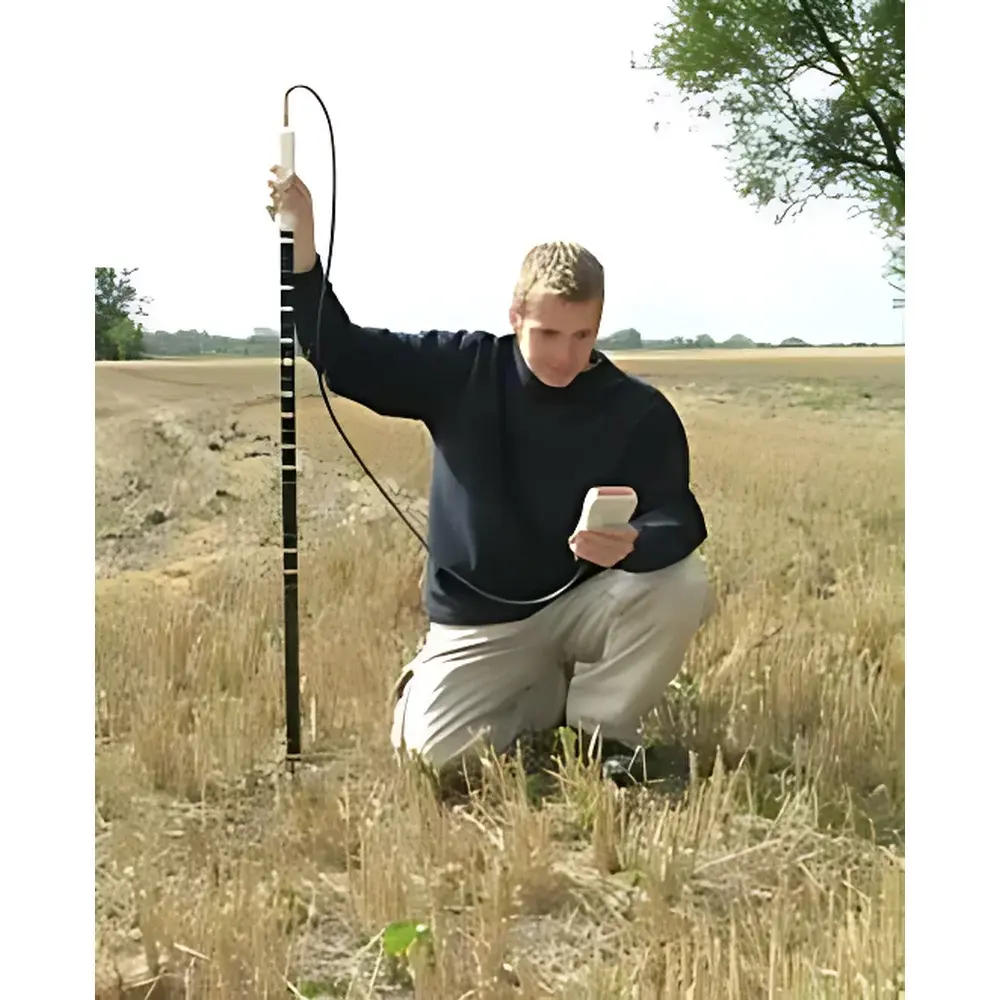
Delta-T Devices PR2-4 Portable Soil Profile Moisture Profiler
| Brand | Delta-T Devices |
|---|---|
| Origin | United Kingdom |
| Model | PR2-4 |
| Sensor Type | FDR (Frequency Domain Reflectometry) |
| Measurement Depths | 4 layers (10, 20, 30, 40 cm) |
| Output | 4 analog voltage signals (0–1 V per sensor, calibrated to 0–0.6 m³/m³) |
| Accuracy | ±0.04 m³/m³ (0–40 °C, soil-specific calibration) |
| Full-Scale Range | 0–1.0 m³/m³ |
| Salinity Tolerance | ≤600 mS/m (pore water EC) |
| Operating Temperature | −20 °C to +70 °C (guaranteed accuracy: 0–40 °C) |
| IP Rating | IP67 |
| Probe Material | Polycarbonate body (25.4 mm dia) with stainless steel tip |
| Dimensions (PR2-4) | 750 mm length × 25.4 mm diameter |
| Weight (PR2-4) | 0.6 kg |
| Power Supply | 5.5–15 V DC |
| Current Draw | <80 mA |
| Response Time | <1 s |
| Cable | Shielded 9-conductor, standard 2 m with M12 IP68 connector |
| Optional Extension Cables | 5, 10, 25, or 100 m |
| Compatible Reader | HH2 Moisture Meter (resolution: 1 mV |
| memory | 1100 readings |
| battery life | ~6500 readings) |
Overview
The Delta-T Devices PR2-4 Portable Soil Profile Moisture Profiler is a field-deployable, multi-depth soil moisture monitoring system engineered for high-reproducibility volumetric water content (θv) measurement across heterogeneous soil profiles. Utilizing Frequency Domain Reflectometry (FDR), the PR2-4 integrates four coaxial dielectric sensors along a single rigid probe rod—each precisely positioned at 10, 20, 30, and 40 cm depths—to enable simultaneous, co-located measurements within a single borehole. Unlike time-domain transmission (TDT) or capacitance-based systems requiring individual installation per depth, the PR2-4’s monolithic design minimizes soil disturbance, eliminates inter-sensor spatial variability, and ensures vertical profile integrity. Its robust polycarbonate and stainless-steel construction, combined with IP67 ingress protection, supports long-term deployment in diverse agroecological, hydrological, and environmental research settings—including arid soils, clay-rich subsoils, and seasonally saturated profiles.
Key Features
- Four integrated FDR sensors on a single 750 mm probe, enabling synchronized volumetric water content measurement at 10, 20, 30, and 40 cm depths
- Soil-specific calibration validated across major texture classes (sand, loam, clay), delivering ±0.04 m³/m³ accuracy within 0–40 °C operating range
- High salinity tolerance (≤600 mS/m pore water electrical conductivity), suitable for irrigated agriculture and coastal soils
- Low-power analog output (0–1 V per sensor, linearly scaled to 0–0.6 m³/m³), compatible with data loggers supporting 0–5 V or 0–10 V differential inputs
- M12 IP68-rated connector and shielded 9-conductor cable architecture ensure signal integrity over extended distances (up to 100 m with optional extension cables)
- Compact, lightweight form factor (0.6 kg) optimized for manual insertion into augered access tubes or direct push deployment
Sample Compatibility & Compliance
The PR2-4 is validated for use in mineral soils ranging from coarse sand to heavy clay, including structured and compacted horizons. Its FDR operating frequency (20–100 MHz) mitigates electromagnetic interference from soil-bound iron oxides and organic matter, enhancing reliability in variable redox environments. The probe meets IEC 60529 (IP67) for dust-tightness and temporary immersion resistance. While not certified to ISO/IEC 17025 for metrological traceability, its calibration methodology aligns with ASTM D5084 (Standard Test Methods for Measurement of Hydraulic Conductivity of Saturated Porous Materials) and FAO guidelines for soil moisture network instrumentation. Data acquisition using the HH2 meter supports GLP-compliant field logging through timestamped, non-volatile storage and user-defined metadata tagging.
Software & Data Management
The PR2-4 operates as a standalone analog sensor array and does not require embedded firmware or wireless connectivity. When paired with the HH2 handheld meter, measurements are stored locally with 1 mV resolution (equivalent to ~0.001 m³/m³ at full scale) and time/date stamps. Raw voltage outputs can be interfaced with third-party dataloggers (e.g., Campbell Scientific CR1000X, HOBO UX120) for continuous profiling. Exported CSV files contain depth-indexed θv values, temperature-corrected readings (via optional integrated thermistor), and instrument ID—facilitating integration into LIMS or GIS workflows. No proprietary software is required; calibration coefficients and conversion equations are publicly documented in Delta-T’s technical manuals for transparent post-processing.
Applications
- Root-zone water dynamics monitoring in precision irrigation scheduling and deficit irrigation trials
- Validation of soil hydraulic models (e.g., HYDRUS-1D, SWAP) by providing high-vertical-resolution θv time series
- Long-term climate observatory networks assessing soil moisture memory and drought propagation
- Ecological studies of plant–soil water relations across depth-stratified rhizosphere zones
- Regulatory compliance monitoring for landfill cap performance and leachate barrier integrity
- Calibration and ground-truthing of satellite-derived soil moisture products (e.g., SMAP, Sentinel-1)
FAQ
Can the PR2-4 be installed permanently in the field?
Yes—the probe is rated IP67 and constructed for continuous burial; however, permanent deployment requires a dedicated access tube and periodic verification of cable integrity and zero-drift stability.
Is temperature compensation automatic?
The PR2-4 itself does not include an onboard temperature sensor; accurate thermal correction requires concurrent measurement using a separate calibrated thermistor placed adjacent to the probe.
What is the minimum recommended access tube internal diameter?
A 40 mm inner diameter PVC or aluminum access tube is required to accommodate the 25.4 mm probe with clearance for smooth insertion and removal.
Does the HH2 meter support data export via USB or Bluetooth?
No—the HH2 uses a proprietary serial interface; data must be retrieved via RS-232 cable and Delta-T’s free Loggernet-compatible utility software.
Can the PR2-4 be used in frozen soils?
FDR measurement becomes unreliable below 0 °C due to phase change effects on dielectric permittivity; the probe may be physically installed but should not be operated during freezing conditions.
Related Products







