
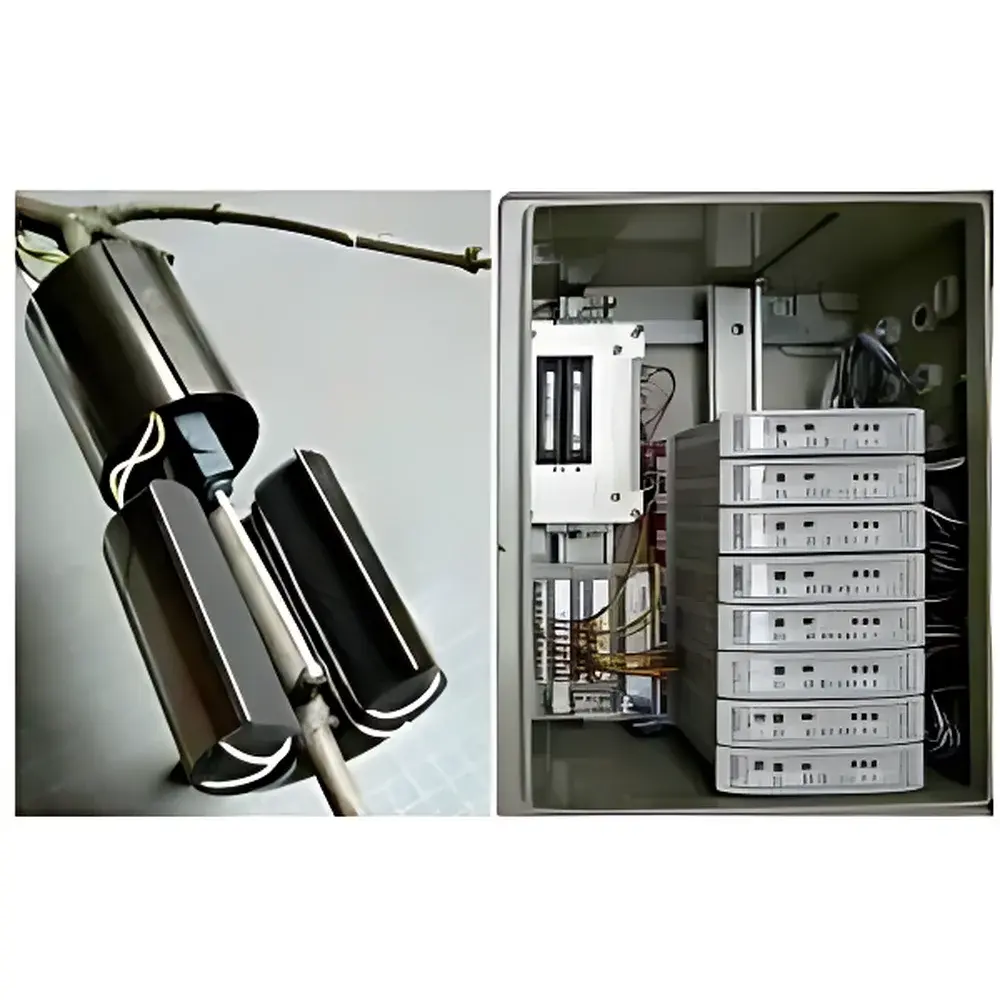
PSI EMS 62 Sap Flow Measurement System (Wrap-Around Type)
| Brand | PSI / Photon Systems Instruments |
|---|---|
| Origin | Czech Republic |
| Model | EMS 62 |
| Data Logger Channels | 8 differential voltage + 2 × 16-bit pulse counters + 1 service channel + temperature input |
| Voltage Input Range | ±20 mV (extendable to ±2.5 V) |
| Input Accuracy | 0.01% of full scale |
| Resolution | 16-bit |
| Pulse Input | contact closure (R < 100 kΩ), max frequency 1000 Hz |
| Measurement Interval | 3 s – 24 h |
| Sampling & Averaging Interval | configurable independently |
| Excitation Voltage | 5 V ±2 mV |
| Reference Voltage | 2.5 V ±10 mV (20 mA limit) or 3.0 V ±10 mV (30 mA limit) |
| Current Measurement Range | ~250 µA (measurement + storage), ~150 µA (measurement only) |
| Max Per-Channel Voltage Drop | 350 mV (internal), 300 mV (external) |
| Overvoltage Protection | diode-fused per input |
| Power Supply | 2 × AA alkaline (3 V) or external 4–16 V (NiMH rechargeable) |
| Standby Current | 60 µA (internal), 100 µA (external) |
| Active Current | 25 mA |
| Memory Capacity | 120,000 (internal) / 220,000 (external) records |
| Relay Output | 125 V AC / 0.5 A |
| Dimensions | 120 × 75 × 22 mm (internal) / 175 × 75 × 22 mm (external) |
| Weight | 0.25 kg (internal battery) / 0.45 kg (with batteries) |
| Operating Temperature | −20 °C to +60 °C |
Overview
The PSI EMS 62 Sap Flow Measurement System (Wrap-Around Type) is a field-deployable, modular instrumentation platform engineered for continuous, non-invasive quantification of sap flow velocity and volumetric flux in woody plant stems. It operates on the principle of thermal dissipation—specifically, the Granier-type constant-heating method—where a calibrated heater element warms a section of the xylem, and paired thermocouples measure the resulting temperature gradient downstream and upstream. The system computes real-time sap flux density (Js, in g H2O·m−2·s−1) directly onboard using empirically validated thermal conduction models, eliminating post-acquisition computational steps required by raw-sensor data loggers. Designed for stem diameters between 6 mm and 20 mm, the EMS 62 accommodates young trees, shrubs, vines, and herbaceous perennials—making it especially suitable for ecophysiological studies, irrigation scheduling validation, drought response phenotyping, and long-term forest water-use monitoring.
Key Features
- Onboard sap flow calculation: Real-time derivation of Js using built-in Granier algorithm—no external software preprocessing required.
- Modular architecture: Independent sensor modules (heater + dual thermocouple probes) mount via flexible, adjustable stainless-steel bands—ensuring mechanical stability and thermal coupling without bark damage.
- Dual-power operation: Supports internal 2×AA alkaline batteries (3 V, >12 months standby) or external 4–16 V DC supply (e.g., NiMH packs or solar-charged systems) for extended deployments.
- High-precision analog acquisition: 16-bit resolution, 0.01% full-scale accuracy across all differential voltage inputs; optimized for low-mV thermocouple signals (±20 mV nominal).
- Robust environmental tolerance: IP65-rated enclosure with operating range from −20 °C to +60 °C—validated for multi-season use in temperate, Mediterranean, and semi-arid climates.
- Configurable timing: Adjustable measurement interval (3 s to 24 h) and independent averaging window—enabling high-temporal-resolution stress-response capture or low-power seasonal baselines.
Sample Compatibility & Compliance
The EMS 62 is validated for use on dicotyledonous and gymnosperm species with intact phloem and functional secondary xylem. Its wrap-around probe geometry ensures consistent thermal contact across variable bark textures (smooth, fissured, or lenticellate), provided stem diameter falls within the 6–20 mm specification. Calibration coefficients are species-agnostic but require site-specific empirical verification against gravimetric or lysimetric controls where absolute transpiration rates are needed. The system complies with ISO 17025-aligned measurement traceability principles for environmental sensors; its analog signal chain meets IEC 61000-4-5 surge immunity standards. While not FDA- or GLP-certified (as it is not used in regulated clinical or pharmaceutical workflows), its data integrity features—including timestamped storage, checksum-verified memory writes, and hardware-level overvoltage protection—support FAIR (Findable, Accessible, Interoperable, Reusable) data practices recommended by the International Organization of Vine and Wine (OIV) and the European Federation of Plant Physiology Societies (EFPPS).
Software & Data Management
Data retrieval occurs via USB-C interface using PSI’s proprietary SapView Desktop application (Windows/macOS), which supports firmware updates, configuration scripting, and export to CSV/NetCDF formats. All measurements include embedded UTC timestamps, sensor ID tags, and diagnostic flags (e.g., heater fault, thermocouple open-circuit). The logger implements cyclic memory buffering with automatic overwrite protection for critical intervals. For networked deployments, optional RS-485 or LoRaWAN gateways enable integration into larger environmental telemetry networks compliant with OGC SensorThings API v1.1. Audit trails—including configuration changes and power-cycle events—are stored in non-volatile memory and accessible via command-line diagnostics, satisfying basic requirements for reproducible ecological experimentation under FAIR and CARE (Collective Benefit, Authority to Control, Responsibility, Ethics) data governance frameworks.
Applications
- Quantifying diurnal and seasonal transpiration dynamics in orchard crops (e.g., apple, olive, grapevine) to refine deficit irrigation protocols.
- Assessing hydraulic redistribution and root-zone water uptake partitioning in mixed-species agroforestry systems.
- Validating stomatal conductance models (e.g., Ball-Berry, Medlyn) under controlled drought imposition in greenhouse or common-garden experiments.
- Monitoring sap flow recovery kinetics following heatwave or frost events—serving as an early indicator of xylem embolism resilience.
- Long-term eddy covariance gap-filling: Providing ground-truthed canopy conductance estimates to constrain evapotranspiration partitioning in flux tower datasets.
FAQ
What stem diameter range is supported by the EMS 62?
The system is calibrated and mechanically optimized for stems measuring 6–20 mm in diameter. Probes must fully encircle the stem without overlap or gap; excessive curvature beyond this range compromises thermal coupling and introduces systematic bias.
Does the EMS 62 require external software to calculate sap flow?
No—sap flux density (Js) is computed in real time using the onboard Granier algorithm. Raw thermocouple voltages and heater status are also logged for advanced post-processing if needed.
Can the EMS 62 operate autonomously for more than one year?
Yes—when configured for 15-minute measurement intervals and powered by two high-capacity AA alkaline cells, typical field runtime exceeds 14 months at 20 °C ambient temperature.
Is calibration required before deployment?
While factory-calibrated for standard thermocouple sensitivity, users should perform in situ zero-offset verification (heater off, ambient equilibrium) and validate slope using a known thermal gradient source prior to critical experiments.
How is data integrity ensured during power interruptions?
All measurements are written to flash memory with CRC-16 error checking; the system resumes logging from the last confirmed record upon power restoration, with no data loss in the buffer.
Related Products




