Aquaread LeveLine-EWS Flood Early Warning System
| Brand | Aquaread |
|---|---|
| Country of Origin | United Kingdom |
| Model | LeveLine-EWS |
| Sensor Output | SDI-12 or Modbus RTU |
| Pressure Compensation | Integrated Barometric Sensor |
| Enclosure Dimensions | 90 × 90 × 160 mm |
| Water Level Accuracy | ±0.1% FS |
| Sensor Material | Stainless Steel Body with Polyoxymethylene (POM) Nose Cone |
| Warranty | 2 Years on LeveLine-Mini Sensor |
| Data Transmission | SMS and Email Alerts |
| Local Data Logging | Yes |
| Remote Configuration | SMS-based Command Interface |
| Third-Party Sensor Support | Up to 5 SDI-12 Devices |
Overview
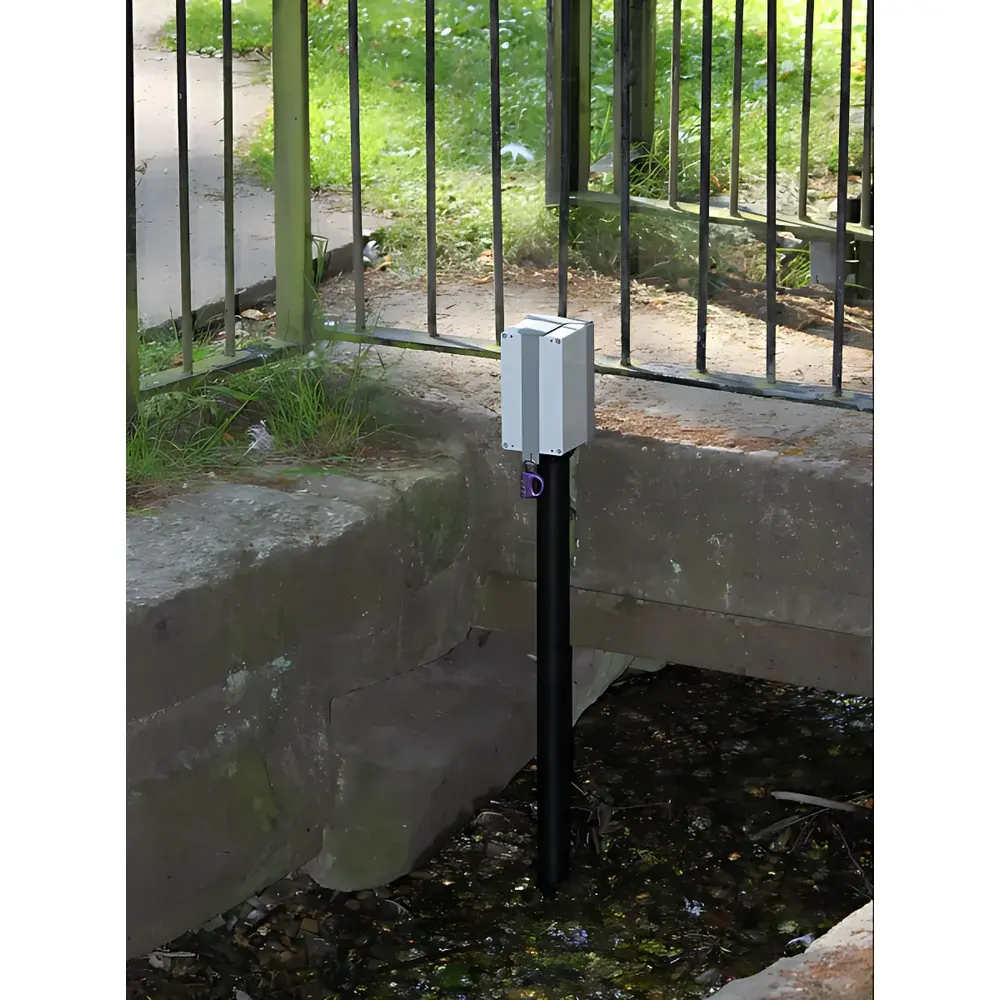
The Aquaread LeveLine-EWS Flood Early Warning System is a field-deployable, low-maintenance hydrological monitoring solution engineered for autonomous, real-time water level surveillance in flood-prone environments. Built upon a dual-component architecture—comprising the LeveLine-Mini submersible pressure transducer and the AquaTel telemetry unit—the system operates on the principle of absolute pressure measurement, compensated in real time by an integrated barometric sensor to deliver true gauge-level water depth readings. Unlike non-compensated systems vulnerable to atmospheric pressure drift, the LeveLine-EWS ensures metrological integrity across diurnal and seasonal barometric fluctuations. Designed for deployment in rivers, drainage channels, urban culverts, coastal outfalls, and reservoir perimeters, it delivers continuous, timestamped water level and temperature data at user-defined intervals, enabling predictive modeling and rapid incident response.
Key Features
- True gauge-level measurement via simultaneous absolute water pressure and ambient barometric pressure sensing
- LeveLine-Mini sensor constructed from 316 stainless steel with POM nose cone for corrosion resistance and mechanical durability in abrasive or biofouling-prone environments
- AquaTel telemetry unit supports configurable alert thresholds with dual-channel notification: SMS and email—no subscription fees, only standard carrier/data costs apply
- On-demand interrogation via inbound SMS: users can request current water level, temperature, battery status, or memory usage and receive an immediate formatted reply
- Remote configuration capability: sensor sampling interval, alarm setpoints, transmission schedule, and communication parameters are adjustable via text command syntax without physical access
- Local data logging capacity within AquaTel enables gap-free record retention during network outages; stored data is retrievable via SMS or direct USB connection
- Expandable architecture: supports up to five additional SDI-12 compatible environmental sensors (e.g., rainfall, conductivity, turbidity) for multi-parameter flood context analysis
Sample Compatibility & Compliance
The LeveLine-Mini sensor is rated for continuous immersion in freshwater, brackish water, and estuarine environments with salinity up to 35 ppt. Its IP68-rated housing withstands sustained submersion to 10 m depth and mechanical impact per IEC 60068-2-75. The system meets CE marking requirements under the EMC Directive 2014/30/EU and RoHS 2011/65/EU. While not certified to SIL or IEC 61508 for safety-critical process control, its architecture aligns with best practices outlined in ISO/IEC 17025 for field-deployed environmental measurement systems. Alarm logic and data handling comply with principles of traceability and repeatability required under UK Environment Agency Technical Guidance Note WRM01 and EU Floods Directive (2007/60/EC) monitoring frameworks.
Software & Data Management
The LeveLine-EWS operates without proprietary cloud platforms or recurring licensing. Configuration, diagnostics, and data retrieval are executed through human-readable SMS commands or local serial/USB interface using ASCII protocol documentation provided in the user manual. All logged data adhere to ISO 8601 timestamping and CSV formatting for seamless import into GIS platforms (e.g., QGIS), SCADA historians, or statistical analysis tools (e.g., R, Python pandas). Audit trails—including alarm triggers, configuration changes, and message timestamps—are retained in non-volatile memory. Though not natively 21 CFR Part 11 compliant, the system supports external validation protocols when integrated into GLP/GMP-aligned flood monitoring programs via documented operational procedures and electronic log export.
Applications
- River and canal level monitoring for Environment Agency or local authority flood forecasting networks
- Urban drainage infrastructure surveillance—stormwater overflows, combined sewer systems, and pump station sump levels
- Coastal flood risk management including tidal surge detection and barrier gate control inputs
- Construction site dewatering compliance monitoring where statutory water level reporting is mandated
- Post-event forensic analysis using high-resolution logged data to reconstruct flood wave propagation and peak timing
- Academic hydrological research requiring long-term, unattended deployment with minimal site visits
FAQ
Does the LeveLine-EWS require annual calibration or service contracts?
No. The LeveLine-Mini sensor is factory-calibrated with NIST-traceable reference standards and exhibits long-term stability (<0.05% FS/year drift). No scheduled recalibration or vendor-mandated maintenance is required.
Can the system operate reliably in areas with poor cellular coverage?
Yes. AquaTel includes fallback operation modes: local data logging continues uninterrupted, and alarms resume transmission once signal is restored. Optional satellite modem integration (e.g., Iridium 9603) is available for remote or offshore deployments.
Is temperature compensation applied to water level readings?
Yes. The LeveLine-Mini integrates a high-stability thermistor; all pressure outputs are automatically corrected for fluid density variation across 0–40 °C per ISO 748:2022 Annex B.
How is data security handled for SMS/email alerts?
Alert messages contain no personally identifiable information (PII) and use pre-registered recipient numbers/addresses only. Communication channels are one-way outbound; the device does not accept unsolicited remote execution commands beyond documented SMS syntax.
What power options are supported?
Standard operation uses a sealed 12 V 7 Ah lead-acid battery (typical 12-month life at 15-min sampling). Optional solar charging kits (10 W panel + charge controller) extend deployment duration indefinitely under adequate insolation.