
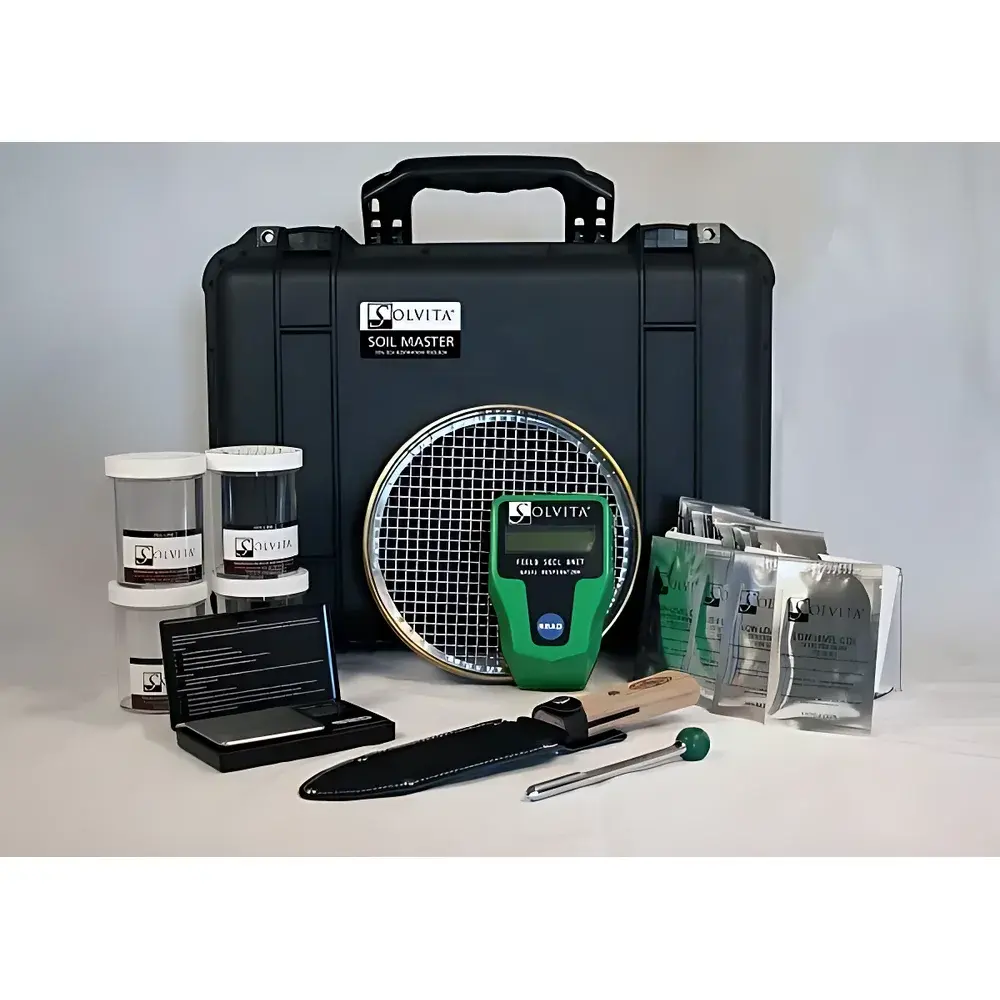
Soil Master Kit Portable Soil Respiration Measurement System
| Origin | USA |
|---|---|
| Manufacturer Type | Distributor |
| Origin Category | Imported |
| Model | Soil Master Kit |
| Instrument Type | Multi-Function Soil Analyzer |
| Included Components | Color LCD Readout Meter (Green DCR), Soil CO₂ Sensor, Soil Coring Knife, Standard Soil Sieve (0.635 cm), Soil Brush, Soil Thermometer, Plastic Sample Jars, Digital Balance, USB Data Cable |
Overview
The Soil Master Kit Portable Soil Respiration Measurement System is an engineered field-deployable solution for quantifying microbial carbon dioxide evolution from soil under near-natural conditions. It operates on the principle of dynamic closed-chamber CO₂ accumulation measurement, where a calibrated infrared (NDIR) sensor continuously monitors temporal CO₂ concentration changes within a sealed headspace above a minimally disturbed soil core. Coupled with concurrent in-situ soil temperature logging and optional moisture input, the system computes respiration rates (µmol CO₂ m⁻² s⁻¹ or nmol CO₂ g⁻¹ soil h⁻¹) using first-order linear regression of the CO₂ concentration curve over time. Designed for ecological monitoring, agronomic research, and climate change impact assessment, the kit delivers high reproducibility across heterogeneous field settings—including potted experiments, plot-scale trials, open-field agriculture, forest floors, and grassland ecosystems—without requiring laboratory incubation or soil homogenization.
Key Features
- Minimally invasive sampling protocol: Precision coring knife enables extraction of intact soil columns with preserved pore structure and microbial microhabitats, eliminating compaction artifacts common in bulk sampling.
- Real-time, on-site CO₂ quantification: Integrated NDIR sensor with factory calibration traceable to NIST standards ensures measurement accuracy within ±2% of reading across 0–5,000 ppm range.
- Field-synchronized environmental correction: Simultaneous soil temperature recording (±0.1 °C resolution) allows automatic thermal normalization of respiration rates using Arrhenius-based algorithms embedded in firmware.
- Integrated data acquisition and processing: Green DCR readout meter features color LCD display, onboard calculation engine, and timestamped data logging (up to 10,000 records), supporting immediate rate derivation without external software.
- Rugged, battery-operated architecture: Powered by rechargeable Li-ion battery (≥12 hours continuous operation); housed in IP65-rated portable carry case with custom foam inserts for shock protection during transport.
- Comprehensive accessory suite: Includes ASTM E11-compliant 0.635 cm (¼-inch) stainless steel sieve, calibrated digital balance (0.01 g resolution), inert plastic sample jars, and field-grade soil thermometer—all optimized for ISO 16072 and USDA NRCS soil survey protocols.
Sample Compatibility & Compliance
The Soil Master Kit accommodates mineral soils (sandy loam to clay), organic-rich histosols, rhizosphere-adjacent samples, and surface litter layers up to 5 cm depth. It complies with methodological frameworks referenced in ISO 16072:2022 (Soil quality — Determination of carbon dioxide evolution), ASTM D5918-21 (Standard Guide for Soil Respiration Testing), and USDA-NRCS Field Handbook Chapter 13. All hardware components meet RoHS 2.0 directives; sensor electronics conform to IEC 61326-1 (EMC for laboratory and field equipment). Data output formats (CSV, Excel-compatible) support GLP-compliant record retention, and optional firmware upgrade enables audit-trail functionality aligned with FDA 21 CFR Part 11 requirements for regulated environmental studies.
Software & Data Management
Raw sensor outputs and metadata are stored locally on the Green DCR meter’s non-volatile memory. Data export occurs via USB interface to Windows/macOS systems using included SoilRespiro v3.2 desktop application—supporting batch calibration validation, outlier detection, temperature-moisture response surface modeling, and automated report generation (PDF/HTML). The software enforces electronic signature capability, user access levels, and immutable data logs compliant with ALCOA+ principles (Attributable, Legible, Contemporaneous, Original, Accurate, Complete, Consistent, Enduring, Available). Cloud synchronization (optional subscription) enables multi-site dataset aggregation for longitudinal analysis across regional monitoring networks.
Applications
- Agricultural soil health assessment: Tracking seasonal respiration dynamics in response to tillage, cover cropping, fertilizer regimes, and biochar amendments.
- Forest and grassland carbon flux studies: Quantifying heterotrophic respiration contributions to ecosystem-level net carbon exchange.
- Contaminated site bioremediation monitoring: Evaluating microbial metabolic reactivation following remediation interventions.
- Climate change experimentation: Measuring Q₁₀ temperature sensitivity of soil respiration in open-top chamber (OTC) or free-air CO₂ enrichment (FACE) trials.
- Educational field pedagogy: Supporting undergraduate and graduate curricula in soil ecology, biogeochemistry, and environmental instrumentation.
FAQ
What is the minimum detectable respiration rate?
The system reliably detects rates ≥0.1 nmol CO₂ g⁻¹ dry soil h⁻¹ under standard 10-minute measurement cycles at 20 °C.
Can the CO₂ sensor be recalibrated in the field?
Yes—zero calibration is supported using ambient air flush; span calibration requires certified 1,000 ppm CO₂ gas cylinder (sold separately) and is recommended annually or after 500 measurement cycles.
Is the digital balance included suitable for gravimetric moisture determination?
Yes—the 0.01 g resolution balance meets ASTM D2216 requirements for soil water content determination when used with pre-weighed aluminum pans and oven-drying at 105 °C.
Does the system support wireless data transmission?
Not natively; however, optional Bluetooth 5.0 adapter module (SM-BT-01) enables real-time telemetry to mobile devices running the companion SoilRespiro Field app.
How is temperature compensation applied during computation?
The firmware applies a modified Arrhenius equation using user-input or auto-detected soil temperature, referencing baseline Q₁₀ = 2.3 unless overridden per experimental protocol.







