
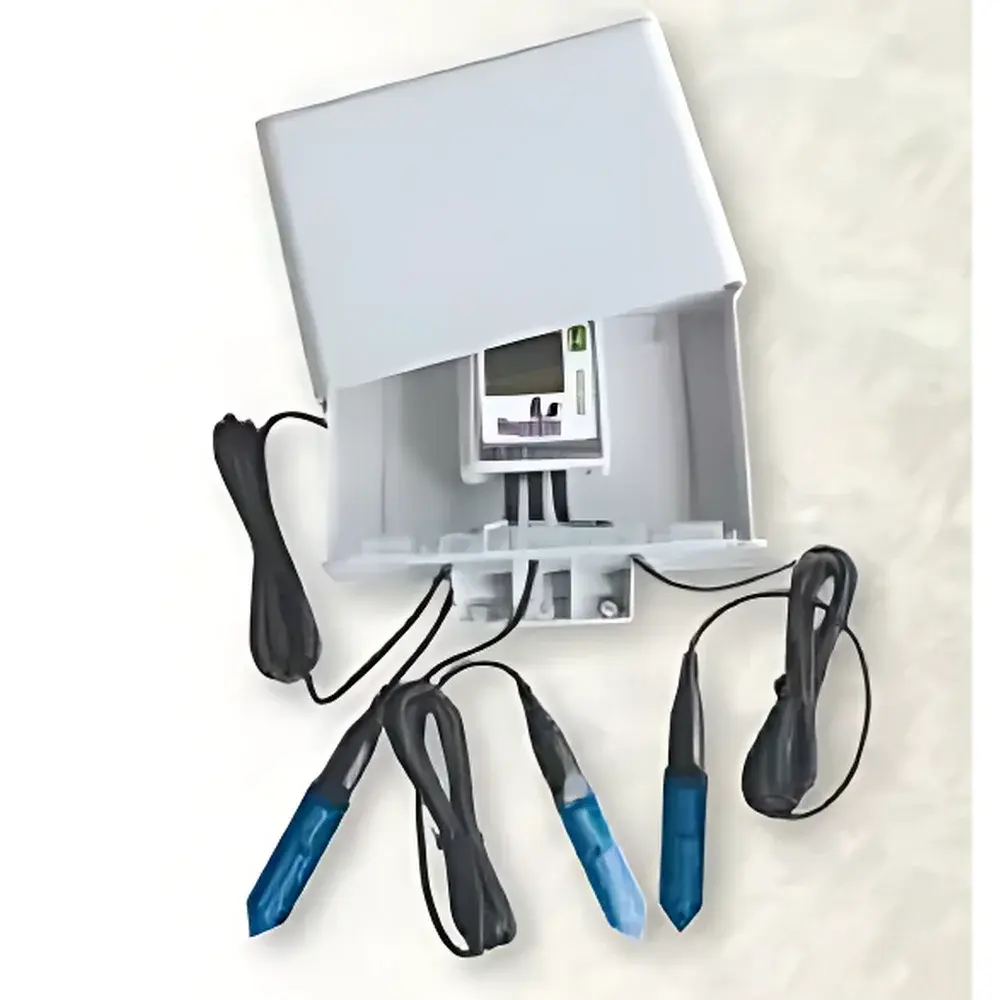
Decagon Devices 3680WM Series Agricultural Irrigation Monitoring Station
| Origin | USA |
|---|---|
| Manufacturer Type | Authorized Distributor |
| Import Status | Imported |
| Model | 3680WM12 / 3685WM12 / 3685WM13 / 3685WM14 |
| Instrument Type | Soil Water Potential & Moisture Monitoring System |
| Data Logger Memory | 10,584 records |
| Logging Interval | 1–60 minutes (default 30 min supports 220 days continuous operation) |
| Soil Moisture Sensor | Resistive cable type, 2-conductor, 1.5 m length, resolution: 1 cbar, range: 0–200 cbar, update interval: 62.5–75 s |
| Onboard Sensors | Integrated air temperature and relative humidity sensor |
| External Ports | 4 standard sensor ports (expandable to 6 on 3685-series loggers) |
| Display | Backlit LCD showing real-time sensor readings and battery status |
| Enclosure | IP67-rated sliding waterproof housing |
| Optional Sensors | Leaf wetness sensor, soil temperature sensor (–30 to 100 °C, ±0.6 °C), tipping-bucket rain gauge (0.25 mm resolution, ±2% accuracy) |
Overview
The Decagon Devices 3680WM Series Agricultural Irrigation Monitoring Station is a field-deployable, low-power environmental data acquisition system engineered for precision irrigation management in agronomic, turfgrass, and horticultural applications. It operates on the principle of soil water potential measurement via resistive tensiometric sensing—providing direct insight into plant-available water status at root-zone depth. Unlike volumetric water content sensors, this system quantifies the energy state of soil water (in centibars, cbar), enabling irrigation decisions aligned with crop physiological thresholds rather than arbitrary moisture percentages. The station integrates a ruggedized data logger, pre-calibrated soil water potential sensors, and an IP67-rated sliding enclosure designed for long-term outdoor exposure across diverse climatic zones—from arid orchards to humid golf course fairways. Its architecture supports autonomous operation for up to 220 days on internal batteries when configured at standard 30-minute logging intervals, minimizing site visits while maintaining temporal fidelity in soil hydration dynamics.
Key Features
- Programmable logging interval from 1 to 60 minutes, configurable via serial interface or optional software
- Onboard backlit LCD display showing real-time soil water potential, air temperature, relative humidity, and battery voltage
- Four standardized analog/digital sensor input ports; expandable to six on 3685-series loggers for multi-parameter monitoring
- Integrated air temperature and relative humidity sensor with factory calibration traceable to NIST standards
- Resistive soil water potential sensors featuring 1.5 m two-conductor cable, 1 cbar resolution, and 0–200 cbar operational range
- IP67-rated sliding waterproof enclosure with UV-stabilized polycarbonate construction for sustained field deployment
- Internal memory capacity of 10,584 timestamped records, supporting extended unattended operation without data offload
Sample Compatibility & Compliance
The 3680WM Series is validated for use in mineral soils, sandy loams, clay loams, and organic growing media typical of commercial agriculture and managed landscapes. Sensor placement follows ASTM D4944 and ISO 11274 guidelines for in-situ soil water potential measurement. All electronic components comply with FCC Part 15 Class B and CE EMC Directive 2014/30/EU requirements. Data integrity protocols align with GLP principles: each recorded value includes embedded UTC timestamp, sensor ID, and diagnostic flags for out-of-range or unstable readings. While not FDA 21 CFR Part 11-certified out-of-the-box, audit-trail functionality can be implemented through validated third-party software environments used in regulated agricultural research settings.
Software & Data Management
Data retrieval is performed via RS-232 or USB-to-serial adapter using Decagon’s legacy Em50/Em5b configuration utility (Windows-compatible). Raw data exports as tab-delimited ASCII files compatible with MATLAB, R, Python (pandas), and industry-standard statistical platforms. No cloud connectivity is embedded; all data remain under user control—supporting air-gapped network deployments required by certain institutional IT policies. Firmware updates are delivered via signed binary packages, with version history logged internally. Optional post-processing tools enable conversion of cbar values to soil matric potential curves using van Genuchten or Brooks-Corey parameterization, facilitating integration with irrigation scheduling models such as CropSyst or Irrigator’s Pro.
Applications
- Deficit irrigation scheduling in high-value perennial crops (e.g., almonds, grapes, citrus)
- Turfgrass moisture optimization on golf courses, sports fields, and municipal parks
- Validation of soil hydraulic property estimates in field-scale hydrological modeling
- Long-term phenological studies linking soil water stress to canopy development indices
- Calibration and ground-truthing of satellite-based evapotranspiration (ET) products (e.g., Landsat-8, Sentinel-2)
- Research-grade validation of smart irrigation controllers under controlled drought stress trials
FAQ
What is the difference between soil water potential (cbar) and volumetric water content (%)?
Soil water potential reflects the energy status of water available to plants and is measured in pressure units (cbar); it directly correlates with plant physiological response. Volumetric water content expresses the volume fraction of water in soil pores and requires soil-specific calibration. The 3680WM system measures the former, enabling cross-soil-type comparability.
Can the system operate in frozen soil conditions?
The resistive sensors are not rated for operation below 0 °C. Ice formation disrupts electrical continuity in the sensing element; deployment is recommended only in non-frozen soil profiles.
Is sensor calibration required after installation?
Factory calibration is provided per ASTM F2777; field recalibration is not necessary unless mechanical damage occurs. Users may perform zero-point verification using saturated salt solutions per ISO 11277 Annex B.
How is data security handled during transfer?
All communication uses plain-text ASCII over serial protocol; encryption is not implemented. For secure environments, data transfer should occur within isolated local networks or via encrypted offline transport media.
Are replacement sensors traceable to national metrology institutes?
Yes—each soil water potential sensor ships with a calibration certificate referencing NIST-traceable pressure standards, valid for 24 months from date of manufacture.
Related Products







