
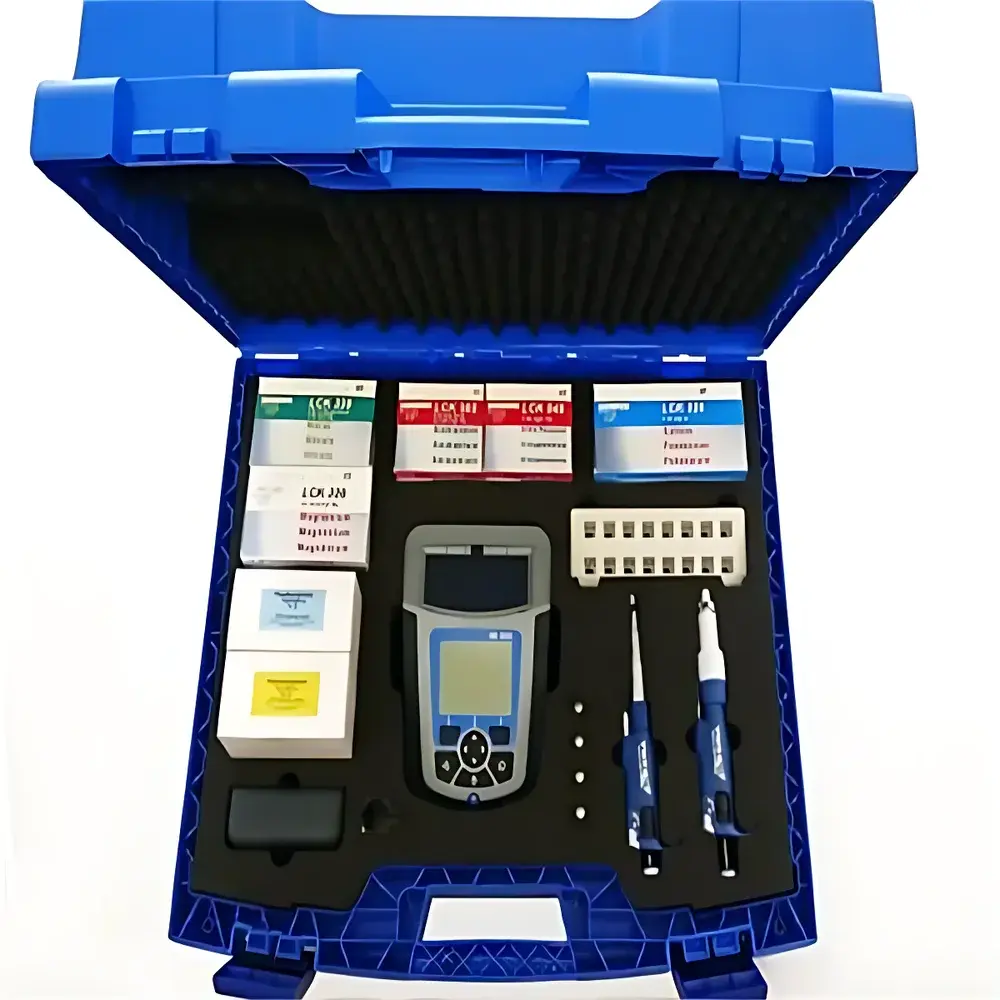
COMBI 5000 Portable Multi-Parameter Soil and Ambient Environmental Analyzer
| Origin | Germany |
|---|---|
| Type | Imported Instrument |
| Model | COMBI 5000 |
| Instrument Category | Multiparameter Soil Analyzer |
| Sensor Configuration | pH, Electrical Conductivity (EC), Redox Potential (mV), Soil Moisture (v/v %), Soil Temperature (°C), Ambient Air Temperature (°C), Relative Humidity (% RH), Barometric Pressure (hPa) |
| Compliance | IP67-rated housing, CE-marked, RoHS-compliant |
| Language Support | English, German (optional: French, Italian, Spanish, Russian) |
| Data Logging | Integrated datalogger with USB interface and COMBI 5000 mobile application support |
Overview
The COMBI 5000 is a field-deployable, handheld multiparameter environmental analyzer engineered for simultaneous in-situ measurement of eight critical parameters governing soil health and ambient microclimate conditions. Unlike conventional single-parameter meters, the COMBI 5000 integrates electrochemical, capacitive, thermistor-based, and piezoresistive sensing technologies into a unified platform—enabling concurrent acquisition of soil pH, electrical conductivity (EC), redox potential (Eh), volumetric water content (θv), soil temperature, plus ambient air temperature, relative humidity, and barometric pressure. Its architecture follows the principles of modular sensor interoperability: each probe is auto-recognized upon physical connection via standardized digital interfaces, triggering automatic unit scaling, calibration context switching, and mode-specific signal conditioning. Designed for agronomic diagnostics, ecological monitoring, and controlled-environment agriculture (CEA), the instrument delivers traceable, repeatable measurements under variable field conditions without requiring external power or laboratory infrastructure.
Key Features
- Auto-sensing probe recognition: Eliminates manual configuration errors; firmware dynamically assigns measurement units and calibration protocols based on connected sensor identity.
- IP67-rated rugged enclosure: Fully sealed against dust ingress and immersion up to 1 m for 30 minutes—suitable for extended outdoor use in rain, dew, or high-humidity environments.
- Dual-language interface (English/German) with optional multilingual firmware: Supports operational flexibility across EU member states and international research collaborations.
- Integrated data logger with 32 GB internal storage: Timestamped records include GPS metadata (when paired with external GNSS module), sensor status flags, and environmental context tags.
- USB-C connectivity and COMBI 5000 mobile application (iOS/Android): Enables real-time visualization, spectral trend analysis, export to CSV/Excel, and cloud synchronization compliant with ISO/IEC 17025 documentation requirements.
- Pre-calibrated sensor suite with NIST-traceable reference materials: Includes certified pH 4.01 and 7.00 buffer solutions (100 mL each), KCl storage solution (3 mol/L), and mechanical soil coring tool for consistent sampling depth control.
Sample Compatibility & Compliance
The COMBI 5000 is validated for direct contact measurement in mineral soils, organic substrates (e.g., peat, coco coir), hydroponic nutrient solutions, and irrigation water. Electrode-based sensors meet ASTM D2777–22 for pH and EC methodology equivalence, while moisture probes conform to ISO 11274:2021 for volumetric water content determination in heterogeneous media. All firmware and data handling routines comply with GLP principles—including full audit trails, user authentication logs, and electronic signature capability per FDA 21 CFR Part 11 when used in regulated agricultural trials. Device certification includes CE marking under Directive 2014/30/EU (EMC) and 2014/35/EU (LVD), as well as RoHS 2011/65/EU material restrictions.
Software & Data Management
Data acquisition and post-processing are managed through two complementary pathways: embedded firmware and the COMBI 5000 mobile application. The onboard operating system supports customizable sampling intervals (1 s to 24 h), alarm thresholds per parameter, and automatic outlier detection using Tukey’s fences (IQR-based). Exported datasets retain native resolution (pH: ±0.02, EC: ±1 µS/cm, θv: ±0.8%, Tsoil: ±0.2°C) and embed ISO 8601 timestamps with UTC offset. The mobile app implements role-based access control (RBAC), encrypted local database storage (AES-256), and export templates aligned with FAO’s Global Soil Laboratory Network (GLOSOLAN) reporting standards. Raw binary files (.cmb) are convertible to netCDF-4 format for integration into GIS platforms or statistical modeling workflows (R, Python SciPy).
Applications
- Agronomic site assessment: Correlating soil pH, EC, and moisture gradients with crop yield variability across precision farming zones.
- Greenhouse climate optimization: Synchronizing substrate metrics with ambient air parameters to model vapor pressure deficit (VPD) and irrigation scheduling algorithms.
- Ecological restoration monitoring: Tracking redox shifts and moisture dynamics in wetland reclamation projects over seasonal cycles.
- Regulatory compliance testing: Supporting EU Nitrates Directive (91/676/EEC) reporting requirements for soil nutrient status and leaching risk evaluation.
- Academic pedagogy: Field-based environmental science instruction with immediate data visualization and hypothesis-driven experimental design capabilities.
FAQ
Does the COMBI 5000 require annual recalibration?
No—each sensor module is factory-calibrated with documented uncertainty budgets; however, users should perform verification checks before critical deployments using supplied reference standards.
Can the device operate continuously in saturated soil conditions?
Yes—the IP67 rating ensures functionality during temporary submersion; prolonged exposure beyond 30 minutes at 1 m depth is not recommended due to potential electrolyte diffusion into sealed junctions.
Is the COMBI 5000 compatible with third-party sensors?
No—only COMBI-branded, digitally authenticated probes are supported to maintain metrological integrity and firmware compatibility.
What is the battery life under typical field usage?
With active logging every 5 minutes and Bluetooth enabled, average runtime exceeds 18 hours on a single 4,200 mAh Li-ion charge.
How are measurement uncertainties reported in exported datasets?
Each record includes an embedded uncertainty column derived from sensor-specific GUM-compliant models, referencing ISO/IEC Guide 98-3:2008 (JCGM 100:2008).
Related Products







