
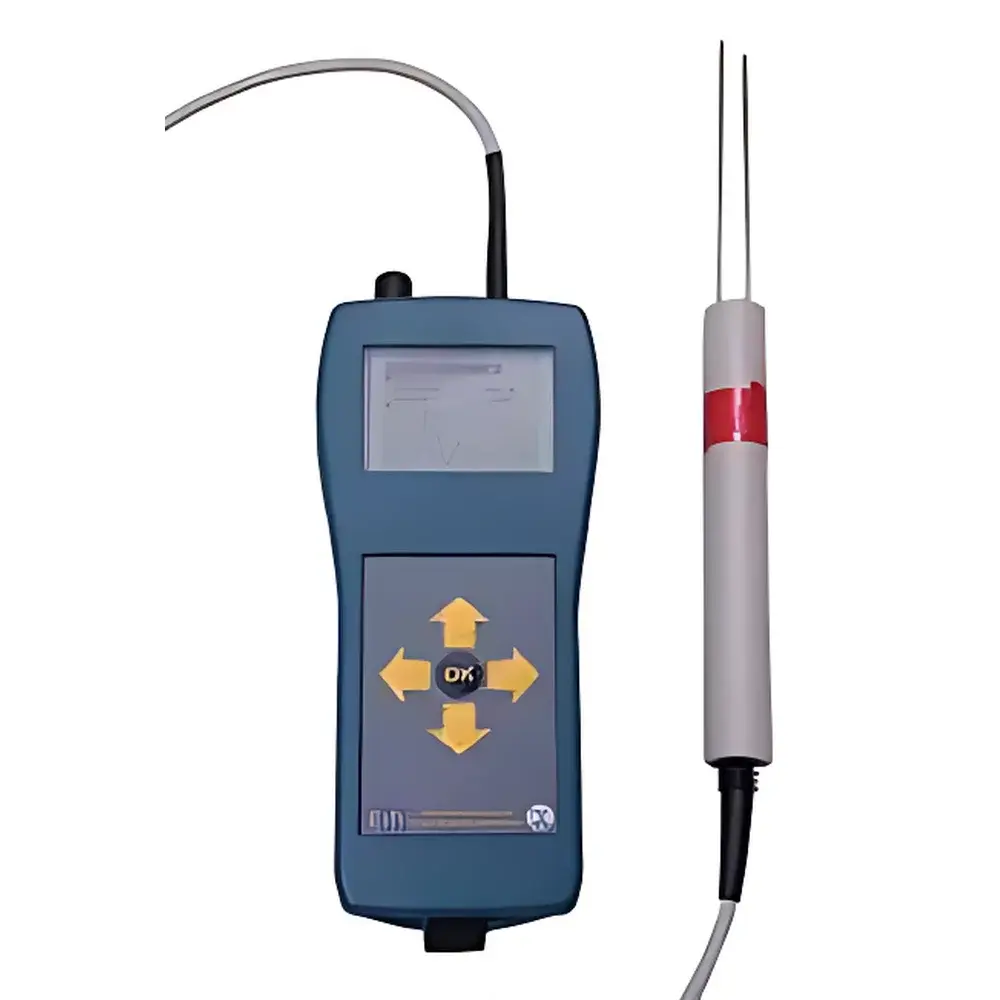
TDR Soil Moisture, Temperature & Electrical Conductivity Analyzer – Polish-Made Portable Field Instrument
| Origin | Poland |
|---|---|
| Manufacturer Type | Authorized Distributor |
| Import Status | Imported |
| Model | TDR |
| Instrument Category | Soil Moisture / Water Potential Analyzer |
| Price Range | USD 1,400–2,800 (FOB) |
| Measurement Principle | Time-Domain Reflectometry (TDR) |
Overview
The TDR Soil Moisture, Temperature & Electrical Conductivity Analyzer is a field-deployable, battery-powered instrument engineered for in-situ, real-time quantification of three critical soil physical parameters: volumetric water content (θv), bulk electrical conductivity (ECb), and soil temperature. Its core measurement principle—Time-Domain Reflectometry—relies on the propagation and reflection of high-frequency electromagnetic pulses (with <200 ps rise time) along a two-rod probe inserted into the soil matrix. The dielectric permittivity of the soil medium—dominated by water’s high relative permittivity (~80)—directly governs pulse velocity and reflection amplitude. By precisely analyzing the travel time and attenuation characteristics of the reflected waveform (displayed live on the integrated 160×128 LCD), the device calculates θv using the empirically validated Malicki et al. (1996, *Eur. J. Soil Sci.*) calibration model, or outputs apparent dielectric constant (Ka) per user-defined configuration. Simultaneous ECb and temperature measurements are acquired via integrated sensing elements within the same probe assembly, eliminating inter-sensor spatial offsets and enabling thermally compensated conductivity computation.
Key Features
- Integrated tri-parameter sensing: Single two-rod probe simultaneously acquires volumetric water content, bulk electrical conductivity, and temperature—no co-location error or sequential measurement delay.
- On-device TDR waveform visualization: Real-time oscilloscope-style display of incident and reflected voltage pulses enables immediate verification of probe installation quality, contact integrity, and signal fidelity.
- Field-rugged architecture: IP65-rated housing, operating temperature range of 0–50 °C (storage: −20–50 °C), and rechargeable Li-ion battery (0.35 kg total weight with battery) support extended unattended operation in remote environments.
- Flexible deployment modes: Probe supports both portable spot measurements and permanent burial for long-term profile monitoring; standard probe length is 10 cm (reducible to 5 cm with documented accuracy trade-offs).
- Digital data integrity: USB interface enables direct download of up to 1,000 timestamped records (including raw waveform metadata); no proprietary software required for basic data extraction.
Sample Compatibility & Compliance
The analyzer is validated for use across mineral soils, loams, and sandy textures under field conditions. It is not recommended for highly conductive (>1 S/m) clay-rich or saline-saturated soils without empirical recalibration due to signal distortion at elevated ECb. While the instrument itself does not carry formal certification, its measurement methodology aligns with ASTM D5778 (Standard Test Method for Electronic Friction Cone and Piezocone Penetration Testing of Soils) and ISO 11274 (Soil Quality — Determination of Water Retention Characteristic). Data acquisition protocols support GLP-compliant field logging when paired with external GPS modules (optional 5 m-accuracy unit available).
Software & Data Management
No embedded operating system is required for core functionality. Raw data files are exported as ASCII-delimited text (.txt) via USB, containing columns for timestamp, θv (vol%), ECb (S/m), temperature (°C), Ka, and waveform diagnostic flags. Third-party analysis tools (e.g., MATLAB, Python pandas, R) can directly ingest these files for statistical modeling, temporal trend analysis, or integration into GIS-based soil moisture mapping workflows. Firmware updates are delivered via USB and maintain full backward compatibility with historical datasets.
Applications
- Irrigation scheduling and precision agriculture: Quantifying root-zone moisture deficits across heterogeneous fields to optimize water use efficiency.
- Environmental hydrology: Monitoring infiltration dynamics, vadose zone flux estimation, and recharge rate validation in watershed studies.
- Soil salinity assessment: Tracking seasonal ECb variations in arid-zone agriculture or reclaimed coastal soils.
- Ecological research: Correlating soil thermal and hydric properties with microbial activity, seed germination thresholds, or plant phenology.
- Geotechnical site characterization: Supporting unsaturated soil mechanics modeling where matric suction estimation requires coupled θv–T–ECb inputs.
FAQ
What calibration standard is used for volumetric water content?
The device applies the Malicki et al. (1996) empirical dielectric mixing model, which relates apparent dielectric constant (Ka) to θv for mineral soils. Users may override this with custom calibration coefficients if working with organic-rich or volcanic substrates.
Can the probe be installed permanently in the soil?
Yes—the stainless-steel two-rod probe is corrosion-resistant and rated for continuous burial; cable length is 6 m, and optional GPS synchronization allows georeferenced long-term profiling.
Is temperature compensation applied to ECb readings?
Yes—temperature is measured at the probe tip and used in real time to normalize ECb to 25 °C using the standard 2% per °C correction factor.
What is the minimum detectable change in water content?
Resolution is 0.1 vol%, with typical accuracy of ±2% of reading under field conditions meeting probe–soil contact requirements.
Does the instrument meet FDA 21 CFR Part 11 requirements?
No—it is not designed for regulated pharmaceutical or clinical use; it lacks electronic audit trails, user access controls, or digital signature capability.
Related Products







