
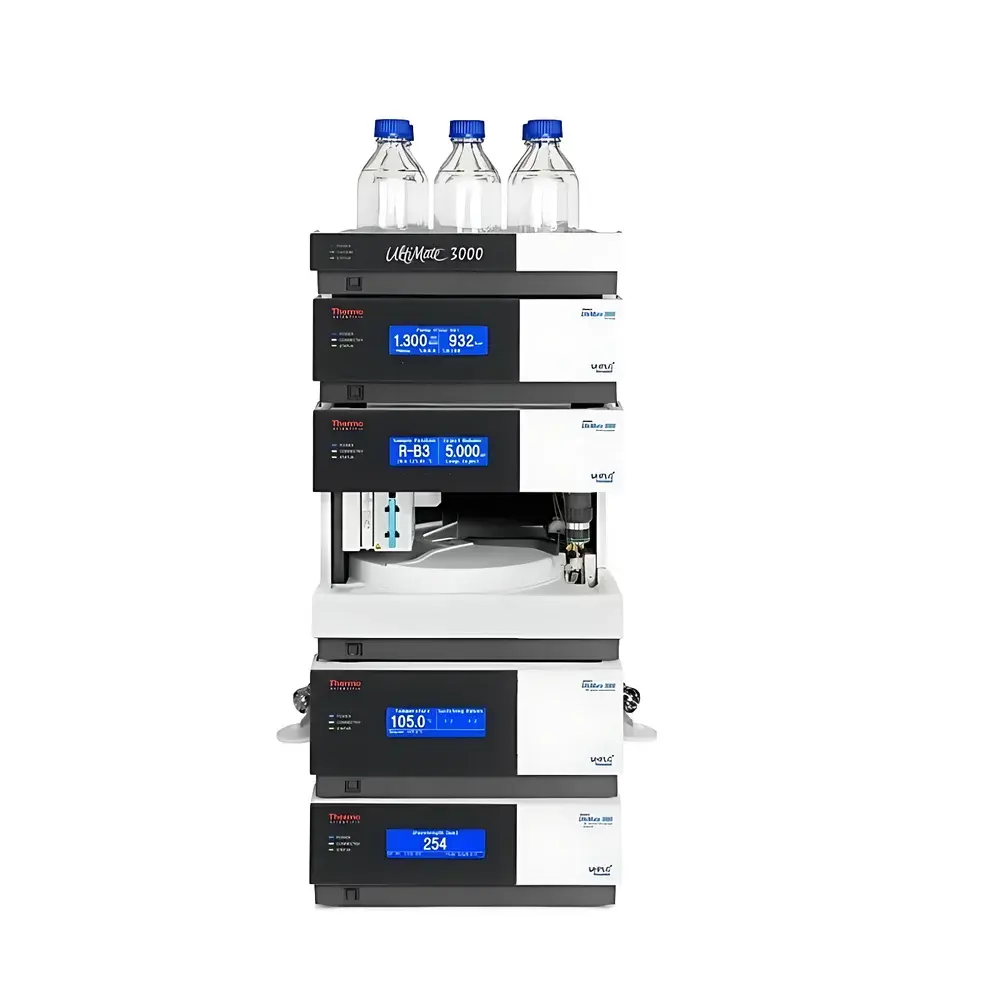
Thermo Fisher UltiMate 3000 BioRS Bio-Ready UHPLC System
| Brand | Thermo Fisher |
|---|---|
| Origin | Germany |
| Manufacturer Type | Original Equipment Manufacturer (OEM) |
| Origin Category | Imported |
| Model | U3000 BioRS |
| Instrument Type | Ultra-High Performance Liquid Chromatograph (UHPLC) for Biopharmaceutical Applications |
| Maximum Pressure | 1000 bar |
| Maximum Flow Rate | 8 mL/min |
| Injection Cycle Time | <20 s |
| Column Temperature Range | 5–110 °C |
| Data Acquisition Rate | up to 200 Hz |
| Gradient Compatibility | Binary, Quaternary, and Dual-Triple LC configurations |
Overview
The Thermo Fisher UltiMate 3000 BioRS is a purpose-engineered ultra-high performance liquid chromatography (UHPLC) system designed specifically for the rigorous demands of biopharmaceutical analysis. Unlike conventional reversed-phase UHPLC platforms, the BioRS architecture implements a fully bio-compatible fluidic path—from pump to detector—enabling robust operation under extreme mobile phase conditions including high-salt buffers (e.g., ammonium acetate/formate), low- and high-pH solvents (pH 1–12), and chaotropic agents commonly used in ion exchange (IEX), hydrophilic interaction (HILIC), size exclusion (SEC), and reversed-phase (RP) separations of biomolecules. Its core principle relies on high-pressure gradient elution (up to 1000 bar) coupled with minimal extra-column dispersion (<10 µL total system volume), ensuring maximal peak capacity, resolution, and sensitivity for complex biological samples such as monoclonal antibodies (mAbs), antibody-drug conjugates (ADCs), peptides, glycans, oligonucleotides, and biosimilars.
Key Features
- Full-system bio-inert flow path constructed from titanium, PEEK, and ceramic components—resistant to corrosion from aggressive aqueous and organic solvents across pH 1–12
- RS (Rapid Separation) dual-gradient pump technology supporting binary, quaternary, and dual-triple configurations for method flexibility and multi-dimensional LC applications
- Viper™ fingertight fittings delivering near-zero dead volume connections, minimizing band broadening and improving reproducibility across repeated injections
- Autosampler with <20-second cycle time and temperature-controlled sample tray (4–40 °C) for stability of labile biologics
- Column compartment with precise thermal control (5–110 °C) and optional active pre-heating for optimal retention time stability in HILIC and IEX
- High-speed UV-Vis and fluorescence detectors capable of data acquisition at up to 200 Hz—critical for narrow UHPLC peaks and accurate peak integration
Sample Compatibility & Compliance
The UltiMate 3000 BioRS is validated for use with a broad spectrum of biomolecular analytes, including intact proteins, subunit fragments, deamidated/oxidized variants, charge isoforms, glycoforms, and nucleic acid therapeutics. Its hardware design conforms to key regulatory expectations for GxP environments: all fluidic surfaces meet USP Class VI biocompatibility standards; system suitability testing (SST) protocols align with ICH Q2(R2) and USP ; and firmware supports audit trail functionality compliant with FDA 21 CFR Part 11 requirements when integrated with Thermo Scientific Chromeleon™ CDS software. The system has been successfully deployed in GLP-compliant QC laboratories for release testing of biologics per EP/USP monographs and in R&D settings supporting ICH Q5E comparability studies.
Software & Data Management
Controlled via Thermo Scientific Chromeleon Chromatography Data System (CDS) v7.3 or later, the BioRS platform delivers full method development, execution, reporting, and electronic signature capabilities. Chromeleon supports automated system suitability checks, peak tracking across sequences, and customizable report templates aligned with ALCOA+ principles. When paired with Thermo Scientific Compound Discoverer or FreeStyle software, raw chromatographic data can be directly exported to mass spectrometry workflows—including seamless interface with Orbitrap, Q Exactive, and TSQ series instruments—for comprehensive characterization of post-translational modifications (PTMs), sequence variants, and higher-order structure attributes. All data files are stored in open-format .RAW or .CDF containers, enabling long-term archival and third-party reprocessing.
Applications
- Charge variant analysis of mAbs using cation-exchange chromatography (CEX) with salt gradients and pH modulation
- Peptide mapping workflows for primary structure confirmation and PTM localization
- Glycan profiling via HILIC-UHPLC with fluorescent labeling (2-AB, procainamide)
- Intact mass analysis and subunit separation under native or denaturing SEC conditions
- Oligonucleotide purity assessment and impurity profiling using anion-exchange or RP methods
- Stability-indicating assays for forced degradation studies (acid/base/oxidative/thermal)
FAQ
Is the UltiMate 3000 BioRS compatible with mass spectrometry interfaces?
Yes—the system features standard ESI and APCI source coupling ports, low-flow micro- and nano-electrospray configurations, and synchronization signals for trigger-based MS acquisition.
Can it operate with high-salt mobile phases without compromising pump lifetime?
Yes—its RS pumps utilize ceramic plungers and titanium housings, enabling extended operation with up to 1 M ammonium sulfate or sodium phosphate buffers without seal degradation.
Does it support method transfer from legacy HPLC or UPLC systems?
Yes—Chromeleon includes method translation tools that automatically adjust gradient slopes, flow rates, and injection volumes based on column dimensions and particle size, facilitating smooth migration from Agilent 1290 or Waters ACQUITY platforms.
What column formats are supported?
All standard analytical (2.1–4.6 mm ID), capillary (0.3–0.5 mm ID), and microbore (1.0 mm ID) columns—including superficially porous particles (SPP), sub-2-µm fully porous silica, and polymeric SEC media—are fully supported with appropriate flow cell and detector configuration options.
Is remote monitoring and diagnostics available?
Yes—Chromeleon Connect enables secure cloud-based instrument status monitoring, predictive maintenance alerts, and real-time log review through encrypted HTTPS connections, supporting hybrid and distributed laboratory operations.



