
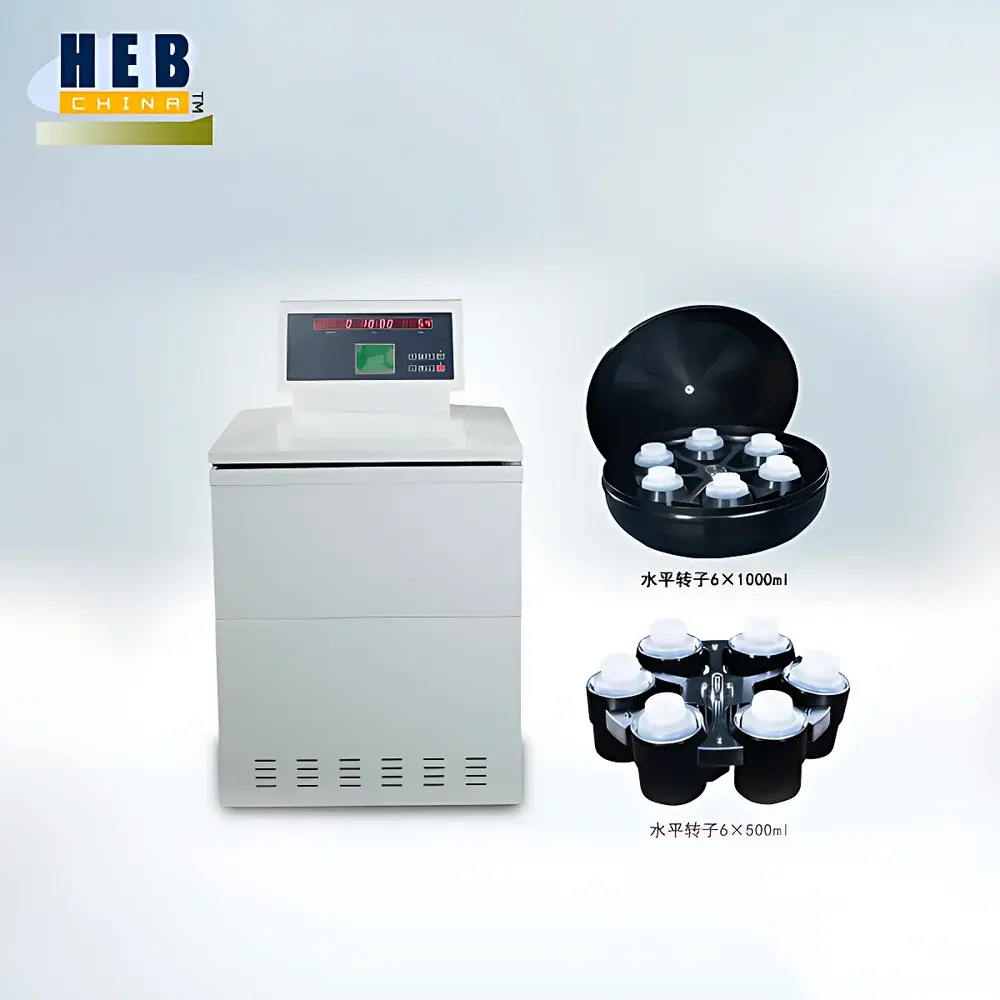
H6-10KR High-Speed Refrigerated Centrifuge
| Brand | Jihepu (Jinan Hepu) |
|---|---|
| Origin | Shandong, China |
| Model | H6-10KR |
| Instrument Type | Floor-Standing Centrifuge |
| Speed Range | 10,000 rpm |
| Max RCF | 18,300 × g |
| Max Capacity | 6 × 1000 mL |
| Temperature Range | −20 °C to +40 °C |
| Temp. Accuracy | ±2.0 °C |
| Timer Range | 1 min – 23 h 59 min |
| Speed Accuracy | ±20 rpm |
| Noise Level | ≤65 dB(A) |
| Dimensions (W×D×H) | 830 × 720 × 1250 mm |
| Net Weight | 268 kg |
| Power Supply | AC 220 V ±10%, 50 Hz, 30 A |
| Total Power | 4500 W |
| Rotor Cavity Diameter | Φ600 mm |
Overview
The H6-10KR High-Speed Refrigerated Centrifuge is a floor-standing, microprocessor-controlled laboratory centrifuge engineered for high-throughput separation of biological macromolecules—including nucleic acids, proteins, subcellular organelles, and viral particles—under precisely controlled thermal conditions. It operates on the principle of sedimentation velocity centrifugation, where differential centrifugal forces (expressed as relative centrifugal force, RCF) separate components based on size, density, and shape within a rotating sample chamber. Designed for demanding applications in clinical diagnostics, biopharmaceutical process development, genomics laboratories, and academic research, the H6-10KR delivers consistent performance at up to 10,000 rpm and 18,300 × g, with active refrigeration maintaining sample integrity across extended runs. Its robust cast-iron base, precision-balanced rotor assembly, and sealed refrigeration circuit ensure mechanical stability and thermal uniformity—even during prolonged operation at maximum speed.
Key Features
- AC brushless frequency-controlled motor: Eliminates carbon brush wear, reduces particulate contamination, and enhances service life and rotational stability.
- Intelligent temperature management: Dual-path refrigeration and heating control maintains setpoint accuracy within ±2.0 °C across the full range (−20 °C to +40 °C), critical for thermosensitive biomolecules.
- Programmable touch interface: Real-time digital display supports user-defined ramp-up/ramp-down profiles, automatic RCF calculation, and multi-step protocols with independent time, speed, and temperature parameters.
- Comprehensive safety architecture: Integrated safeguards include overspeed detection, real-time imbalance monitoring, rotor recognition (via mechanical coding), lid interlock with auto-locking mechanism, and overtemperature cutoff.
- Optimized acoustic design: Sound-dampened housing and vibration-isolated drive system limit operational noise to ≤65 dB(A), meeting ISO 15707 requirements for laboratory ambient noise levels.
- Large-capacity rotor compatibility: Supports six interchangeable rotors—including fixed-angle and horizontal configurations—with maximum load capacity of 6 × 1000 mL per run.
Sample Compatibility & Compliance
The H6-10KR accommodates standard laboratory consumables including polypropylene and polycarbonate centrifuge tubes (15–1000 mL), conical-bottom bottles, and sealed centrifuge buckets. Its rotor geometry and acceleration profile are validated for routine isolation of plasmid DNA, mitochondrial fractions, exosomes, and clarified cell lysates. The instrument complies with IEC 61010-1:2010 (Safety Requirements for Electrical Equipment for Measurement, Control, and Laboratory Use) and meets electromagnetic compatibility standards per EN 61326-1. While not pre-certified for GMP or FDA 21 CFR Part 11 environments, its programmable audit trail functionality (via optional data logging module) supports GLP-compliant documentation when integrated into validated workflows.
Software & Data Management
The embedded control firmware records all run parameters—including actual vs. set speed, real-time temperature, elapsed time, and error codes—in non-volatile memory. Optional USB data export enables traceable protocol archiving and post-run analysis in CSV format. Though no proprietary PC software is bundled, the device supports manual protocol transfer via USB flash drive and retains up to 100 user-defined programs locally. For regulated environments, third-party LIMS integration is achievable through RS-232 serial output (standard) or optional Ethernet module (firmware v2.3+), enabling remote monitoring and electronic signature support under documented SOPs.
Applications
- Clinical microbiology: Rapid concentration of blood-derived pathogens and extracellular vesicles for downstream PCR or ELISA.
- Bioprocessing: Clarification of monoclonal antibody harvests and intermediate purification steps prior to chromatography.
- Structural biology: Preparative isolation of ribosomal subunits and membrane protein complexes at defined g-forces.
- Virology: Pelletization of lentiviral and AAV vectors without capsid denaturation.
- Environmental testing: Sedimentation of microbial biomass from wastewater samples for metagenomic sequencing library prep.
FAQ
What is the maximum allowable imbalance tolerance for the H6-10KR during operation?
The system detects mass asymmetry exceeding 5 g per rotor position and halts acceleration before reaching operational speed.
Can the H6-10KR be used for continuous-flow centrifugation?
No—it is designed exclusively for batch-mode operation with fixed-volume rotors; continuous processing requires dedicated flow-through centrifuges.
Is rotor calibration required before first use?
Yes—each rotor must be registered using its engraved identification number via the front-panel menu to enable RCF validation and safety interlocks.
Does the refrigeration system use environmentally regulated refrigerants?
It employs R134a (1,1,1,2-tetrafluoroethane), an ASHRAE-classified A1 refrigerant compliant with current EU F-Gas Regulation Annex I thresholds.
What maintenance intervals are recommended for optimal performance?
Vacuum pump oil replacement every 12 months, condenser coil cleaning quarterly, and annual verification of temperature sensor drift and speed encoder linearity by authorized service personnel.



