
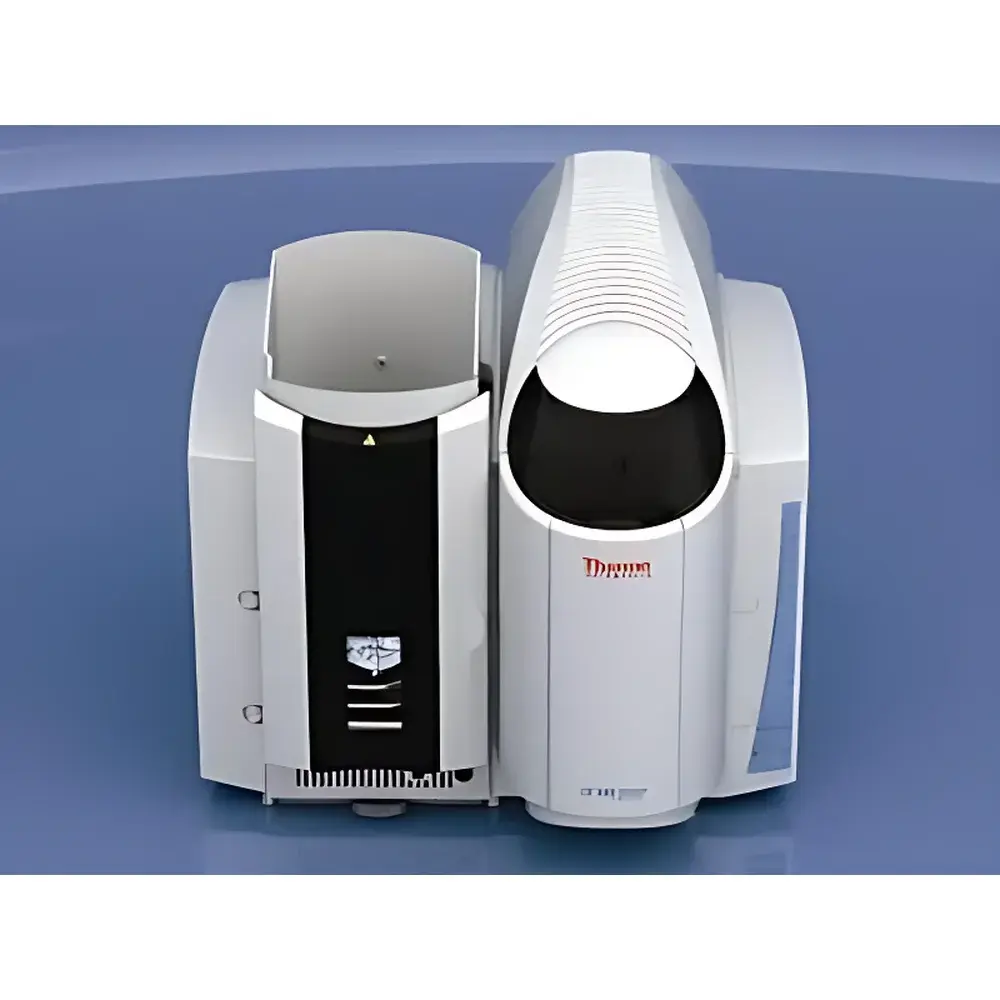
Thermo Scientific iCE 3300 Flame Atomic Absorption Spectrometer
| Brand | Thermo Fisher |
|---|---|
| Origin | United Kingdom |
| Manufacturer Type | Original Equipment Manufacturer (OEM) |
| Instrument Type | Flame AAS |
| Monochromator | Plane Grating (1800 lines/mm) |
| Optical System | Double-Beam |
| Detector | Photomultiplier Tube (PMT) |
| Background Correction | Deuterium Lamp + Self-Reversal Method |
| Wavelength Range | 190–900 nm |
| Focal Length | 270 mm |
| Slit Widths | 0.2, 0.5, 1.0, 2.0 nm (motorized) |
| Lamp Holder | 6-position, fully automated, independent lamp power supplies |
| Burner Head | Titanium alloy, finned design, optional 50 mm or 100 mm length |
| Nebulizer Chamber | Inert PTFE-nozzle & Pt/Ir capillary |
| Gas Control | Binary-valve digital pneumatic system for air/acetylene and N₂O/acetylene |
Overview
The Thermo Scientific iCE 3300 Flame Atomic Absorption Spectrometer is a fully PC-controlled, benchtop atomic absorption instrument engineered for precision, robustness, and operational efficiency in routine elemental analysis laboratories. It operates on the fundamental principle of atomic absorption spectroscopy—measuring the attenuation of characteristic hollow cathode lamp radiation as ground-state atoms in a flame absorb specific wavelengths. Designed exclusively for flame-based quantification (not graphite furnace), the iCE 3300 delivers high sensitivity, low detection limits, and exceptional reproducibility for metals and metalloids across environmental, clinical, food, and industrial quality control applications. Its double-beam optical architecture compensates for source drift and lamp intensity fluctuations in real time, ensuring long-term photometric stability without manual recalibration. The 270 mm focal length monochromator, equipped with a high-efficiency 1800 lines/mm plane grating and quartz-coated optics, maximizes radiant throughput while maintaining high spectral resolution—critical for resolving closely spaced absorption lines in complex matrices.
Key Features
- Automated 6-lamp turret with independent power supplies, supporting coded, standard, and domestic hollow cathode lamps; front-access lamp sockets enable rapid element switching without optical realignment.
- Dual-background correction system: Combines deuterium arc (D₂) and self-reversal (SR) methods—D₂ provides broad-band correction up to 3 A absorbance, with <2% error at 2 A and <1% at 1 A; SR enables precise line-specific correction for volatile elements such as As and Se.
- Inert nebulization system: Platinum/iridium capillary and PTFE spray chamber resist corrosion from strong acids—including hydrofluoric acid—and ensure stable aerosol generation for both organic and aqueous samples.
- Titanium finned burner head: Chemically inert, salt-tolerant design minimizes carbon buildup and flame instability; interchangeable 50 mm and 100 mm configurations optimize sensitivity vs. sample throughput trade-offs.
- Binary-valve gas control: Digitally regulated solenoid manifold automates ignition, flame switching (air/acetylene ↔ nitrous oxide/acetylene), and stoichiometric fuel/oxidant ratio maintenance—meeting EN ISO 11885 and ASTM D1688 safety protocols.
- Motorized slit selection (0.2–2.0 nm) and auto-wavelength scanning eliminate manual adjustments, reducing operator dependency and inter-user variability.
Sample Compatibility & Compliance
The iCE 3300 is validated for liquid samples within typical concentration ranges of 0.1–10 mg/L for most transition metals (e.g., Cu, Zn, Fe, Mn, Pb, Cd). It supports direct analysis of digested environmental waters (EPA Method 200.7), soil extracts (ISO 11047), and biological fluids (CLSI C38-A2). All hardware and firmware comply with IEC 61010-1 (electrical safety), CE marking requirements, and electromagnetic compatibility (EMC) Directive 2014/30/EU. The system architecture supports audit-trail-enabled operation under GLP and GMP environments when paired with Thermo Scientific Qtegra Intelligent Scientific Data Solution™ software configured for 21 CFR Part 11 compliance (electronic signatures, user access levels, change logs).
Software & Data Management
Controlled via Thermo Scientific Qtegra ISDS software, the iCE 3300 offers guided workflows—from method setup and calibration curve generation to QC checking and report export. The wizard-driven interface reduces training time and minimizes procedural errors during high-throughput analyses (e.g., multi-element water testing). Raw absorbance data, peak area/intensity integrations, and background-corrected results are stored in vendor-neutral .csv and .xml formats. Full traceability is maintained through embedded metadata: lamp identity, slit width, integration time, gas flow rates, and background correction mode. Optional LIMS integration (via ASTM E1384-compliant drivers) enables seamless data transfer to laboratory information management systems.
Applications
- Environmental monitoring: Quantification of regulated metals (As, Cd, Cr, Cu, Ni, Pb, Zn) in drinking water, wastewater, and leachates per EPA 200.7 and ISO 11885.
- Food safety: Determination of essential (Fe, Zn, Cu) and toxic (Pb, Cd, As) elements in dairy, cereals, and infant formula following AOAC 974.02 and EN 15510.
- Pharmaceutical QC: Elemental impurity screening in excipients and APIs per ICH Q3D guidelines (Class 1–3 elements).
- Geochemical analysis: Rapid determination of base metals in acid-digested rock and sediment samples (ASTM D5686).
- Industrial process control: Monitoring catalyst poisons (e.g., Na, V, Ni) in petrochemical feedstocks and lubricants.
FAQ
Is the iCE 3300 compatible with graphite furnace or hydride generation accessories?
No—the iCE 3300 is a dedicated flame AAS platform. Thermo Fisher offers the iCE 3500 model for integrated flame/graphite furnace capability, and the iCE 3400 for dedicated hydride generation applications.
What safety certifications does the gas control system meet?
The binary-valve pneumatic module complies with EN 746-2 (industrial thermoprocessing equipment) and incorporates flame failure detection, automatic shutdown, and pressure interlocks aligned with NFPA 56 and CGA G-1 standards.
Can the instrument be operated without Qtegra software?
No—full functionality, including lamp management, background correction selection, and data acquisition, requires Qtegra ISDS v3.2 or later. Standalone operation or third-party software control is not supported.
What maintenance intervals are recommended for optimal performance?
Nebulizer capillary cleaning every 40–60 hours of operation; burner head cleaning after 8–10 hours of high-salt matrix analysis; annual PM including grating alignment verification, PMT voltage calibration, and gas line leak testing per Thermo Fisher Service Bulletin AAS-PM-01.
Related Products






