
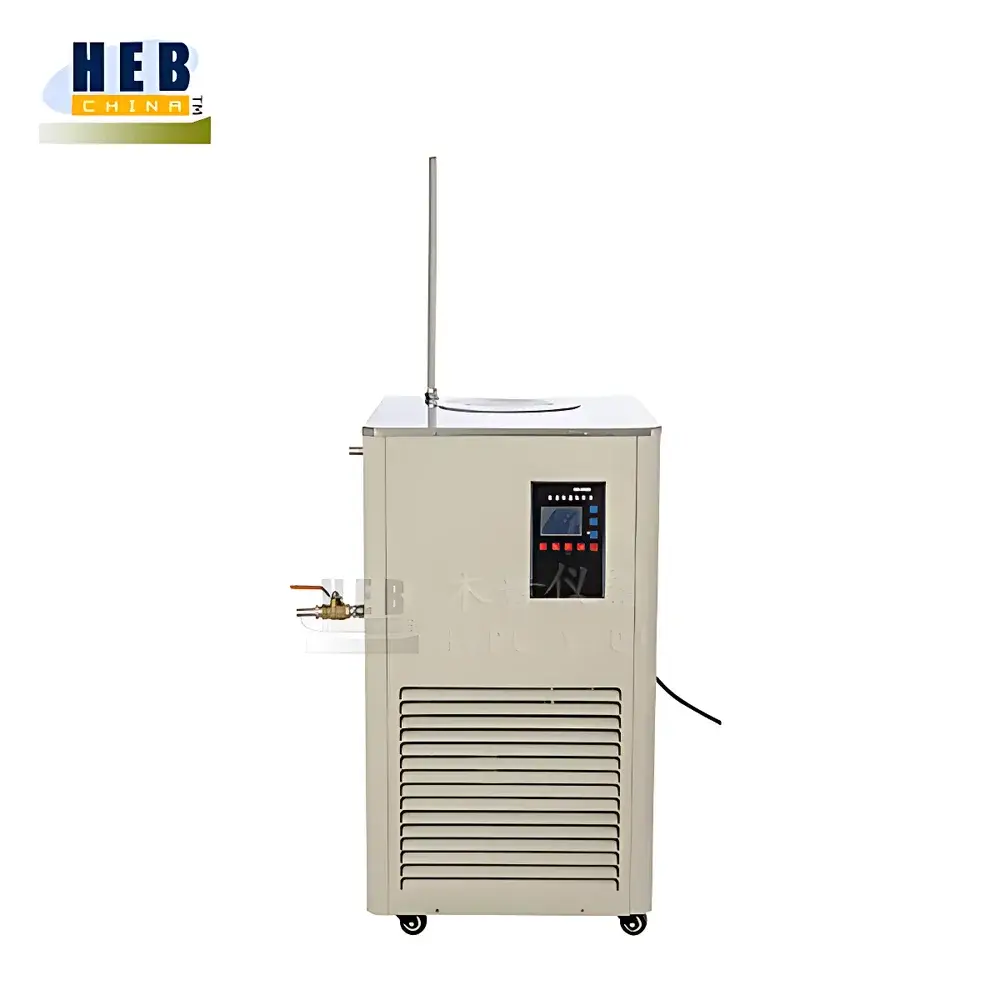
HePu DFY-50/30 Low-Temperature Constant-Temperature Bath
| Brand | HePu (Jinan Hepu Instrument Co., Ltd.) |
|---|---|
| Origin | Shandong, China |
| Model | DFY-50/30 |
| Bath Volume | 50 L |
| Temperature Range (No Load) | –30 °C to +98 °C |
| Temperature Stability | ±0.5 °C |
| Refrigeration Capacity | 7549 W at –30 °C |
| Circulating Pump Flow Rate | 3540 L/h |
| Opening Diameter | Φ360 mm |
| Power Supply | 380 V / 50 Hz (3-phase) |
| Construction | 304 Stainless Steel Bath Tank |
| Compressor Type | Hermetic Air-Cooled Imported Compressor |
| Control System | Digital PID Controller with Dual LED Display (Setpoint & Actual Temperature) |
| Optional Features | Dual-Stage Magnetic Stirring, External Temperature Sensor Input, RS485 Communication Interface |
Overview
The HePu DFY-50/30 Low-Temperature Constant-Temperature Bath is a precision-engineered circulating chiller-bath system designed for laboratory-scale thermal control in demanding scientific applications. Operating on the principle of vapor-compression refrigeration combined with forced convection circulation, it delivers stable, uniform temperature environments across a wide operational range—from –30 °C to +98 °C—without reliance on consumable cryogens such as dry ice or liquid nitrogen. Its 50-liter stainless steel bath reservoir serves both as a direct immersion medium and as a heat-transfer fluid source for external equipment (e.g., rotary evaporators, spectrophotometer jackets, or reaction calorimeters). The unit integrates a high-efficiency hermetic air-cooled compressor, low-temperature-compatible silicone oil or aqueous glycol-based heat transfer fluids, and a dual-stage magnetic stirrer to minimize thermal stratification and ensure spatial temperature homogeneity within ±0.5 °C across the entire working volume. This architecture meets the functional requirements of ISO/IEC 17025-accredited laboratories for temperature-controlled experimental reproducibility.
Key Features
- Dual digital LED display showing both setpoint and real-time bath temperature with 0.1 °C resolution
- 304 stainless steel bath tank resistant to corrosion from common organic solvents and aqueous salt solutions
- Intelligent PID temperature controller with auto-tuning capability and programmable ramp/soak profiles
- Two-stage magnetic stirring system (top and bottom-mounted) enabling uniform thermal distribution even at sub-zero temperatures
- High-capacity circulating pump delivering up to 3540 L/h flow rate with adjustable pressure output for compatibility with external jacketed reactors and condensers
- Robust thermal insulation and optimized airflow management to maintain efficiency under continuous low-temperature operation
- Over-temperature, low-level, and compressor overpressure safety interlocks compliant with IEC 61010-1 Class II electrical safety standards
Sample Compatibility & Compliance
The DFY-50/30 accommodates a broad spectrum of sample vessels and apparatus—including glass-jacketed reactors (up to 5 L), viscometers, electrochemical cells, and cryogenic sample holders—provided they are compatible with standard silicone oil (e.g., Dow Corning 200 Fluid) or 30–50% ethylene glycol/water mixtures. Its design conforms to general-purpose laboratory equipment safety directives under CE marking (2014/35/EU Low Voltage Directive and 2014/30/EU EMC Directive). While not certified for GMP manufacturing environments per se, its digital logging capability, stable thermal performance, and traceable calibration support adherence to GLP documentation practices. For regulated QC labs, optional RS485 interface enables integration with LIMS platforms for audit-trail generation in accordance with FDA 21 CFR Part 11 principles when paired with validated software.
Software & Data Management
The DFY-50/30 operates autonomously via its onboard microcontroller but supports external data acquisition through an RS485 serial port (Modbus RTU protocol). When connected to PC-based monitoring software (e.g., LabVIEW-compatible drivers or HePu’s proprietary HeView Suite), users can log temperature history, export CSV-formatted datasets, configure multi-step temperature programs, and trigger alarms based on user-defined thresholds. All temperature readings are timestamped and stored in non-volatile memory for post-experiment review. No cloud connectivity or proprietary firmware updates are required; configuration remains fully local and deterministic—critical for environments where network isolation is mandated.
Applications
- Low-temperature synthesis of organometallic compounds and sensitive pharmaceutical intermediates
- Viscosity measurements of polymer melts and lubricants using capillary or rotational viscometers
- Controlled cooling of NMR probe preamplifiers and CCD detectors in spectroscopy setups
- Thermal conditioning of calibration standards for thermocouple and RTD verification
- Stabilization of enzymatic reaction kinetics in biochemistry assays between –20 °C and +40 °C
- Supporting cryo-milling and cold grinding operations by maintaining consistent coolant bath temperatures
FAQ
What types of heat transfer fluids are recommended for operation below –20 °C?
Silicone oils with pour points ≤ –50 °C (e.g., DC-200 series) or 40% propylene glycol/water mixtures are suitable. Ethanol-water blends are discouraged due to volatility and flammability risks.
Can the DFY-50/30 be used for external recirculation only—without filling the internal bath?
No. The unit requires minimum fluid level detection for safe compressor operation; external-only mode is not supported.
Is calibration certificate included with shipment?
A factory calibration report (traceable to NIM, China) is provided. Full ISO/IEC 17025 calibration with uncertainty budget requires third-party service.
What maintenance intervals are recommended for long-term reliability?
Compressor oil and refrigerant levels should be verified annually; condenser coils require bi-monthly dust removal; magnetic stirrer seals inspected every 18 months.
Does the unit meet noise emission limits for quiet laboratory zones?
At rated load, sound pressure level is ≤ 68 dB(A) at 1 m distance—within typical academic lab ambient limits per ISO 7779.



