
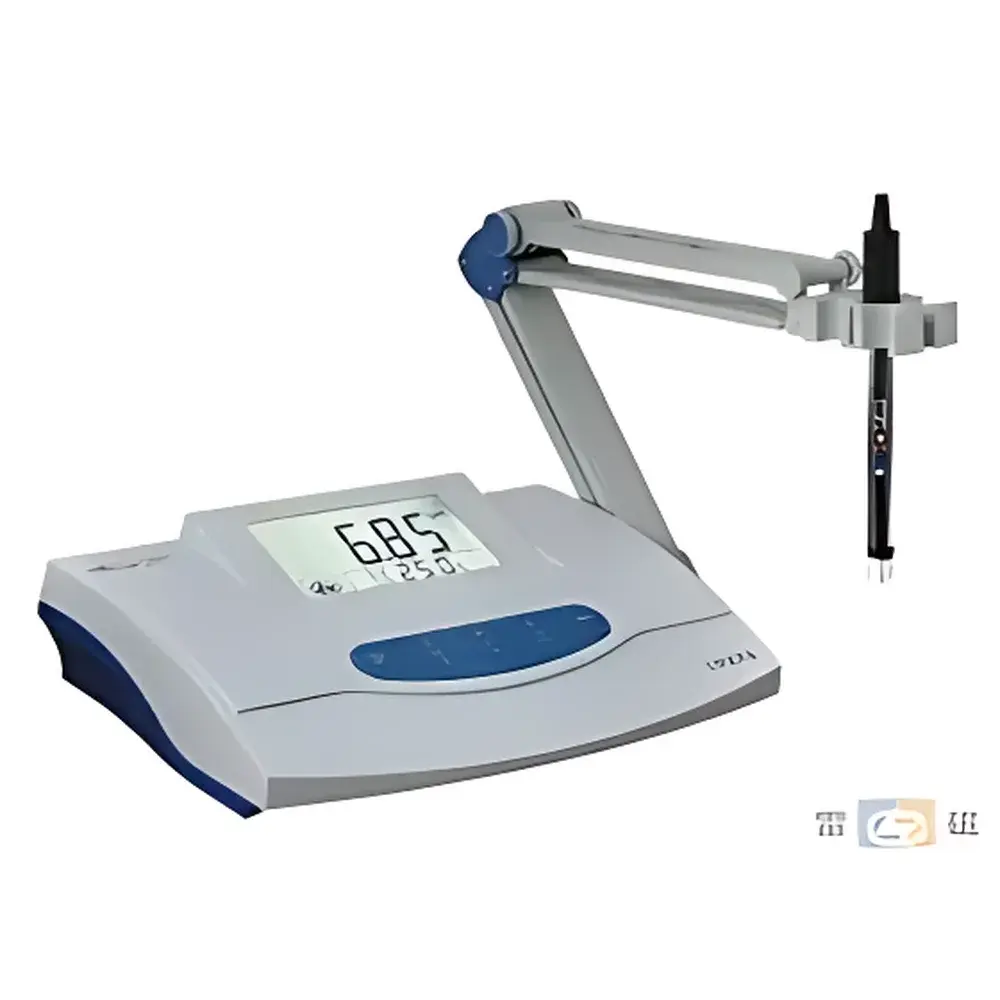
PHS-3C Benchtop pH Meter
| Origin | Shandong, China |
|---|---|
| Manufacturer Type | Authorized Distributor |
| Origin Category | Domestic (PRC) |
| Model | PHS-3C |
| Price | USD 340 (FOB Shandong) |
| Instrument Type | Benchtop |
| Parameter Channels | Dual (pH + mV) |
| Measurement Accuracy | ±0.01 pH |
| pH Range | 0.00–14.00 pH |
| mV Range | −1999 to +1999 mV |
| pH Resolution | 0.01 pH |
| mV Resolution | 1 mV |
| Temperature Compensation | Manual (0.0–60.0 °C) |
| Calibration Standard Compliance | GB/T 27501 & DIN 19265 |
Overview
The PHS-3C Benchtop pH Meter is a precision electrochemical instrument engineered for reliable, repeatable pH and redox potential (mV) measurements in routine laboratory, quality control, and educational environments. It operates on the principle of potentiometric measurement using a glass electrode and reference electrode assembly, generating a Nernstian voltage response proportional to hydrogen ion activity in aqueous solutions. Designed to meet Class 0.01 accuracy requirements per GB/T 27501 (Chinese national standard equivalent to ISO 7027 and DIN 19265), the PHS-3C delivers stable readings under controlled ambient conditions and supports manual temperature compensation to correct for solution temperature effects on electrode response—critical for compliance with ASTM D1293 (Standard Test Method for pH of Water) and USP guidelines.
Key Features
- Benchtop form factor with compact footprint (300 × 220 × 90 mm) and lightweight design (1 kg), optimized for space-constrained lab benches and mobile QA/QC stations.
- Segmented LCD display with high-contrast, low-power consumption segments ensuring legibility under varied lighting conditions—including ambient lab lighting and glove-box environments.
- Automatic standard buffer recognition during calibration: detects and labels common GB/DIN-compliant buffers (e.g., pH 4.01, 6.86, 9.18 at 25 °C) without manual input, reducing operator error and accelerating setup.
- Two-point calibration protocol with slope and offset verification, supporting both single-solution and dual-solution calibration workflows per ISO 17025 technical requirements for measurement traceability.
- Manual temperature compensation (0.0–60.0 °C) with direct numeric entry via front-panel keys; eliminates need for external thermometers while maintaining alignment with IUPAC-recommended temperature correction algorithms.
- Robust electrical architecture featuring isolated analog input stage, EMI-resistant signal conditioning, and stable DC power regulation from AC mains (220 V ± 10 %, 50 Hz ± 1 %).
Sample Compatibility & Compliance
The PHS-3C is validated for use with aqueous samples including process water, buffer solutions, biological media, food extracts, and mild chemical formulations. It is not intended for non-aqueous solvents, highly viscous suspensions, or aggressive oxidizing/reducing matrices that may degrade glass electrode membranes. All calibration and verification procedures comply with GB/T 27501–2011 (“General Specification for Laboratory pH Meters”) and DIN 19265 (“Water Quality — Determination of pH Value”). While not certified for GLP or GMP environments out-of-the-box, its documented calibration logs, fixed resolution settings, and stable baseline drift (< ±0.01 pH/3 h) support integration into auditable workflows when paired with SOP-defined maintenance schedules and electrode qualification records.
Software & Data Management
The PHS-3C operates as a standalone instrument without proprietary software dependency. All measurement data remain visible only on the local LCD display and are not stored internally or exportable via digital interface (no USB, RS-232, or Bluetooth). This architecture ensures electromagnetic compatibility in regulated labs where uncontrolled data transmission is restricted under FDA 21 CFR Part 11 Annex 11 and EU GMP Annex 11 interpretations. Users are advised to manually record results in bound logbooks or LIMS-integrated templates to satisfy ALCOA+ data integrity principles (Attributable, Legible, Contemporaneous, Original, Accurate, Complete, Consistent, Enduring, Available).
Applications
- Environmental monitoring: pH verification of surface water, wastewater effluents, and soil leachates per EPA Method 150.1.
- Pharmaceutical QC: Routine pH testing of injectables, ophthalmic solutions, and buffer preparations aligned with USP and Ph. Eur. 2.2.3.
- Food & beverage: Batch verification of dairy products, fruit juices, and fermentation broths where regulatory pH thresholds govern microbial stability.
- Academic teaching: Electrochemistry laboratories requiring cost-effective, durable instruments for Nernst equation validation, buffer capacity studies, and electrode response characterization.
- Industrial process support: On-site verification of rinse water pH in electroplating lines or cleaning validation cycles in medical device manufacturing.
FAQ
Does the PHS-3C support automatic temperature compensation (ATC)?
No. It provides manual temperature entry only, requiring users to measure sample temperature externally and input the value prior to measurement.
Can the PHS-3C be used with non-GB/DIN calibration buffers?
Yes—though automatic recognition is limited to GB/DIN-certified standards, manual calibration with other buffers (e.g., NIST-traceable solutions) is fully supported via user-defined values.
Is the instrument suitable for ISO/IEC 17025-accredited laboratories?
It meets metrological performance criteria for Class 0.01 meters and supports documented calibration; however, full accreditation requires supplementary evidence including electrode certification, environmental monitoring logs, and uncertainty budgets per ILAC-G8:2022.
What is the recommended electrode type for optimal performance?
A combination pH electrode with Ag/AgCl reference system and low-resistance glass membrane (e.g., 25–50 Ω at 25 °C) is recommended; avoid double-junction electrodes unless measuring samples with high sulfide or protein content.
How often should calibration be performed?
Prior to each analytical session or after every 2–3 hours of continuous use—whichever occurs first—as specified in internal SOPs aligned with CLSI EP21-A and ISO 15197:2013 guidance.






