
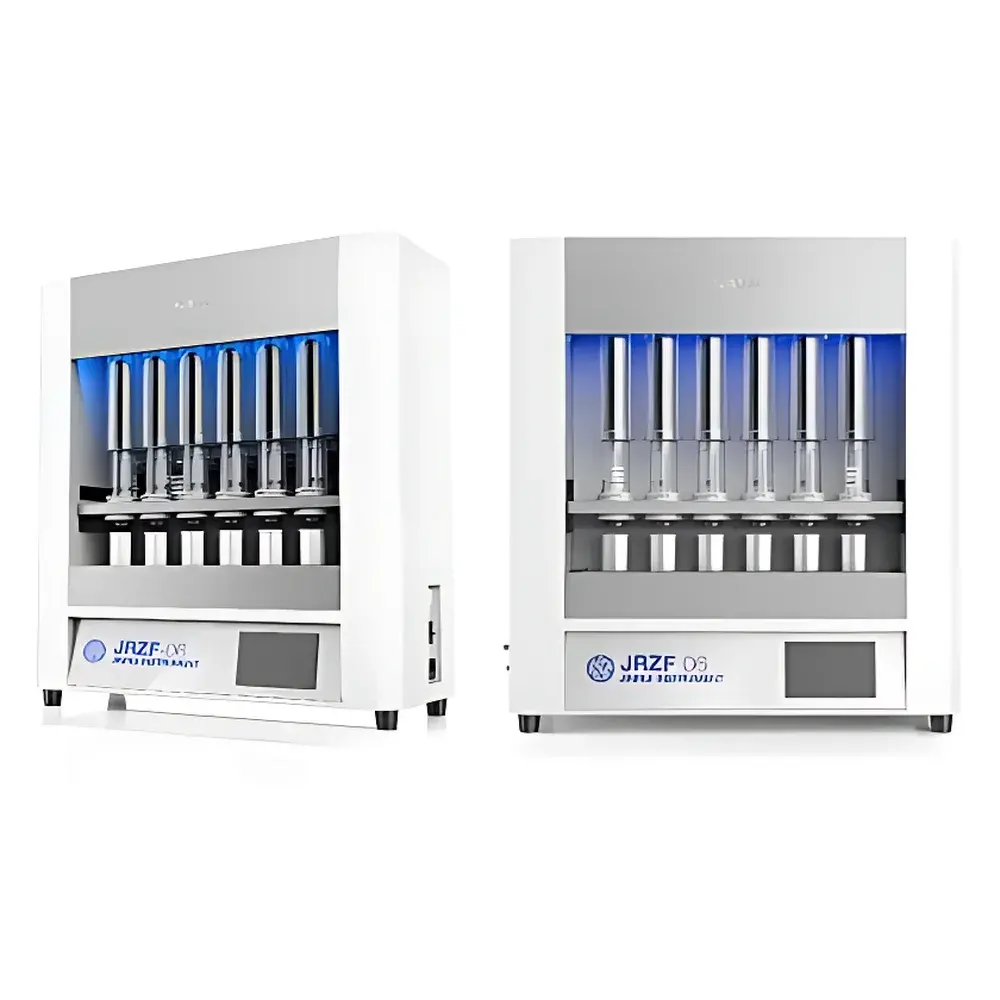
HePu JRZF-06 Fully Automated Fat Analyzer
| [Brand | HePu (Jihepu) |
|---|---|
| Origin | Shandong, China |
| Model | JRZF-06 |
| Extraction Chamber Volume | 100 mL |
| Receiving Flask Volume | 100 mL |
| Temperature Range | RT+5°C to 300°C |
| Temperature Control Accuracy | ±1°C |
| Number of Channels | 6 |
| Power Supply | 220 V ±10%, 50 Hz |
| Heating Power | 1500 W |
| Sample Weight Capacity | 0.5–15 g per vessel |
| Fat Determination Range | 0.1–100% |
| Solvent Recovery Rate | ≥85%] |
Overview
The HePu JRZF-06 Fully Automated Fat Analyzer is an integrated, PLC-controlled system engineered for precise and reproducible fat quantification in food, grain, feed, and agricultural commodities using the classical Soxhlet extraction principle—combined with modern thermal and dynamic solvent delivery modes. It operates on gravimetric analysis: after exhaustive lipid extraction with organic solvents, the solvent is evaporated, and residual fat mass is determined by weight difference before and after extraction. Designed to meet stringent regulatory requirements, the instrument fully complies with GB 5009.6–2016 (National Food Safety Standard for Fat Determination in Foods), GB/T 6433–2006 (Crude Fat Determination in Feeds), and SN/T 0800.2–1999 (Import/Export Grain and Feed Testing). Its architecture supports method flexibility—including standard Soxhlet, hot extraction, Soxhlet-hot hybrid, continuous flow, and programmable timed flow—enabling laboratories to optimize recovery efficiency across diverse sample matrices and solvent systems.
Key Features
- 6-channel parallel processing with independent temperature and timing control per station, enabling high-throughput batch analysis without cross-contamination.
- True-color 4.5-inch capacitive touch HMI interface paired with industrial-grade PLC controller—ensuring stable operation, intuitive navigation, and audit-ready event logging.
- Fully automated mechanical actuation: motorized lifting/lowering of filter paper cups, pneumatically assisted sealing, and electromagnetic valve-driven solvent flow control eliminate manual intervention during extraction cycles.
- Integrated metal-block heating bath with programmable ramp-and-hold profiles—providing rapid thermal response, uniform temperature distribution (±1°C accuracy), and compatibility with solvent boiling points ranging from 35°C (diethyl ether) to 130°C (xylene).
- Multi-mode solvent management: supports static immersion, reflux cycling, continuous percolation, and pulsed-flow extraction—each configurable via user-defined time/temperature/solvent volume parameters.
- Smart cooling water regulation: inlet/outlet temperature sensing enables adaptive flow modulation—reducing water consumption by up to 40% versus fixed-flow systems while maintaining condenser efficiency.
- Universal solvent compatibility: validated for petroleum ether, diethyl ether, acetone, dichloromethane, n-hexane, alcohols, aromatic hydrocarbons, and benzene derivatives—subject to lab safety protocols and fume hood ventilation compliance.
Sample Compatibility & Compliance
The JRZF-06 accommodates solid and semi-solid samples within a 0.5–15 g mass range, including cereal grains, milled flour, dairy powders, meat products, oilseeds, and compound animal feeds. Filter paper cup dimensions conform to ISO 1443–1973 and AOAC 920.39 specifications. All operational sequences—including heating, solvent delivery, reflux duration, and evaporation—are programmable and traceable, supporting GLP and GMP documentation workflows. Data integrity safeguards include timestamped method execution logs, operator ID tagging, and non-modifiable cycle records—aligning with FDA 21 CFR Part 11 principles for electronic records and signatures where local validation policies apply.
Software & Data Management
While the JRZF-06 operates via embedded PLC firmware (no external PC dependency), it provides USB export capability for raw cycle data—including start/stop timestamps, temperature profiles, solvent volume consumed, and lift/valve actuation events. Exported CSV files are compatible with LIMS integration and statistical process control (SPC) platforms. Optional RS-485 Modbus RTU interface allows centralized monitoring in multi-instrument laboratory environments. All parameter changes require password authentication; system defaults are factory-locked to ensure method consistency across shifts and operators.
Applications
- Quality control laboratories in food manufacturing—verifying label claims for total fat, saturated fat, and trans-fat content per nutritional labeling regulations.
- Feed mills and agritech R&D centers—assessing crude fat stability during pelleting, extrusion, or storage under accelerated oxidation conditions.
- Government testing institutes conducting statutory surveillance under national food safety monitoring programs (e.g., China’s NIFDC oversight framework).
- Academic research groups studying lipid migration in multilayer packaging, enzymatic lipolysis kinetics, or solvent–matrix interaction thermodynamics.
- Contract testing labs serving ISO/IEC 17025-accredited reporting—leveraging built-in repeatability (RSD ≤ 2.1% at 5% fat level) and inter-laboratory comparability data per collaborative studies.
FAQ
Does the JRZF-06 support method validation per ISO 5505 or AOAC 991.36?
Yes—the instrument’s programmable extraction parameters (soak time, reflux frequency, solvent volume, and temperature ramp rates) allow full alignment with validation protocols requiring documented precision, accuracy, and robustness assessments.
Can the system be calibrated for solvent-specific density compensation?
No—gravimetric analysis inherently eliminates density dependence; however, users must account for solvent volatility losses during evaporation using standardized drying protocols (e.g., 105°C × 30 min under nitrogen purge) as specified in GB 5009.6–2016 Annex A.
Is remote monitoring or Ethernet connectivity available?
Not natively—operation and diagnostics are managed locally via the touch HMI. For networked environments, third-party SCADA gateways may be deployed via the RS-485 interface with appropriate protocol mapping.
What maintenance intervals are recommended for long-term reliability?
Monthly inspection of sealing gaskets and electromagnetic valves; biannual verification of temperature sensor calibration against NIST-traceable reference standards; annual replacement of cooling water filtration cartridges if hard water is used.



