
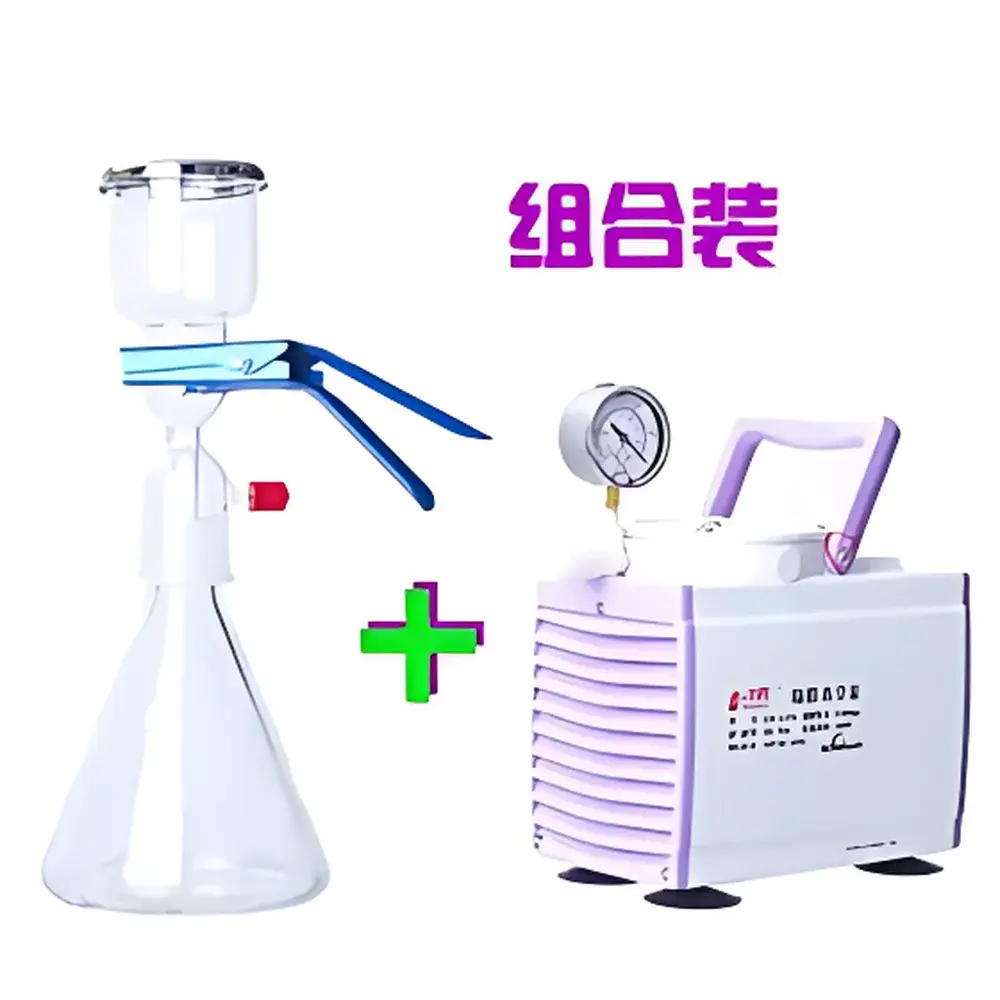
Jihepu GM-0.33A Laboratory Solvent Filtration System with Oil-Free Diaphragm Vacuum Pump
| Brand | Jihepu |
|---|---|
| Origin | Shandong, China |
| Pump Type | Oil-Free Diaphragm Vacuum Pump |
| Air Displacement Rate | 20 L/min |
| Ultimate Vacuum Pressure | ≥0.08 MPa (≥200 mbar) |
| Dimensions (L×W×H) | 215 × 120 × 235 mm |
| Weight | 7.5 kg |
| Motor Power | 160 W |
| Input Voltage | 220 V AC, 50 Hz |
| Inlet Port Diameter | φ6 mm |
| Noise Level | <60 dB(A) |
| Operating Temperature Range | 7–40 °C |
| Pump Head Temperature | <55 °C |
| Membrane Material | Imported Nitrile Rubber |
| Valve Material | Imported Rubber |
| Corrosion Protection | PTFE-coated wetted parts |
| Filter Compatibility | 47 mm & 50 mm diameter membranes (cellulose acetate, nylon, PVDF, PTFE, mixed ester), 60 mm optional |
| Flask Options | 1 L or 2 L borosilicate glass triangular flasks with 10 µm or 20 µm sintered glass frits |
Overview
The Jihepu GM-0.33A Laboratory Solvent Filtration System is an integrated, CE-certified vacuum-assisted filtration platform engineered for precision liquid clarification and particulate removal in analytical, pharmaceutical, and quality control laboratories. It combines a high-integrity borosilicate glass solvent filtration assembly with a maintenance-free, oil-free diaphragm vacuum pump—designed to meet the stringent demands of HPLC mobile phase preparation, sterile filtration, and trace contaminant analysis. The system operates on the principle of negative-pressure-driven membrane filtration: vacuum applied via the diaphragm pump draws liquid through a microporous membrane seated on a sintered glass frit, retaining particles, microorganisms, and colloids while delivering clarified filtrate into a calibrated collection flask. Its all-dry, oil-free architecture eliminates hydrocarbon contamination risk—critical for GC-MS, ICP-MS, and ultra-trace elemental analysis workflows where background interference must be minimized.
Key Features
- Oil-free diaphragm pump with imported nitrile rubber membranes and fluoropolymer-coated wetted surfaces—ensuring full chemical compatibility with aggressive solvents (e.g., acetonitrile, THF, concentrated acids/bases) and long-term stability under continuous operation.
- Integrated thermal protection: automatic shutdown at 130 °C motor temperature, coupled with passive cooling fins and internal airflow management—enabling unattended 24-hour duty cycles without performance degradation.
- Borosilicate glass filtration manifold (Class A, ISO 3585-compliant) featuring uniform wall thickness, zero optical distortion, and autoclavable construction (up to 121 °C, 2 bar steam sterilization).
- Adjustable vacuum regulation via built-in pressure control valve—allowing fine-tuning of suction force to prevent membrane rupture during low-surface-tension solvent filtration (e.g., methanol/water mixtures).
- Low-noise operation (<60 dB[A]) achieved through acoustic damping chambers, balanced rotor dynamics, and vibration-isolating feet—suitable for shared lab environments and laminar flow hoods.
- Modular filter flask configuration: supports 1 L and 2 L triangular flasks with interchangeable 47 mm/50 mm/60 mm filter holders and optional 10 µm or 20 µm sintered glass frits for pre-filtration staging.
Sample Compatibility & Compliance
The GM-0.33A system accommodates aqueous, organic, and corrosive liquid matrices—including HPLC-grade mobile phases, biological buffers, pesticide extracts, environmental water samples, and API solutions. Its PTFE-coated gas path and inert glass components comply with USP particulate matter testing requirements and support GLP/GMP-aligned documentation practices. When used with certified low-protein-binding membranes (e.g., PVDF, PTFE), it satisfies ISO 8573-1 Class 2 compressed air purity standards for vacuum supply in cleanroom-adjacent applications. The system’s design facilitates full auditability: all wetted materials are documented per FDA 21 CFR Part 11 readiness guidelines, and pump motor certification includes EU CE marking (2014/30/EU EMC Directive and 2014/35/EU Low Voltage Directive).
Software & Data Management
While the GM-0.33A is a standalone analog instrument, its operational parameters are fully compatible with laboratory information management systems (LIMS) via external digital vacuum gauges (e.g., MKS Baratron series) and programmable relay modules. Optional integration kits enable RS-485 Modbus RTU communication for centralized monitoring of runtime, vacuum setpoint deviation, and thermal status—supporting IQ/OQ validation protocols required by pharmaceutical QA departments. All mechanical components adhere to ISO 9001:2015 manufacturing controls, and material traceability records (including membrane lot numbers and glass batch certifications) are provided upon request for regulatory submissions.
Applications
- HPLC and UHPLC mobile phase degassing and particulate removal prior to column injection—reducing backpressure spikes and extending column lifetime.
- Sterile filtration of heat-labile biologics, vaccines, and cell culture media using 0.22 µm membranes—validated for ISO 13408-1 aseptic processing requirements.
- Environmental analysis: filtration of wastewater, soil leachates, and air sampling impinger solutions for subsequent ICP-OES or LC-MS/MS quantification.
- Pharmaceutical QC: endotoxin-free filtration of injectables and ophthalmic solutions per USP and EP 2.6.14.
- Academic research: rapid sample cleanup in metabolomics, proteomics, and nanomaterial synthesis workflows requiring solvent purity below 10 ppb metal contaminants.
FAQ
Is the GM-0.33A suitable for filtering strong acids such as concentrated HNO₃ or HF?
Yes—the pump’s gas pathway features PTFE surface treatment, and the filtration manifold uses borosilicate glass (Duran®-grade equivalent), providing resistance to most mineral acids except hydrofluoric acid above 5% concentration. For HF applications, consult the chemical compatibility chart before use.
Can this system be validated for GMP environments?
Yes—its CE-marked motor, autoclavable glassware, and documented material certifications support IQ/OQ execution. Full validation packages (including calibration certificates, leak test procedures, and PQ protocols) are available upon order.
What is the recommended maintenance interval for the diaphragm pump?
Under standard lab conditions (8 hrs/day, ambient temperature), membrane replacement is recommended every 12–18 months. No lubrication or oil changes are required due to the oil-free architecture.
Does the system include a vacuum gauge?
No—the base configuration is analog-only. A digital vacuum sensor (0–1000 mbar range, ±0.5% FS accuracy) can be added as an accessory for real-time pressure logging.
Are replacement membranes and filter flasks supplied with traceable lot documentation?
Yes—certificates of conformance, endotoxin test reports (<0.03 EU/mL), and sterility verification (if applicable) accompany each consumable shipment per ISO 13485 requirements.



