
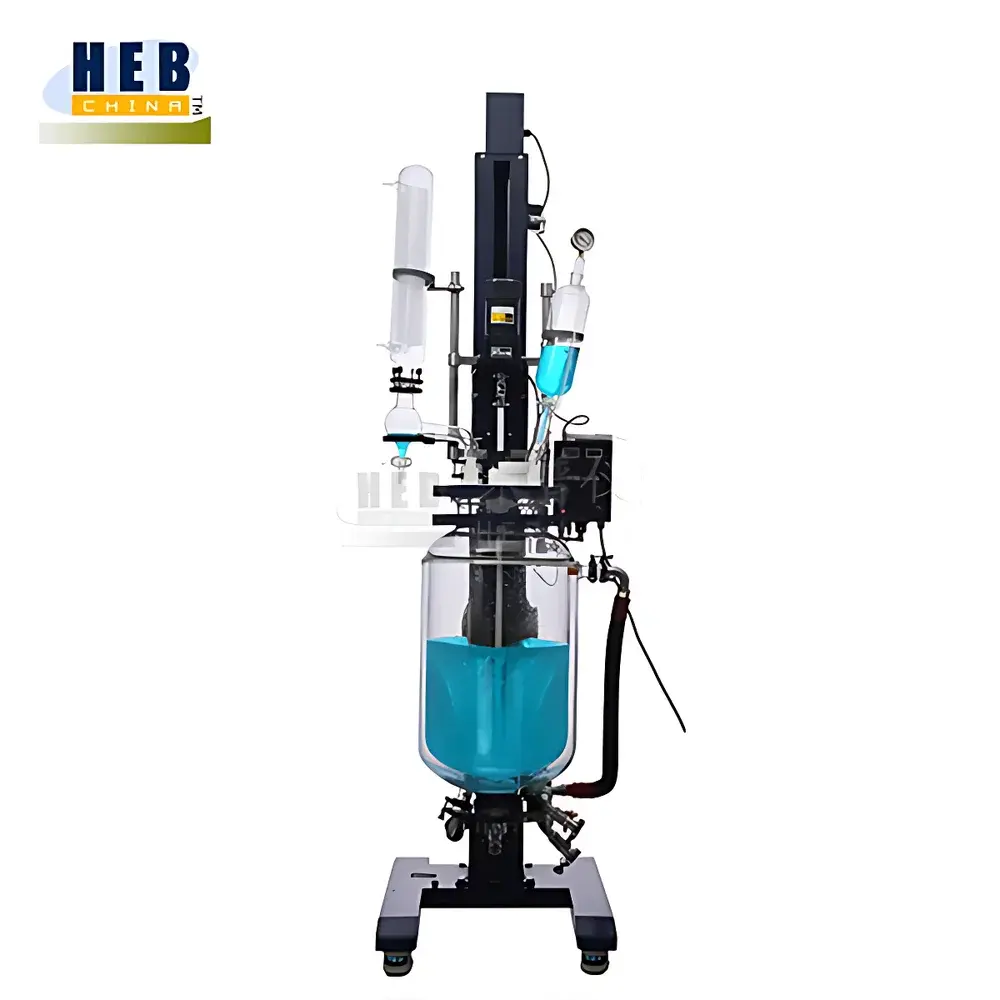
Jihepu SJHEB-10L Automatic Lifting Double-Jacketed Glass Reactor
| Brand | Jihepu |
|---|---|
| Origin | Shandong, China |
| Model | SJHEB-10L |
| Capacity | 10 L |
| Material | GG-17 borosilicate glass (3.3) |
| Operating Pressure Range | Ambient to –0.096 MPa (–96 kPa) |
| Jacket Service | Thermal oil or cryogenic fluid circulation |
| Stirring Motor | AC induction, frequency-controlled, 90–120 W |
| Speed Range | 0–900 rpm |
| Max Torque | 7200 g·cm |
| Glass Thermal Shock Resistance | ΔT ≤ 200 °C |
| Max Operating Temp | +300 °C |
| Min Operating Temp | –120 °C |
| Design Pressure | 0.4 MPa |
| Safe Working Pressure | 0.3 MPa |
| Sealing | Mechanical seal with PTFE-coated shaft and fluoropolymer gaskets |
| Vacuum Compatibility | Compatible with SHB-IIIA-type circulating water vacuum pumps |
Overview
The Jihepu SJHEB-10L Automatic Lifting Double-Jacketed Glass Reactor is an engineered platform for controlled chemical synthesis, process development, and laboratory-scale reaction optimization under variable thermal and pressure conditions. It operates on the principle of jacketed heat transfer—where a precisely regulated thermal medium (e.g., silicone oil, ethylene glycol/water mixtures, or liquid nitrogen coolant) circulates through the annular space between inner and outer glass walls—enabling accurate temperature control of the reaction mass from –120 °C to +300 °C. The reactor integrates vertical motorized lifting functionality for safe, repeatable access to the vessel interior during charging, sampling, or cleaning—eliminating manual hoisting and reducing operator exposure to hot/cold surfaces or reactive vapors. Its GG-17 borosilicate glass construction (DIN ISO 3585 compliant) ensures high chemical inertness, low thermal expansion (3.3 × 10⁻⁶/K), and mechanical robustness under thermal cycling and moderate vacuum. Designed for use in fine chemical synthesis, pharmaceutical process R&D, polymerization studies, and catalytic screening, the SJHEB-10L supports both atmospheric and reduced-pressure operation down to –0.096 MPa, facilitating solvent removal, azeotropic distillation, and moisture-sensitive reactions.
Key Features
- Motorized vertical lift mechanism with programmable height positioning and overload protection—enables reproducible alignment with condensers, addition funnels, or sampling ports.
- Frequency-controlled AC induction stirring system (90–120 W) delivering 0–900 rpm with constant torque output; brushless design eliminates sparking hazards and ensures long-term stability in continuous operation.
- PTFE-coated 321 stainless steel stirring shaft with dual mechanical seals—provides exceptional corrosion resistance against halogenated solvents, strong acids, and bases while maintaining vacuum integrity up to –0.096 MPa.
- Modular multi-port lid configuration (standard 4-port, optional 5- or 6-port) with standardized ISO-KF/NS taper joints (e.g., 50/40/34/19 mm) for seamless integration of reflux condensers, dropping funnels, thermowells, pH electrodes, or gas inlets.
- Bottom discharge assembly featuring PTFE-lined flanged valve and full-bore outlet—minimizes dead volume and enables complete evacuation of viscous, particulate-laden, or crystallizing reaction mixtures.
- Double-jacketed GG-17 glass vessel rated for 0.3 MPa safe working pressure and validated for ≥200 °C thermal shock—certified per ASTM E438 Type I, Class A specifications for laboratory glassware.
Sample Compatibility & Compliance
The SJHEB-10L accommodates heterogeneous, viscous, and gas-evolving reaction systems—including Grignard formations, hydrogenations, esterifications, and emulsion polymerizations—without material degradation or cross-contamination. Its all-glass wetted path (excluding stirrer shaft and seals) complies with USP and EP 3.2.1 requirements for extractables and leachables in non-metallic lab equipment. The mechanical sealing system meets ISO 20816-1 vibration severity thresholds for rotating equipment in GMP-aligned environments. When operated with optional pH probes and peristaltic feed pumps, the system supports automated reaction monitoring and reagent dosing traceable under FDA 21 CFR Part 11-compliant software protocols (when integrated with validated third-party control platforms). Vacuum performance is verified per ISO 21645 for low-pressure reactor applications.
Software & Data Management
While the base SJHEB-10L operates via standalone frequency converter and analog instrumentation, it is designed for integration with industrial-grade process controllers (e.g., Eurotherm, Watlow) or SCADA-compatible DAQ systems. Optional digital interfaces support RS485 Modbus RTU or Ethernet/IP communication for real-time logging of stir speed, jacket inlet/outlet temperatures, and vacuum level. All user-configurable parameters—including ramp rates, hold times, and safety interlocks—are stored with timestamped audit trails meeting GLP documentation standards. Data export conforms to CSV and Excel-compatible formats for downstream statistical process analysis (SPC) and regulatory submission packages.
Applications
- Process intensification studies in API intermediate synthesis under controlled exothermic conditions.
- Low-temperature lithiation and organolithium chemistry requiring cryogenic jacketing and inert atmosphere maintenance.
- Solvent-free condensation polymerizations with simultaneous vacuum-assisted volatiles removal.
- Teaching laboratories performing green chemistry experiments—e.g., microwave-assisted solvent extraction followed by rotary evaporation integration.
- Quality-by-Design (QbD) parameter mapping for DOE-based optimization of catalyst loading, stoichiometry, and residence time.
FAQ
What thermal media are compatible with the double jacket?
Silicone oil (up to 300 °C), 50/50 ethylene glycol/water (–20 to 120 °C), and specialized low-temperature heat transfer fluids (e.g., Dynalene HT-4000) down to –120 °C. Avoid halogenated solvents due to potential elastomer swelling in circulation seals.
Can the reactor be used under positive pressure?
It is rated for safe operation up to 0.3 MPa gauge pressure; however, standard configuration is optimized for ambient/vacuum service. Positive-pressure adaptation requires optional reinforced clamping hardware and pressure-rated sight glasses.
Is the lifting mechanism programmable?
Yes—the integrated stepper-motor-driven lift supports preset height memory (up to 3 positions) and synchronized movement with external PLCs via dry-contact inputs.
How is vacuum integrity verified during commissioning?
A helium leak test per ASTM E493 is recommended; typical leak rate is <1 × 10⁻⁸ mbar·L/s when assembled with fluoropolymer gaskets and properly torqued KF fittings.
What maintenance intervals are recommended for the mechanical seal?
Under continuous operation at ≤600 rpm and ≤80 °C, inspect seal faces and spring tension every 500 operational hours; replace PTFE components annually or after exposure to abrasive slurries.



