
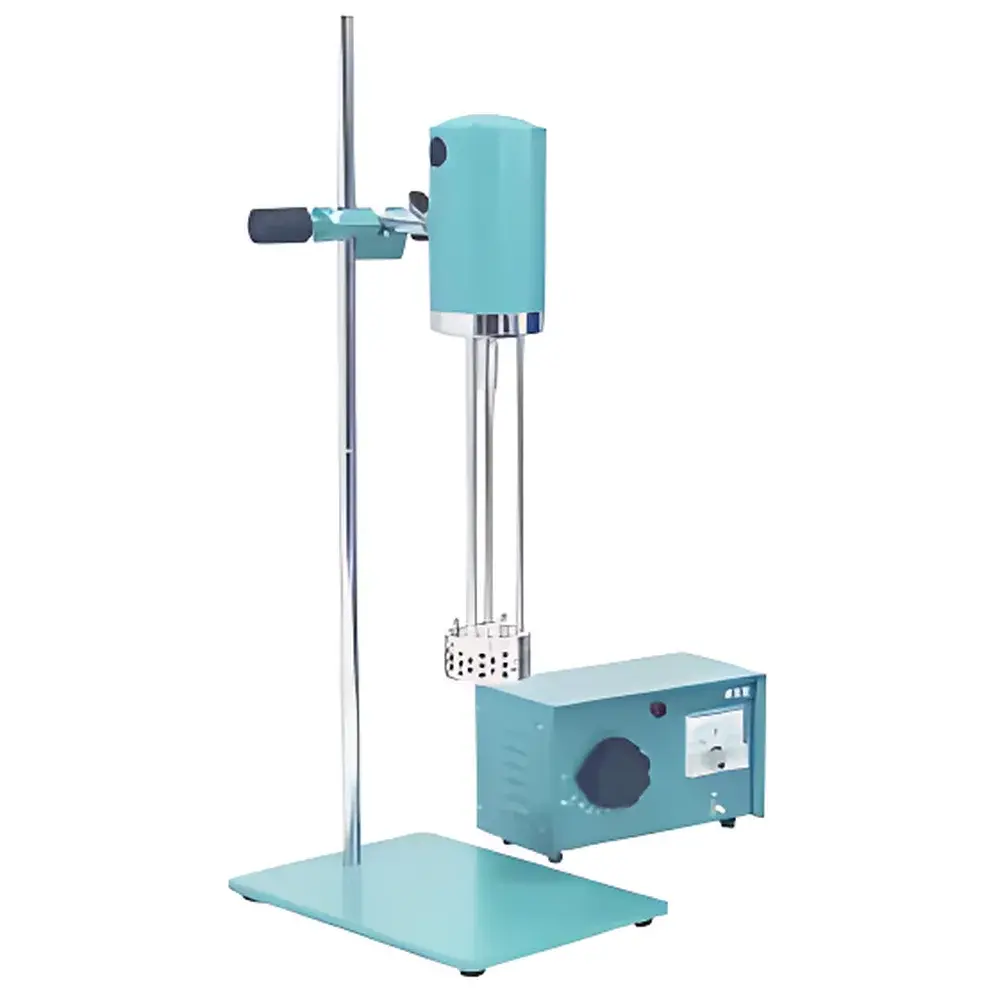
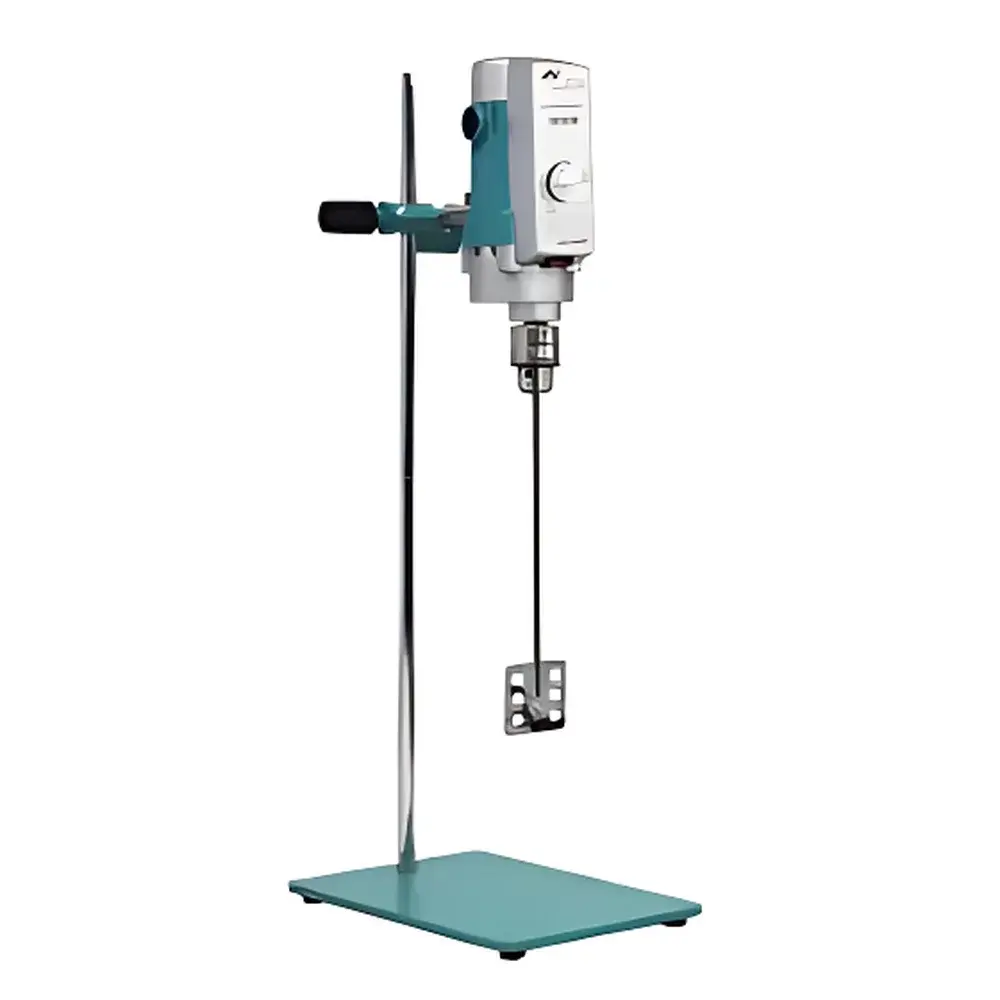
Jihepu AE300L-P Laboratory High-Shear Homogenizer
| Brand | Jihepu |
|---|---|
| Origin | Shandong, China |
| Model | AE300L-P |
| Instrument Type | Probe-type Rotor-Stator Homogenizer |
| Dimensions (W×D×H) | 215 × 310 × 720 mm |
| Weight | 13.8 kg (gross: 15.0 kg) |
| Processing Volume | 500–40,000 mL |
| Maximum Viscosity | 8,000 mPa·s |
| Speed Range | 200–12,000 rpm |
| Rotor Tip Speed | 19 m/s |
| Power Input | 510 W |
| Output Power | 300 W |
| Rated Torque | 22.1 N·cm |
| Operating Voltage | AC 220 V, 50/60 Hz |
| Duty Cycle | S1 (continuous) |
| Ambient Temperature Limit | ≤40 °C |
| Relative Humidity Limit | ≤80 % |
| Rotor/Stator Material | SS304 stainless steel |
| Rotor Diameter | 70 mm |
| Minimum Immersion Depth | 50 mm |
| Standard Stator Orifice Sizes | 5, 20, and 50 mm² |
Overview
The Jihepu AE300L-P Laboratory High-Shear Homogenizer is a rotor-stator based dispersion and emulsification system engineered for precision-controlled, batch-mode processing of heterogeneous liquid-liquid and solid-liquid systems. It operates on the principle of high-frequency mechanical shear generated within a precisely engineered narrow gap between a high-speed rotating rotor and a fixed stator. As material is drawn axially into the working chamber, centrifugal force accelerates it radially into the rotor-stator clearance—where intense hydrodynamic shear, turbulent flow, cavitation, and impact forces act simultaneously. This multi-mechanism energy input enables efficient droplet size reduction, particle deagglomeration, and phase stabilization in emulsions and suspensions. Designed for laboratory-scale formulation development and process optimization, the AE300L-P delivers reproducible results across diverse viscosities up to 8,000 mPa·s and volumes from 500 mL to 40 L—making it suitable for method transfer to pilot or production-scale equipment.
Key Features
- Variable-speed digital control with continuous 200–12,000 rpm adjustment and real-time current monitoring for process transparency and torque-based load assessment
- SS304 stainless steel rotor-stator assembly ensuring chemical compatibility with aqueous, mildly acidic/basic, and organic solvent-based formulations
- Three standard interchangeable stator orifices (5 mm², 20 mm², 50 mm²) enabling systematic optimization of shear intensity versus throughput
- Robust mechanical architecture with S1-rated continuous-duty motor and thermal protection circuitry for extended operational stability
- Modular probe design with 70 mm rotor diameter and minimum immersion depth of 50 mm—compatible with standard laboratory glassware including beakers, jacketed reactors, and conical flasks
- Compact footprint (215 × 310 × 720 mm) and low mass (13.8 kg) facilitating benchtop integration and mobility within regulated lab environments
Sample Compatibility & Compliance
The AE300L-P accommodates a broad range of sample types, including oil-in-water and water-in-oil emulsions, polymer dispersions, nanoparticle suspensions, pharmaceutical ointments, cosmetic creams, food sauces, pigment pastes, and functional coatings. Its construction meets general-purpose laboratory equipment safety requirements per IEC 61010-1. While not certified for GMP manufacturing use out-of-the-box, the unit supports GLP-aligned documentation practices when paired with validated SOPs and manual log entries. For regulated applications requiring audit trails (e.g., pharmaceutical preformulation), users may integrate external data loggers or connect the analog current output signal to LIMS-compatible acquisition systems. The device complies with electromagnetic compatibility standards EN 61326-1 for laboratory instrumentation.
Software & Data Management
The AE300L-P features an integrated digital speed controller with LED display and rotary encoder interface—providing tactile, non-touch operation suitable for glove-compatible environments. No proprietary software or PC connectivity is included; all parameters are set and monitored locally. However, the analog current output (0–10 V or 4–20 mA, configurable) allows connection to third-party data acquisition hardware for time-stamped recording of motor load profiles—a critical parameter for correlating energy input with emulsion stability or particle size distribution. When used in conjunction with laser diffraction analyzers or rheometers, the AE300L-P supports DOE-driven experimental design for establishing shear history–structure relationships under ISO 13320 or ASTM D445 standards.
Applications
This homogenizer is routinely deployed in formulation laboratories for: developing stable topical emulsions (e.g., sunscreens, moisturizers) per USP ; preparing model drug nanosuspensions for bioavailability studies; optimizing pigment dispersion in waterborne architectural paints per ASTM D1210; generating reference standards for particle size method validation; reducing viscosity of high-solids battery electrode slurries; and producing uniform microbial culture media emulsions. Its scalability—through consistent rotor tip speed and specific energy input (kWh/m³)—enables direct correlation with industrial-scale colloid mills or high-pressure homogenizers operating under comparable hydrodynamic conditions.
FAQ
What is the recommended maintenance schedule for the rotor-stator assembly?
Inspect the rotor and stator surfaces for wear or pitting after every 50 hours of cumulative operation. Clean thoroughly with ethanol or acetone post-use; avoid abrasive scrubbing. Replace both components as a matched pair if groove depth exceeds 0.1 mm.
Can the AE300L-P handle abrasive slurries containing ceramic or metal particles?
It is not recommended for highly abrasive particulates (>5 µm, >10 wt%) without prior testing. SS304 erosion rates increase significantly above 3,000 mPa·s viscosity with hard-phase loading; consider tungsten carbide-coated alternatives for such applications.
Is the unit compatible with explosion-proof environments?
No. The motor and control electronics are not rated for hazardous locations (ATEX/IECEx). Use only in well-ventilated, non-classified laboratory spaces.
How does rotor tip speed relate to emulsion droplet size?
Empirical studies show that droplet size d₅₀ scales approximately with v⁻⁰·⁴⁵ (where v = tip speed in m/s) under constant stator geometry and concentration—validating the AE300L-P’s 19 m/s capability for submicron emulsions in low-viscosity systems.
Does the device support IQ/OQ documentation templates?
Jihepu provides basic technical specifications and electrical schematics upon request. Full qualification packages—including test protocols, calibration certificates, and traceable performance verification—are user-developed per internal quality systems or contracted to third-party validation service providers.



