
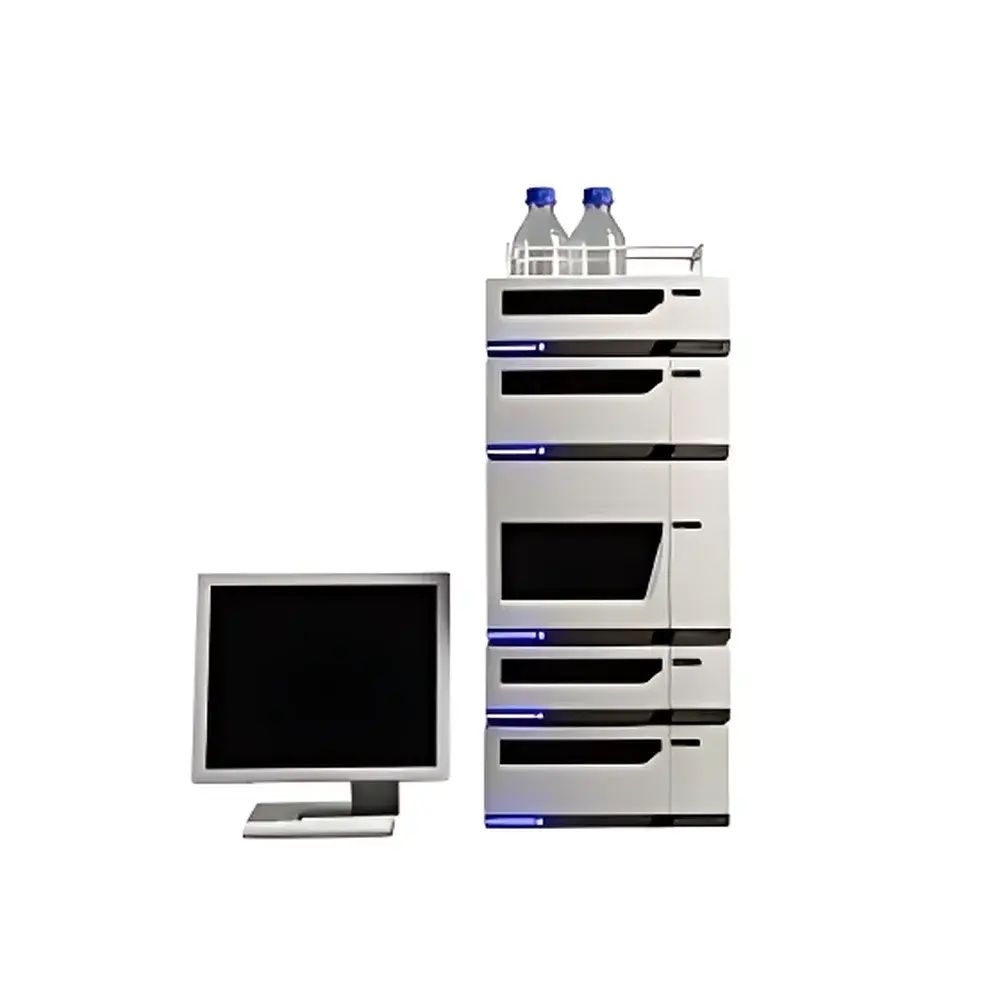
iChrom 5100 High-Performance Liquid Chromatograph
| Origin | Shandong, China |
|---|---|
| Manufacturer Type | Authorized Distributor |
| Origin Category | Domestic (China) |
| Model | iChrom 5100 |
| Price Range | USD 14,000 – 28,000 |
| Instrument Type | Conventional HPLC System |
| Flow Rate Range | 0.001–10.000 mL/min |
| Maximum Pressure | 40 MPa |
| Sample Tray Capacity | 4 mL vial format (compatible with 72-well, 96-well, and 120-well trays) |
| Injection Volume Range | 1–50 µL |
| Column Oven Temperature Range | 5 °C above ambient to 85 °C |
| UV-Vis Wavelength Range | 190–700 nm |
| Data Acquisition Rate | 100 Hz |
Overview
The iChrom 5100 High-Performance Liquid Chromatograph is a modular, CE-compliant HPLC system engineered for precision, reproducibility, and long-term operational stability in regulated and research laboratory environments. Built upon a unified hardware architecture, it employs gradient-capable dual-pump modules, a high-sensitivity UV-Vis absorbance detector with motor-driven grating monochromator, a temperature-controlled column oven with digital PID regulation, and an integrated autosampler featuring simultaneous syringe-and-tray motion mechanics. The system operates on reversed-phase, normal-phase, ion-exchange, and size-exclusion chromatographic principles—supporting isocratic, binary high-pressure gradient, and quaternary low-pressure gradient elution modes. Its design adheres to core analytical requirements defined in ISO/IEC 17025, USP , and ICH Q2(R2) guidelines for method validation, making it suitable for QC release testing, stability studies, impurity profiling, and pharmaceutical assay development.
Key Features
- Modular “Mother-Board + Daughter-Board” electronics architecture enabling seamless firmware upgrades, cross-unit communication via SPI/I²C buses, and LAN/RS485 connectivity for networked lab deployment.
- Autosampler with dual-motion mechanism (tray + needle), optimized tubing layout, and compatibility with 72-position vial racks, 96-well microplates, and 120-position trays—ensuring robust sample handling across diverse throughput demands.
- UV-Vis detector featuring direct-drive grating actuation (replacing legacy sine-bar mechanisms), imported deuterium and tungsten lamps, and high-quality holographic gratings—delivering wavelength accuracy ±1 nm, repeatability 2.5 AU.
- Low-pulsation binary pump with monolithic cam design, active pulse damping, and position-sensing feedback—achieving flow precision ≤±0.1% RSD at 0.2 mL/min and pressure stability ≤±0.2 MPa over 24 h.
- Column oven utilizing AC phase-angle modulation for power control resolution of 1/65,000, enabling ramp rates up to 10 °C/min and thermal uniformity ±0.3 °C across 30 × 150 mm columns.
- Comprehensive leak detection system with multi-zone fluidic sensors and micro-switch-based door interlock—triggering audible, visual, and software-based alerts upon anomaly detection.
Sample Compatibility & Compliance
The iChrom 5100 supports standard 3.9–4.6 mm ID analytical columns (up to 250 mm length) and accommodates both stainless-steel and PEEK-lined flow paths. It complies with key regulatory expectations for instrument qualification: IQ/OQ/PQ protocols are supported through built-in self-diagnostic routines, audit-trail-enabled event logging, and electronic signature capability per FDA 21 CFR Part 11 when used with the iChrom W5100 workstation. All hardware modules meet IEC 61010-1 safety standards; electrical components conform to RoHS 2011/65/EU. The system is validated for use in GLP-compliant laboratories and aligns with Annex 11 (EU GMP) requirements for computerized system validation.
Software & Data Management
The iChrom W5100 Chromatography Data System (CDS) is a validated, database-driven platform designed in accordance with the “Technical Requirements for Chromatographic Data Workstations in Pharmaceutical Research” (NMPA Guidance, 2020). It provides full lifecycle data governance—including user role-based access control, immutable audit trails, electronic signatures, and time-stamped revision history. The CDS supports real-time bidirectional control of all instrument modules, automated sequence execution, peak integration using multiple algorithms (tangent skim, valley-to-valley, exponential curve fit), and customizable report templates compliant with ALCOA+ principles. Raw data files (.ichd) are stored in vendor-neutral HDF5 format with embedded metadata (instrument parameters, method settings, calibration records), ensuring long-term readability and traceability.
Applications
- Pharmaceutical quality control: assay quantitation, related substances analysis, dissolution testing, and cleaning validation swab extracts.
- Food & beverage safety: pesticide residue screening, mycotoxin detection, vitamin profiling, and preservative quantification.
- Environmental monitoring: PAHs, PCBs, phenolic compounds, and emerging contaminants in water and soil extracts.
- Academic and industrial research: natural product isolation, polymer characterization, chiral separations, and biomarker discovery in biological matrices.
- Contract laboratories: multi-client method transfer, system suitability verification, and routine batch release testing under ISO/IEC 17025 accreditation.
FAQ
Does the iChrom 5100 support 21 CFR Part 11 compliance?
Yes—when operated with the iChrom W5100 CDS configured with password-protected user roles, electronic signatures, and enabled audit trail logging, the system meets technical and procedural requirements for Part 11 compliance.
Can the system perform gradient elution with four solvents?
Yes—the quaternary low-pressure gradient module supports independent control of four mobile phase channels, with programmable solvent composition ramps and dwell volume compensation.
What is the minimum injection volume and its precision?
The autosampler achieves 1 µL injections with ≤1.5% RSD (n=6) at 5 µL and ≤0.8% RSD at ≥10 µL, verified per USP system suitability criteria.
Is remote monitoring and control possible?
Yes—via Ethernet interface and RESTful API support, users can initiate sequences, monitor real-time pressure/flow/wavelength status, and retrieve raw data from centralized LIMS or ELN platforms.
How is column oven temperature stability verified during qualification?
The system includes built-in PT100 sensor diagnostics and supports external calibration using NIST-traceable dry-block calibrators; temperature uniformity maps are generated per ASTM E2203-20 protocols.




