
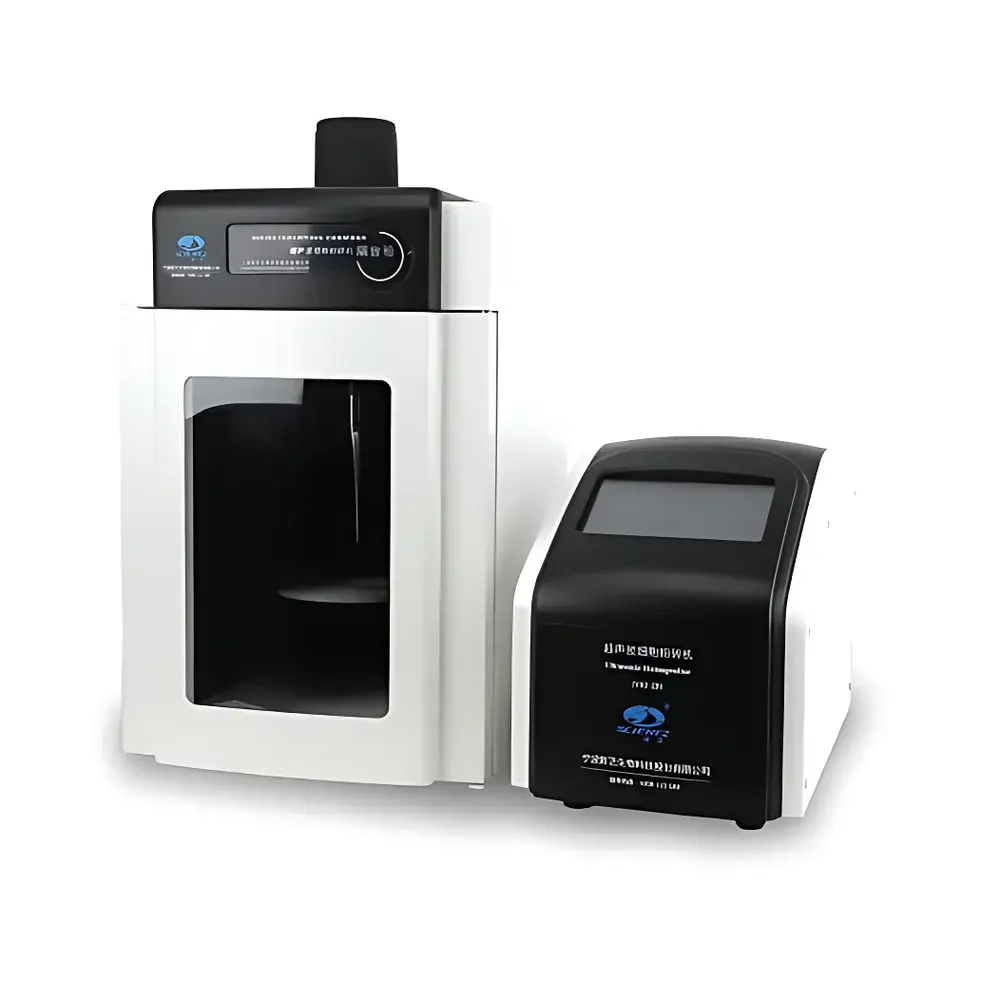
JY98-IIIDN Ultrasonic Cell Disruptor
| Origin | Zhejiang, China |
|---|---|
| Manufacturer Type | Authorized Distributor |
| Origin Category | Domestic (PRC) |
| Model | JY98-IIIDN |
| Instrument Type | Ultrasonic Homogenizer / Cell Disruptor |
| Sample Suitability | Soft to semi-soft biological materials (tissues, cells, bacteria, viruses, plant extracts) |
| Feed Particle Size | <15 mm |
| Output Particle Size Distribution | D90 ≥ 0.5 mm (post-processing suspension homogeneity dependent) |
| Batch Processing Volume | 50–1000 mL |
| Nominal Ultrasonic Frequency | 19.5–20.5 kHz |
| Power Output Range | 1200 W (adjustable from 20% to 99% in 1% increments) |
| Display | Backlit LCD with real-time parameter monitoring |
| Pulse Mode | Adjustable on/off duration (0.1–99.9 s resolution) |
| Duty Cycle | 0.1–99.9% |
| Temperature Monitoring | Integrated sensor with audible/visual overheat alarm (user-set threshold) |
| Standard Horn | Φ20 mm titanium alloy probe |
| Optional Horns | Φ15 mm and Φ25 mm |
| Host Dimensions (W×D×H) | 400 × 280 × 220 mm |
| Net Weight | 12.1 kg |
| Host + Transducer Weight | 14.5 kg |
| Soundproof Enclosure Dimensions (W×D×H) | 534 × 295 × 435 mm |
| Compliance | CE-marked per EN 61000-6-2/6-4 |
Overview
The JY98-IIIDN Ultrasonic Cell Disruptor is an engineered benchtop system designed for controlled mechanical lysis of biological samples through high-intensity ultrasonic cavitation. Operating within a narrow frequency band of 19.5–20.5 kHz, the instrument generates transient microbubbles in liquid media whose implosive collapse delivers localized shear forces, hydrodynamic shockwaves, and microstreaming—mechanisms proven effective for membrane disruption, organelle release, and intracellular content extraction. Unlike rotor-stator homogenizers or bead mills, this system avoids thermal degradation risks associated with prolonged frictional heating when used with appropriate duty cycling and temperature monitoring. It is purpose-built for reproducible sample preparation in upstream bioprocessing, nucleic acid/protein isolation workflows, nanoparticle dispersion, and reaction acceleration in synthetic biology applications.
Key Features
- Microprocessor-controlled ultrasonic generator with real-time feedback loop ensuring stable amplitude output across variable load conditions
- Backlit LCD interface displaying instantaneous power (%), elapsed time, pulse status, duty cycle, and internal temperature
- Stepless amplitude modulation from 20% to 99% in 1% increments—enabling fine-tuned optimization for sensitive samples such as primary neurons or lipid vesicles
- Pulse mode operation with independent adjustment of sonication duration (on-time) and rest interval (off-time), both programmable to 0.1-second resolution
- Integrated temperature sensor with configurable alarm threshold and automatic shutdown to prevent thermal denaturation of labile biomolecules
- Robust titanium alloy horn assembly (standard Φ20 mm) with optional diameters (Φ15 mm for low-volume precision work; Φ25 mm for high-throughput suspensions)
- Modular design compatible with optional acoustic enclosure (534 × 295 × 435 mm) meeting ISO 7196 noise attenuation requirements for shared laboratory environments
Sample Compatibility & Compliance
The JY98-IIIDN is validated for use with soft biological matrices including cultured mammalian cells, yeast, bacterial pellets, plant leaf homogenates, and soft animal tissues (e.g., liver, spleen). Its non-invasive energy delivery avoids metal ion leaching common in bead-beating methods—critical for downstream applications such as mass spectrometry or enzymatic assays. The system complies with electromagnetic compatibility (EMC) directives EN 61000-6-2 (immunity) and EN 61000-6-4 (emission), and its electrical safety meets IEC 61010-1 standards for laboratory equipment. While not certified under FDA 21 CFR Part 11, audit-ready operational logs—including timestamped power settings, total sonication time, and thermal events—can be manually documented to support GLP-aligned workflows in academic and industrial R&D settings.
Software & Data Management
The device operates via embedded firmware without external PC dependency. All critical parameters—including amplitude setpoint, pulse profile, total run time, and thermal alerts—are retained in non-volatile memory across power cycles. Though no proprietary software suite is provided, users may integrate the unit into automated protocols using TTL-triggered external start/stop signals (available via rear-panel I/O port). For quality assurance documentation, laboratories routinely pair the JY98-IIIDN with calibrated thermocouple probes and digital timers to generate traceable SOP records compliant with ISO/IEC 17025 method validation requirements.
Applications
- Cell lysis for genomic DNA, plasmid, and total RNA extraction in molecular biology labs
- Preparation of subcellular fractions (mitochondria, nuclei) requiring minimal proteolytic activation
- Nanomaterial dispersion in aqueous or organic solvents for TEM sample preparation and colloidal stability studies
- Accelerated solvent extraction of phytochemicals (e.g., polyphenols, alkaloids) from plant tissues
- Emulsification of oil-in-water systems for pharmaceutical nanoemulsion development
- Disaggregation of protein aggregates during refolding optimization studies
FAQ
What is the maximum recommended continuous operating time per cycle?
For thermal management and transducer longevity, continuous mode is limited to ≤5 minutes per cycle; extended processing requires pulse mode with ≥1:1 duty ratio.
Can the JY98-IIIDN be used for cryogenic sonication?
No—it is not rated for sub-zero ambient or sample temperatures; condensation ingress may compromise electrical insulation integrity.
Is calibration certification available from the manufacturer?
Factory calibration certificates (power output verification at 20%, 50%, and 99% setpoints) are provided upon request and comply with JJG 798–2010 national metrological verification regulations (PRC).
How often should the titanium horn be inspected for erosion?
Visual inspection is recommended after every 50 hours of cumulative operation; tip pitting exceeding 0.2 mm depth necessitates replacement to maintain acoustic coupling efficiency.
Does the system support remote monitoring via Ethernet or USB?
No native network interface is included; however, analog voltage outputs (0–5 V) corresponding to power level and temperature are accessible via terminal block for third-party DAQ integration.



