
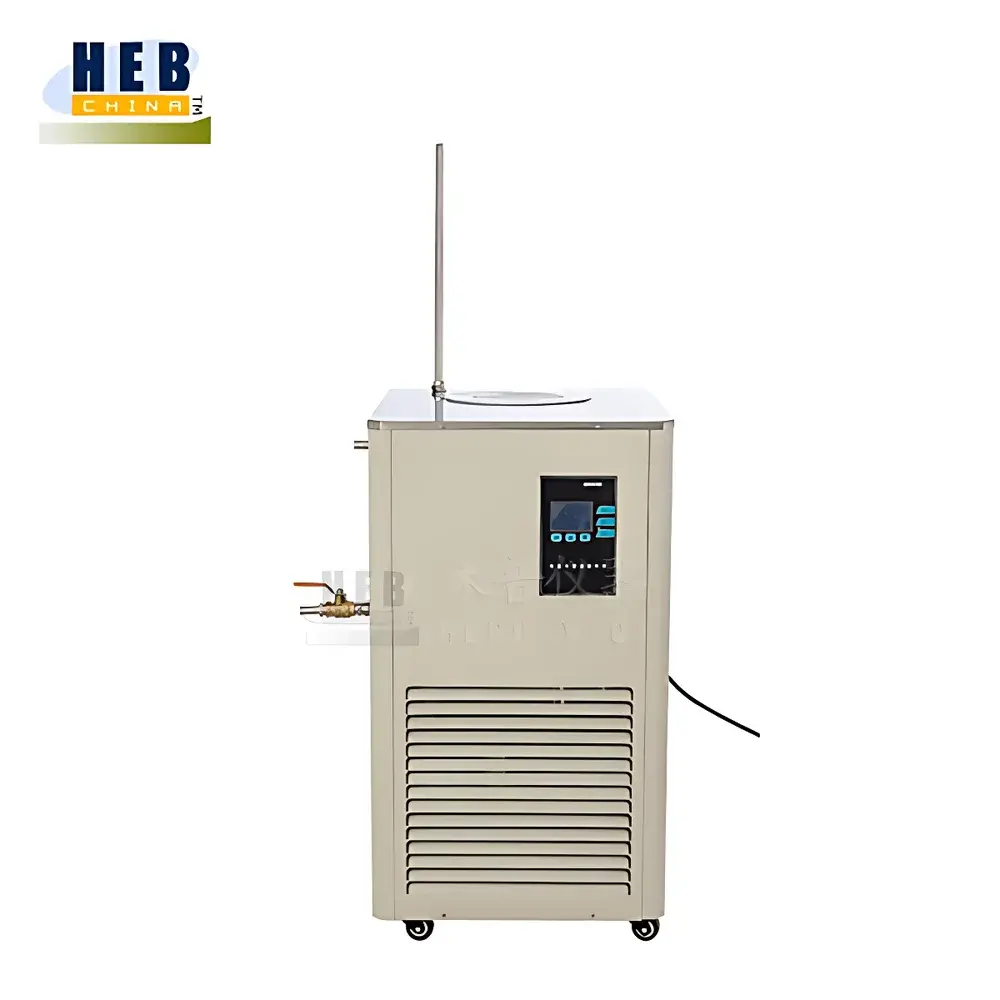
Hebei Jihepu DLSB-20/120 Integrated Circulating Chiller
| Brand | Jihepu |
|---|---|
| Origin | Shandong, China |
| Model | DLSB-20/120 |
| Instrument Type | Integrated Unit |
| Cooling Method | Water-Cooled (with Air-Cooled Condenser) |
| Temperature Range | −120 °C to Ambient +5 °C |
| Operating Ambient Temperature Range | 5–35 °C |
| Temperature Stability | ±0.1 °C |
| Refrigeration Capacity | 20,916 W |
| Circulating Pump Flow Rate | 20–40 L/min |
| Maximum Pump Pressure | ≤0.4 MPa |
| Reservoir Volume | 20 L |
| Power Supply | 220 V AC, 50 Hz |
| Total Power Consumption | 6973 W |
| Compressor Power | 6615 W (3 HP × 3 units) |
| Pump Power | 100 W |
| Pump Head | 4–6 m |
| Refrigerant | R22 |
| Condenser | Air-Cooled, 258 W, 22 m² Heat Exchange Area, 4580 m³/h Airflow |
| Reservoir Dimensions | Φ300 × 300 mm (~21 L usable) |
| Internal Clearance | Φ250 mm |
| External Port | Φ16 mm barbed fitting (left side) |
| Enclosure Material | Powder-Coated Cold-Rolled Steel |
| Display | LCD with Keypad Interface |
| Safety Protections | Delayed Start, Overcurrent, Overtemperature |
| Sensor | PT100 Platinum Resistance Thermometer |
| Working Mode | Continuous Operation |
| Relative Humidity Limit | ≤70 % RH |
| Packaging | Wooden Crate, 1060 × 850 × 1370 mm, 1.24 m³ |
Overview
The Hebei Jihepu DLSB-20/120 Integrated Circulating Chiller is a high-capacity, low-temperature refrigeration system engineered for sustained thermal management in demanding laboratory applications. It employs a cascade mechanical refrigeration architecture utilizing R22 refrigerant and three independent 3 HP compressors to achieve a stable operating range from −120 °C up to ambient +5 °C. Unlike single-stage chillers, the DLSB-20/120’s multi-compressor design enables improved thermal stability and extended low-temperature duty cycles—critical for cryogenic reaction control, vacuum distillation condensation, and long-duration synthesis protocols. The unit integrates a 20 L stainless-steel-lined reservoir with internal copper-nickel plated cooling coils, an air-cooled condenser (22 m² surface area, 4580 m³/h airflow), and a high-flow, pressure-regulated circulation pump. Its closed-loop operation delivers precise, repeatable temperature control (±0.1 °C) across external loads—including jacketed reactors, rotary evaporators, cold traps, and analytical instrument cooling jackets—without requiring external water infrastructure.
Key Features
- Triple-compressor cascade refrigeration system rated at 20,916 W total cooling capacity, enabling reliable operation down to −120 °C
- Integrated 20 L reservoir with nickel-plated copper coil heat exchanger and PT100-based digital temperature feedback loop
- High-efficiency circulation pump delivering 20–40 L/min flow at ≤0.4 MPa maximum pressure and 4–6 m head—optimized for low-resistance external loops
- LCD interface with keypad control, real-time display of setpoint, actual bath temperature, compressor status, and fault codes
- Comprehensive safety architecture including delayed startup, overcurrent protection, overtemperature cutoff, and automatic compressor staging
- Robust enclosure constructed from powder-coated cold-rolled steel with corrosion-resistant internal components and sealed electrical compartments
- Front-accessible barbed outlet (Φ16 mm) and return port, compatible with standard silicone or fluoropolymer tubing (e.g., Viton® or PFA)
Sample Compatibility & Compliance
The DLSB-20/120 is designed for indirect cooling of process fluids and equipment—not direct sample immersion. It interfaces seamlessly with common lab apparatus via standard 1/2″–3/4″ NPT or barbed fittings, including double-jacketed glass reactors (e.g., 5–50 L volume), rotary evaporators (up to 50 L flask capacity), reflux condensers, and GC/FID detector coolers. While not certified to ISO/IEC 17025 or FDA 21 CFR Part 11 out-of-the-box, its digital temperature logging capability (via optional RS485 or analog 4–20 mA output) supports GLP/GMP-aligned documentation when integrated into validated lab networks. All electrical components comply with IEC 61010-1:2010 safety standards for laboratory equipment. Refrigerant handling follows ASHRAE Standard 15 and local EPA Section 608 requirements.
Software & Data Management
The DLSB-20/120 operates as a standalone controller with no embedded PC or proprietary software stack. Temperature setpoints, operational status, and alarm history are managed locally via the front-panel LCD and keypad. For integration into centralized monitoring systems, optional analog outputs (0–5 V or 4–20 mA) provide continuous temperature and pump status signals. RS485 Modbus RTU communication (addressable, baud rate configurable) allows bidirectional control—including remote setpoint adjustment, pump on/off commands, and real-time fault reporting—when interfaced with SCADA, LabVIEW, or custom Python-based data acquisition platforms. Audit trails require external logging; no built-in timestamped event history or electronic signature functionality is included.
Applications
- Cooling jacketed reactors during exothermic Grignard, lithiation, or nitration reactions requiring sub-0 °C thermal control
- Condensing solvent vapors in rotary evaporation systems using low-boiling solvents (e.g., diethyl ether, pentane, THF)
- Maintaining cryogenic trap temperatures in vacuum manifold setups for solvent recovery or gas purification
- Stabilizing detector and column oven temperatures in gas chromatography systems under variable ambient conditions
- Providing consistent coolant supply to laser Doppler vibrometers, FTIR spectrometer beam paths, or CCD camera housings
- Supporting low-temperature crystallization studies and polymorph screening protocols where ±0.1 °C stability directly impacts nucleation kinetics
FAQ
What is the minimum achievable temperature with the DLSB-20/120 under typical lab conditions (25 °C ambient)?
At 25 °C ambient and 60% relative humidity, the unit achieves −118 °C to −120 °C in the reservoir after 4–6 hours of stabilization, assuming no external load and proper ventilation.
Can this chiller be used with ethylene glycol/water mixtures?
Yes—compatible with aqueous glycol solutions up to 30% v/v; higher concentrations may reduce heat transfer efficiency and require recalibration of the PT100 sensor offset.
Is the reservoir accessible for cleaning or fluid replacement?
Yes—the top cover is removable, exposing the full reservoir interior; drain valve is located at the lowest point of the base chassis.
Does the unit include insulation for the external circulation lines?
No—external line insulation must be provided by the end user to minimize heat ingress and condensation, especially below 0 °C operation.
What maintenance intervals are recommended for optimal performance?
Compressor oil and refrigerant levels should be verified annually; air-cooled condenser coils require biweekly dust removal; pump impeller inspection is advised every 12 months under continuous use.



