
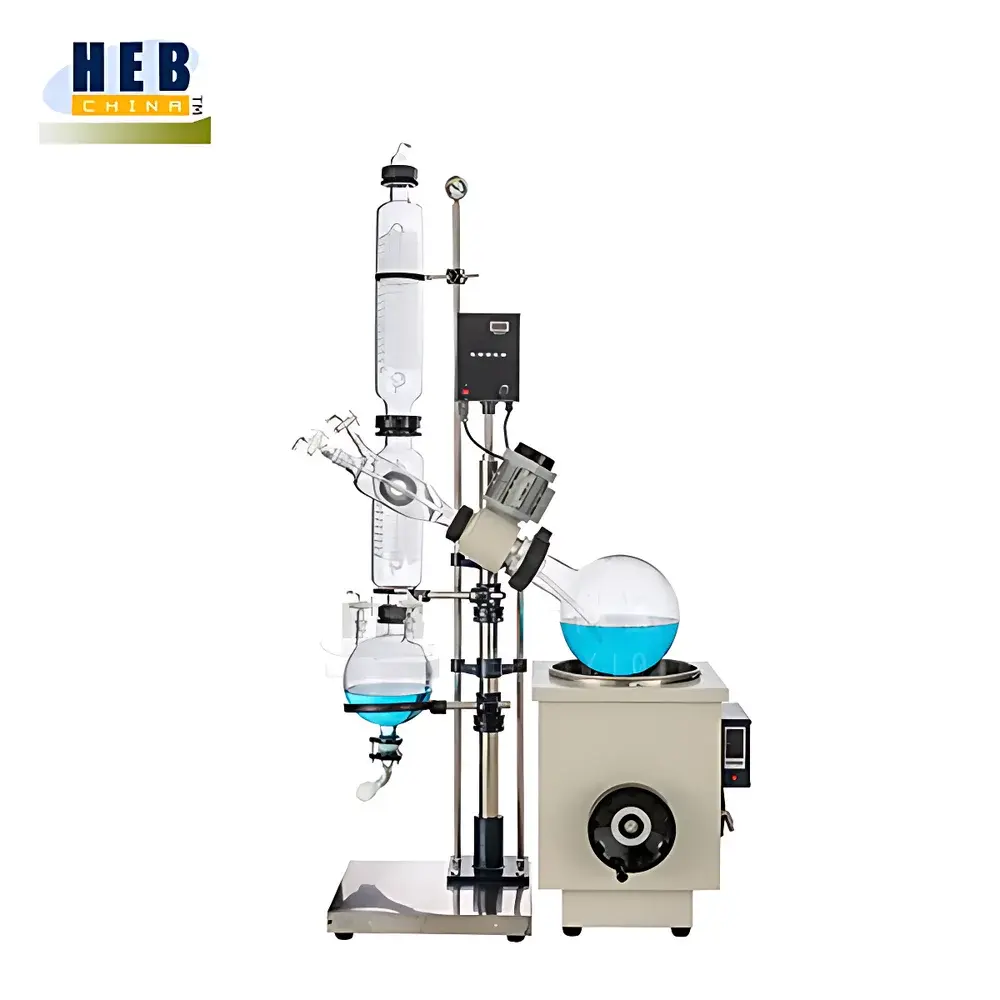
English Product Name
| Brand | Jihepu |
|---|---|
| Origin | Shandong, China |
| Model | RE-1002 |
| Capacity | 10 L |
| Ultimate Vacuum | 0.098 MPa |
| Rotational Speed | 0–120 rpm (frequency-controlled, digital display) |
| Heating Bath Temperature Range | Room temperature to 400 °C |
| Temperature Control Accuracy | ±1 °C |
| Condenser Cooling Area | 0.11 m² |
| Power Supply | 220 V / 50 Hz (optional 110 V / 60 Hz) |
| Heating Power | 3 kW |
| Motor Power | 120 W |
| Bath Volume | ~21 L |
| Overall Dimensions (L×W×H) | 970 × 480 × 1950 mm |
| Net Weight | 106 kg |
Overview
The Jihepu RE-1002 10L Rotary Evaporator is an engineered solution for efficient solvent removal, concentration, and purification under reduced pressure in research laboratories and pilot-scale production environments. It operates on the principle of thin-film evaporation: a motor-driven rotating flask spreads sample liquid into a uniform, high-surface-area film along the inner wall; simultaneous vacuum application lowers the boiling point of solvents, while precise thermal energy from a digitally controlled oil or water bath enables rapid, gentle, and reproducible evaporation. Designed for compatibility with heat-sensitive compounds—including pharmaceutical intermediates, natural product extracts, and biopolymer solutions—the system employs all-GG-17 borosilicate glass components (rated for −80 °C to +250 °C) and PTFE-sealed joints to ensure chemical inertness, thermal stability, and long-term vacuum integrity up to 0.098 MPa (≈2 mbar absolute). Its modular architecture supports integration with external chillers, vacuum controllers, and solvent recovery traps—making it suitable for GLP-compliant workflows and scalable process development.
Key Features
- Stainless steel and aluminum alloy support frame ensures structural rigidity, corrosion resistance, and ergonomic height adjustability via manual handwheel (0–180 mm travel).
- Double-condenser configuration: vertical triple-coil primary condenser (Φ120 × 640 mm) paired with auxiliary condenser (Φ135 × 470 mm) maximizes vapor capture efficiency and solvent recovery yield.
- Frequency-controlled DC motor delivers smooth, stepless rotation (0–120 rpm) with digital speed readout and intuitive rotary knob adjustment—minimizing mechanical vibration and improving film uniformity.
- Intelligent heating bath with K-type thermocouple feedback, digital PID control, and ±1 °C temperature accuracy across 0–400 °C range; stainless steel bath pot (Φ350 × 220 mm, ~21 L capacity) enables stable thermal mass for large-volume processing.
- Multi-point PTFE/FKM composite sealing system maintains high vacuum performance and resists swelling when exposed to aggressive organic solvents (e.g., chloroform, THF, ethyl acetate).
- Dedicated standardized ground-glass interfaces: 34/19/24 standard taper ports for feed, temperature sensing, and venting; Φ50 mm PTFE discharge valve with bottom-release function facilitates quantitative collection of concentrated residue without disassembly.
- Integrated safety protections include thermal cutoff fuse, overtemperature alarm, and automatic power-off on abnormal current draw.
Sample Compatibility & Compliance
The RE-1002 accommodates a broad spectrum of sample matrices—from aqueous buffers and ethanol-based botanical extracts to viscous polymer solutions and low-volatility silicone oils—provided they remain chemically compatible with GG-17 glass and PTFE. Its construction adheres to general laboratory equipment safety standards (IEC 61010-1) and supports traceable operation in regulated environments. While not pre-certified for FDA 21 CFR Part 11, its digital temperature and rotation logging capability (when paired with external data acquisition systems) permits implementation of audit trails required under GLP and GMP frameworks. All wetted surfaces are non-metallic and extractables-free, aligning with USP material suitability expectations for pharmaceutical use.
Software & Data Management
The RE-1002 operates as a standalone instrument with embedded microcontroller-based logic—no proprietary software is required for basic operation. However, analog output signals (0–10 V or 4–20 mA) for bath temperature and rotational speed are available upon request for integration into centralized lab automation platforms (e.g., LabVIEW, DeltaV, or custom SCADA). Optional RS-485 Modbus RTU interface enables remote parameter setting, real-time monitoring, and event logging—supporting SOP-driven batch documentation and electronic record retention per ALCOA+ principles.
Applications
- Solvent removal from reaction mixtures post-synthesis (e.g., removal of dichloromethane after Grignard workup).
- Concentration of heat-labile biomolecules—including peptides, enzymes, and nucleic acid preparations—without denaturation.
- Recovery and recycling of high-purity solvents (e.g., acetone, methanol, hexane) in compliance with ISO 14001 waste minimization objectives.
- Preparative-scale isolation of active pharmaceutical ingredients (APIs) from crude extracts using fractional evaporation protocols.
- Removal of residual moisture from lyophilized intermediates prior to final packaging.
- Standardized evaporation steps in ASTM D2879 (vapor pressure of liquids) and ISO 661 (preparation of test samples for fat analysis) method adaptations.
FAQ
What vacuum level is required for optimal performance?
The system achieves stable operation at ≤0.098 MPa (≤2 mbar absolute), which is sufficient for most low-to-medium boiling point solvents (bp < 150 °C at 1 atm). For high-boiling solvents (e.g., DMF, DMSO), coupling with a secondary cold trap or vacuum controller is recommended.
Can the RE-1002 be used with corrosive solvents like hydrochloric acid or bromine?
No. While PTFE seals resist many organics, halogenated acids and strong oxidizers will degrade both glass and elastomer components. Use only with solvents listed in Corning’s GG-17 compatibility chart.
Is automatic bath lift functionality available?
The standard model features manual handwheel lift. An optional motorized vertical lift (0–180 mm, programmable stop positions) can be specified at time of order.
What cooling media are compatible with the condenser?
Standard operation uses tap water or recirculating chillers (−10 °C to +25 °C). For low-boiling solvents (e.g., diethyl ether), a cryogenic coolant (e.g., dry ice/acetone slurry) may be circulated through the dual condenser jacket—subject to seal temperature limits.
Does the unit comply with CE or UL certification requirements?
The base configuration meets IEC 61010-1 general safety requirements. CE marking requires end-user responsibility for full system integration and local regulatory validation; UL listing is available under custom OEM agreement.
Related Products



