
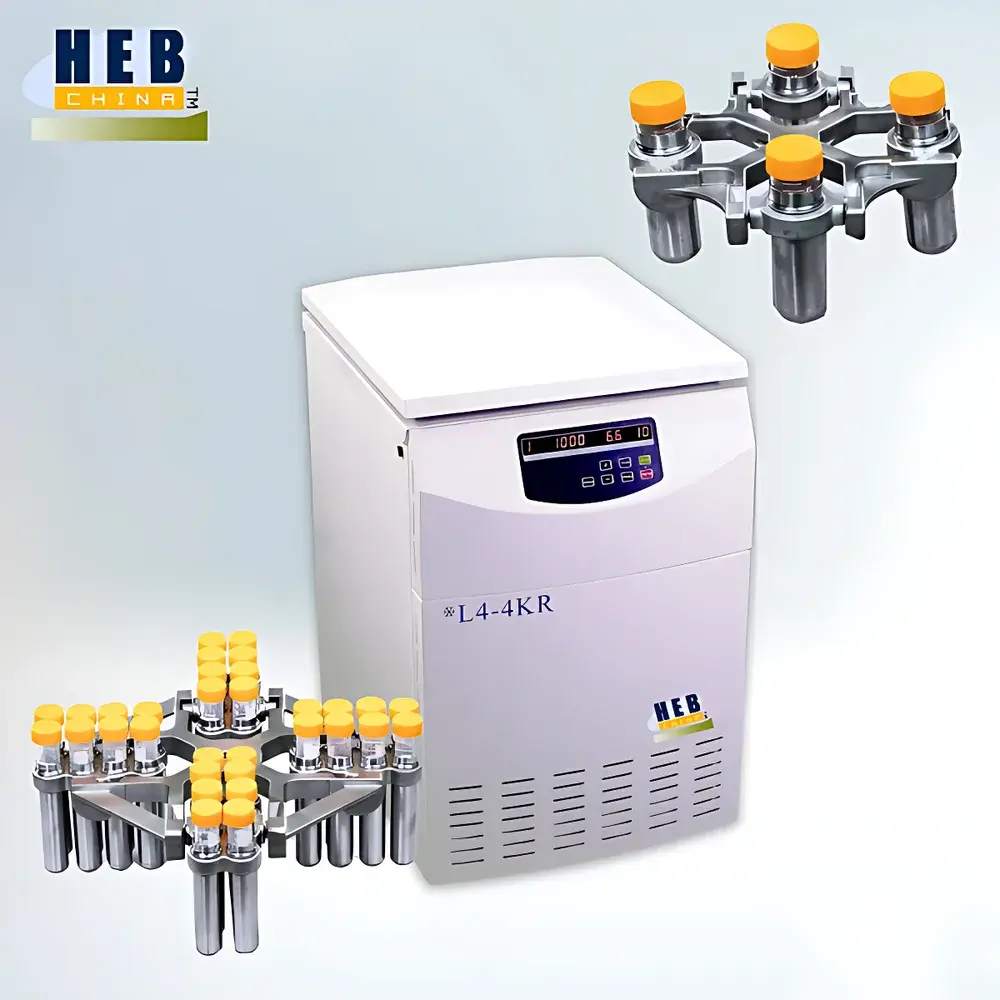
HePu L4-4KR Floor-Standing Low-Speed Refrigerated Centrifuge
| Brand | HePu (Jihepu) |
|---|---|
| Origin | Shandong, China |
| Model | L4-4KR |
| Type | Floor-standing refrigerated centrifuge |
| Maximum Speed | 5000 rpm |
| Maximum RCF | 4390 × g |
| Maximum Capacity | 4 × 750 mL |
| Temperature Range | −20 °C to +40 °C |
| Temperature Accuracy | ±1.0 °C |
| Timer Range | 1 min to 99 min 59 s |
| Speed Accuracy | ±20 rpm |
| Noise Level | ≤65 dB(A) |
| Power Supply | AC 220 V ±10 %, 50 Hz, 15 A |
| Total Power | 1300 W |
| Dimensions (W×D×H) | 680 × 580 × 850 mm |
| Net Weight | 100 kg |
| Rotor Compatibility | Fixed-angle and swing-out rotors including 4×750 mL, 4×500 mL, 4×250 mL, 28×50 mL, 48×5/7 mL (vacutainer), 64×5 mL (vacutainer), and 2×2×96-well microplate rotor |
Overview
The HePu L4-4KR is a floor-standing, low-speed refrigerated centrifuge engineered for high-reliability routine separation of biological samples in clinical, academic, and quality control laboratories. It operates on the principle of sedimentation under controlled gravitational force (RCF), enabling efficient separation of cells, organelles, precipitates, and macromolecular complexes based on density and size differences. Designed for stability at moderate rotational speeds—up to 5000 rpm and 4390 × g—the L4-4KR delivers consistent performance across extended operational cycles while maintaining precise temperature control (−20 °C to +40 °C) throughout runs. Its robust steel-reinforced chamber, electronic door lock, and emergency manual release mechanism meet essential safety requirements for unattended operation in regulated environments. The unit complies with general electrical safety standards (IEC 61010-1) and is suitable for use in laboratories adhering to GLP and ISO/IEC 17025 frameworks where traceable, repeatable sample preparation is critical.
Key Features
- Microprocessor-controlled AC frequency conversion motor ensures smooth acceleration/deceleration, low vibration, and quiet operation (≤65 dB[A]).
- LED display shows real-time parameters—including speed (rpm), RCF (×g), elapsed time, and set temperature—with on-the-fly parameter adjustment without interrupting the run.
- RCF and speed values are interconvertible and automatically recalculated during operation for intuitive method development and validation.
- Nine-step programmable deceleration profiles support specialized protocols requiring gentle braking—e.g., pelleting fragile cell types or viscous biological fluids—with coast-down times exceeding 540 seconds.
- Comprehensive safety system includes overspeed detection, rotor imbalance sensing, overtemperature protection, automatic lid interlock, and fail-safe electronic door locking.
- Full stainless-steel inner chamber and reinforced cavity (Φ400 mm diameter) provide corrosion resistance and structural integrity under repeated thermal cycling.
- Emergency mechanical release cord enables safe sample retrieval during unexpected power failure or system lockout.
- One-minute post-start countdown display with audible alert enhances workflow coordination and prevents premature opening.
- Rotor parameter lock function prevents accidental modification of rotor-specific settings—critical for method consistency and audit readiness.
- High-efficiency imported refrigeration module maintains chamber temperature ≤4 °C even at maximum speed, ensuring thermal stability for heat-sensitive biomolecules.
Sample Compatibility & Compliance
The L4-4KR accommodates a broad range of sample formats via interchangeable rotors: standard conical tubes (10–750 mL), vacuum blood collection tubes (5–7 mL), microcentrifuge tubes (0.2–15 mL), and 96-well microplates. Its 4×750 mL swing-out rotor supports large-volume clinical processing (e.g., plasma separation from whole blood), while smaller-capacity options enable parallel processing of multiple low-volume specimens. All rotors are dynamically balanced and certified for rated speeds per ISO 15197 and ASTM E2912 guidelines. The centrifuge is compatible with common laboratory consumables meeting ISO 8573-1 purity class 4 and USP environmental control expectations. Though not FDA 510(k)-cleared as a medical device, its design aligns with CLIA-waived testing infrastructure requirements for pre-analytical sample handling.
Software & Data Management
The L4-4KR operates as a standalone instrument with embedded firmware—no external PC or proprietary software required. All run parameters (speed, time, temperature, rotor ID, and date/time stamp) are stored in non-volatile memory for up to 100 recent cycles. While it does not feature network connectivity or electronic signature capabilities, its parameter lock, real-time display, and auditable timer logs support basic documentation needs for internal SOP compliance. For laboratories implementing 21 CFR Part 11–compliant workflows, integration with third-party LIMS or ELN systems can be achieved via manual data entry or barcode-assisted protocol logging using external scanners.
Applications
- Clinical diagnostics: Serum/plasma separation from whole blood, urine sediment concentration, and CSF processing in hospital core labs.
- Academic research: Cell harvesting (mammalian, bacterial, yeast), crude subcellular fractionation, and polymer precipitation in biochemistry and molecular biology labs.
- Pharmaceutical QA/QC: Clarification of fermentation broths, excipient suspension homogenization, and stability test sample preparation.
- Blood banking: Platelet-rich plasma (PRP) isolation and red blood cell washing protocols.
- Veterinary and food safety labs: Milk fat separation, pathogen enrichment from liquid matrices, and tissue homogenate clarification.
FAQ
What is the maximum relative centrifugal force (RCF) achievable with the L4-4KR?
The L4-4KR achieves a maximum RCF of 4390 × g when operating at 5000 rpm with the 4×750 mL swing-out rotor.
Can this centrifuge maintain temperature stability during prolonged high-speed runs?
Yes—the imported high-efficiency refrigeration system sustains temperatures ≤4 °C at full speed (5000 rpm), verified across continuous 60-minute runs.
Is rotor calibration required before first use?
No factory calibration is needed; however, users must select the correct rotor ID from the built-in menu to ensure accurate RCF calculation and safety cutoffs.
Does the L4-4KR support GMP/GLP-compliant recordkeeping?
It provides timestamped run logs and parameter locks for procedural integrity but lacks electronic signatures or audit trail export—supplemental documentation is recommended for formal compliance.
What safety certifications does the L4-4KR hold?
The unit conforms to IEC 61010-1 for laboratory electrical safety and incorporates mechanical and thermal protections aligned with EN 61326-1 for electromagnetic compatibility.



