
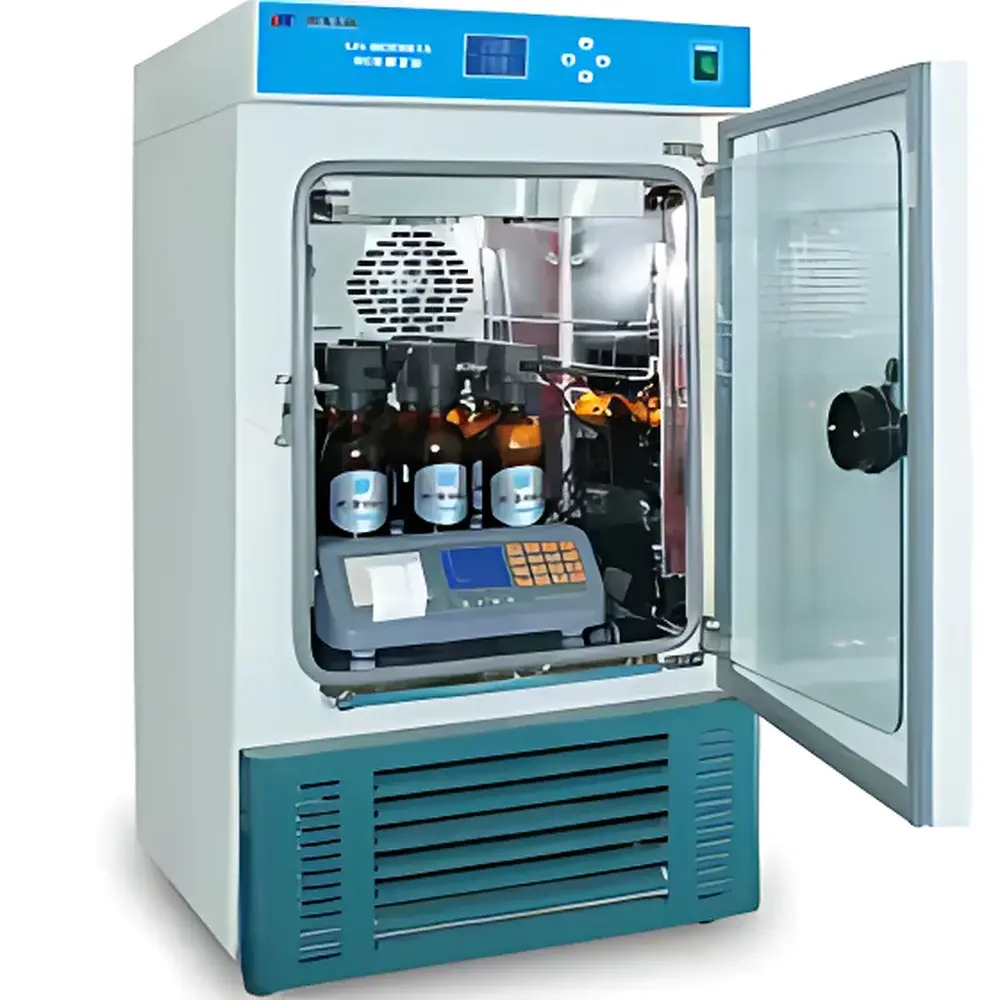
Hepu LH-BOD601A Microbial Respirometric BOD Analyzer
| Brand | Hepu |
|---|---|
| Origin | Shandong, China |
| Model | LH-BOD601A |
| Instrument Type | Laboratory BOD Analyzer |
| Principle | Microbial Respirometric (Mercury-Free Pressure Differential Method) |
| Measurement Range | 0–4000 mg/L |
| Detection Limit | 5 mg/L |
| Accuracy | ±10% |
| Repeatability | 3% |
| Sample Capacity | 6 channels |
| Incubation Temperature | 20 ± 1 °C |
| Data Logging Interval | 6 min – 3 h |
| Incubation Duration | 1–30 days |
| Bottle Volume | 580 mL |
| Data Storage Capacity | 20 years of historical records |
| Interface | USB and Infrared |
| Power Supply | 110–230 V, 50–60 Hz |
| Rated Power | 20 W |
Overview
The Hepu LH-BOD601A Microbial Respirometric BOD Analyzer is a fully automated, mercury-free laboratory instrument engineered for precise and compliant measurement of biochemical oxygen demand (BOD) in water and wastewater samples. It operates on the principle of microbial respirometry—monitoring oxygen consumption by indigenous or seeded microorganisms during aerobic biodegradation under standardized incubation conditions (20 ± 1 °C, dark, 1–30 day duration). Unlike traditional dilution-based 5-day BOD5 methods (per HJ 505–2009 and aligned with ISO 5815-1:2019), the LH-BOD601A employs a pressure-differential sensing system to quantify dissolved oxygen depletion in sealed, stirred BOD bottles—eliminating mercury manometers and associated occupational and environmental hazards. The analyzer replicates natural biodegradation kinetics without chemical reagents or sample dilution (within 0–4000 mg/L range), delivering direct, real-time BOD concentration values in mg/L. Its microprocessor-controlled architecture ensures full unattended operation, including automatic temperature equilibration, adaptive data logging, and end-of-cycle shutdown—making it suitable for routine compliance testing in municipal, industrial, and research laboratories adhering to national and international water quality standards.
Key Features
- Mercury-free pressure differential detection system—fully compliant with global mercury phase-out directives (Minamata Convention) and lab safety protocols
- Six independent measurement channels with 580 mL BOD bottles, enabling parallel analysis of replicate or multi-source samples
- Intelligent incubation control: automatic temperature stabilization delay up to 3.5 hours ensures accurate initiation only when sample reaches 20 ± 1 °C
- Configurable data acquisition frequency—from 6-minute intervals for kinetic profiling to 3-hour intervals for extended monitoring—optimized per test duration
- Full-color LCD interface displaying real-time BOD concentration, trend curves, and channel-specific color-coded values for immediate visual assessment
- Integrated data management: internal storage retains 20 years of timestamped, audit-ready records—including raw pressure differentials, calculated BOD, and environmental metadata
- Dual communication interface (USB + infrared) supports secure, cable-free transfer to LIMS or validated laboratory software platforms
- Robust firmware with automatic power-failure recovery: all active measurement data—including elapsed time, current BOD value, and sensor status—is preserved in non-volatile memory
- Programmable incubation period (1–30 days) accommodates standard BOD5, extended BOD, or specialized biodegradability studies (e.g., OECD 301 series)
- Energy-efficient design (20 W nominal power) with thermal insulation and low-thermal-mass incubation chamber for stable, uniform temperature control
Sample Compatibility & Compliance
The LH-BOD601A is validated for use with raw sewage, treated effluent, surface water, groundwater, and industrial process waters. It accepts standard 580 mL BOD bottles with integrated magnetic stir bars and gas-tight seals, compatible with both native microbiota and standardized seed cultures (e.g., activated sludge supernatant per HJ 505–2009). The instrument meets technical requirements for BOD determination under Chinese Environmental Protection Standard HJ 505–2009 and is functionally aligned with ISO 5815-1:2019 (Water quality — Determination of biochemical oxygen demand after n days — Part 1: BODn by dilution and seeding method) and ASTM D5211–19 (Standard Test Method for Biochemical Oxygen Demand of Water by Dilution Method). While not certified for GLP or 21 CFR Part 11 out-of-the-box, its timestamped, immutable data logs and user-accessible audit trails support integration into regulated environments when paired with validated laboratory procedures and electronic signature workflows.
Software & Data Management
Data generated by the LH-BOD601A is structured as time-series records containing: measurement timestamp, channel ID, absolute pressure differential (mbar), calculated BOD (mg/L), incubation temperature (°C), and operational status flags. Exported files are CSV-formatted and compatible with Excel, MATLAB, or LIMS systems. The analyzer does not require proprietary software; however, optional PC utilities (available via Hepu technical support) provide enhanced visualization—including overlay plots, statistical summaries (mean, SD, CV%), and export to PDF reports with laboratory header fields. All stored data includes embedded CRC checksums to ensure integrity verification. Internal memory allocation follows a circular buffer logic with date-stamped archival—enabling traceability across decades without manual intervention.
Applications
- Routine regulatory compliance testing for municipal wastewater treatment plants (WWTPs) reporting to local EPAs or MEE
- Industrial pretreatment verification and discharge permit monitoring (e.g., food processing, pharmaceutical, textile sectors)
- Environmental impact assessments (EIAs) requiring BOD load estimation for receiving water bodies
- Biodegradability screening of new chemical substances under REACH or OECD test guidelines
- Research on microbial kinetics, nitrification inhibition, or toxicity evaluation using BOD suppression assays
- Method validation and inter-laboratory comparison studies where reproducibility and operator independence are critical
FAQ
Does the LH-BOD601A comply with HJ 505–2009?
Yes—the instrument implements the core procedural requirements of HJ 505–2009, including 20 ± 1 °C incubation, dark conditions, and pressure-differential quantification of oxygen uptake over defined durations.
Can it measure BOD5 specifically?
Yes—users can set the incubation period precisely to 120 hours (5 days), and the system will auto-calculate and report BOD5 in mg/L without manual conversion.
Is sample dilution required?
Dilution is unnecessary for samples within the 0–4000 mg/L range. For concentrations exceeding this limit, standard serial dilution protocols (per HJ 505–2009) apply prior to loading.
How is temperature compensation handled?
The unit continuously monitors bottle temperature and delays assay initiation until thermal equilibrium at 20 ± 1 °C is confirmed—preventing kinetic bias from transient thermal gradients.
What maintenance is required?
Annual calibration verification using certified reference solutions (e.g., glucose-glutamic acid standard) is recommended. No consumables (e.g., membranes, electrodes) are required—the pressure sensor is solid-state and sealed for lifetime operation.
Related Products







