
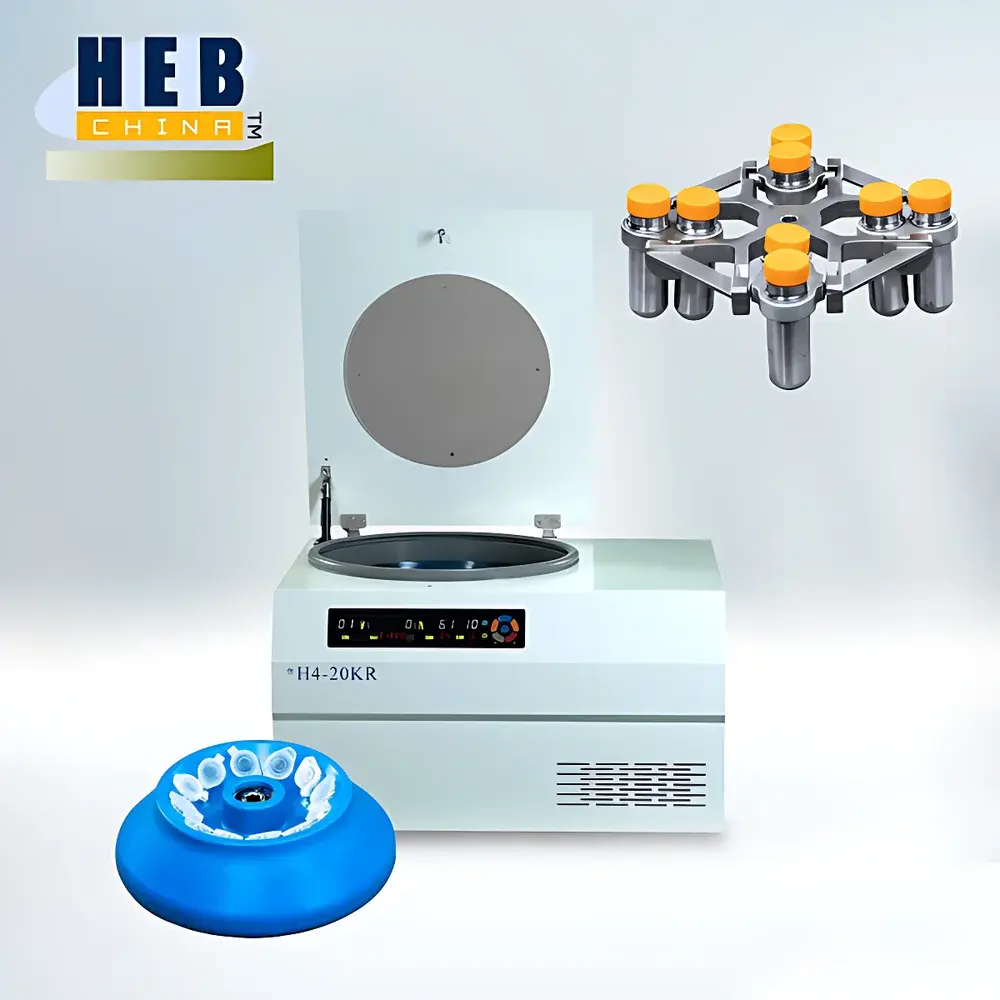
HePu H4-20KR Benchtop High-Speed Refrigerated Centrifuge
| [Brand | HePu (Jinan Hepu) |
|---|---|
| Origin | Shandong, China |
| Model | H4-20KR |
| Maximum Speed | 21,000 rpm |
| Maximum RCF | 30,642 × g |
| Maximum Capacity | 4 × 750 mL |
| Temperature Range | −20 °C to +40 °C |
| Temperature Accuracy | ±2.0 °C |
| Acceleration/Deceleration | 10 selectable ramps (Ramp 9: free deceleration >540 s) |
| Display | Full-color LED with RCF/rpm dual-mode switching |
| Safety | Automatic rotor recognition, electronic door lock, all-steel chamber liner |
| Noise Level | ≤65 dB(A) |
| Dimensions (W×D×H) | 645 × 700 × 445 mm |
| Net Weight | 95 kg |
| Power Supply | AC 220 V ±22 V, 50 Hz, 15 A |
| Total Power | 1300 W] |
Overview
The HePu H4-20KR is a precision-engineered benchtop high-speed refrigerated centrifuge designed for demanding separation tasks in life science laboratories. It operates on the principle of sedimentation under controlled gravitational force (RCF), enabling efficient isolation of subcellular components, macromolecular complexes, and particulate suspensions. With a maximum rotational speed of 21,000 rpm and a peak relative centrifugal force of 30,642 × g, the H4-20KR delivers consistent performance across diverse sample types—including nucleic acids, proteins, organelles, and mammalian cells—while maintaining thermal stability through its high-efficiency refrigeration system. Its compact footprint (645 × 700 × 445 mm) and robust mechanical architecture make it suitable for shared core facilities, QC labs, and academic research environments where space efficiency and operational reliability are critical.
Key Features
- Intelligent Rotor Recognition: Integrated sensor system automatically identifies installed rotors and enforces speed limits based on rotor-specific safety profiles—preventing overspeed operation and ensuring compliance with ISO 21501-4 and IEC 61010-2-020 safety standards.
- Dual-Mode Parameter Control: Simultaneous display and real-time switching between rpm and RCF values; users may set either parameter directly, with automatic recalculations performed in firmware to maintain method reproducibility.
- Programmable Ramp Control: Ten discrete acceleration and deceleration profiles—including ultra-slow coast-down (Ramp 9 ≥540 s)—enable optimization for shear-sensitive samples such as viral particles, exosomes, or intact ribosomal subunits.
- Cryogenic Performance: Imported high-efficiency compressor and optimized airflow path sustain chamber temperatures at ≤−4 °C even at maximum speed (21,000 rpm), supporting cold-active enzyme preservation and thermolabile biomolecule integrity.
- Enhanced User Interface: Full-color LED display with intuitive icon-based navigation; time settings <60 s shown in seconds for precise short-spin protocols; built-in pre-cool function reduces chamber equilibration time by up to 40% versus conventional start-up sequences.
- Structural Integrity & Safety: All-steel inner chamber liner and electromagnetic door interlock conform to EN 61010-1 mechanical safety requirements; acoustic enclosure design achieves ≤65 dB(A) noise emission during full-load operation.
Sample Compatibility & Compliance
The H4-20KR supports broad sample versatility via interchangeable rotor configurations—including fixed-angle, horizontal, and microplate carriers—validated for use with standard laboratory consumables (e.g., 1.5–2.2 mL microtubes, 15–100 mL conical tubes, 750 mL bottles, and 96-well PCR plates). Its maximum capacity of 4 × 750 mL accommodates large-volume preparative workflows common in bioprocessing scale-up and plasma fractionation. The instrument meets essential regulatory expectations for GLP-compliant environments: temperature logging (±2.0 °C accuracy), rpm traceability (±20 rpm), and audit-ready operational records. While not FDA 21 CFR Part 11–certified out-of-the-box, its firmware architecture supports integration with validated LIMS platforms for electronic record retention and user-access control.
Software & Data Management
The H4-20KR operates without proprietary PC software but embeds non-volatile memory capable of storing up to 100 user-defined protocols with timestamped execution logs. Each protocol retains independent settings for speed, RCF, temperature, time, and ramp profile. All parameters—including actual run-time temperature and final rotor speed—are recorded upon completion and accessible via front-panel review. For laboratories requiring extended data governance, optional RS-232 or USB-to-serial interfaces allow connection to external data acquisition systems compliant with ASTM E2500-21 (Good Automated Manufacturing Practice) guidelines. No cloud connectivity or remote access functionality is included, preserving network security in regulated settings.
Applications
- Purification of plasmid DNA, genomic DNA, and RNA from bacterial lysates or mammalian cell cultures
- Isolation of mitochondria, lysosomes, and other subcellular organelles via differential centrifugation
- Clarification of crude protein extracts prior to chromatographic analysis (e.g., SEC, IEX)
- Concentration and pelleting of extracellular vesicles (EVs) and virus-like particles (VLPs)
- Processing of clinical specimens including serum, plasma, PBMCs, and bone marrow aspirates
- Preparative separation of monoclonal antibodies and recombinant therapeutic proteins
- High-throughput processing of ELISA and lateral flow assay plates in diagnostic development
FAQ
What is the minimum operating temperature at maximum speed?
The chamber maintains ≤−4 °C at 21,000 rpm, verified under continuous operation per ISO 13732-1 thermal stability testing.
Does the H4-20KR support rotor calibration verification?
Yes—rotor identification is hardware-based and validated during factory commissioning; users may perform routine verification using certified tachometer and thermometer references per ISO/IEC 17025 calibration protocols.
Can this centrifuge be used for GMP manufacturing environments?
It meets foundational mechanical and thermal specifications required for GMP Annex 11 alignment; however, formal qualification (IQ/OQ/PQ) must be executed by the end user in accordance with their internal validation master plan.
Is the refrigeration system CFC-free?
Yes—the compressor uses R134a refrigerant, compliant with EU F-Gas Regulation (EU) No 517/2014 and EPA SNAP Program requirements.
What maintenance intervals are recommended?
Routine inspection every 6 months includes door seal integrity check, rotor corrosion assessment, and refrigerant pressure verification; full service (bearing replacement, refrigerant recharge) is advised every 3 years or after 10,000 operational hours.
Related Products



