
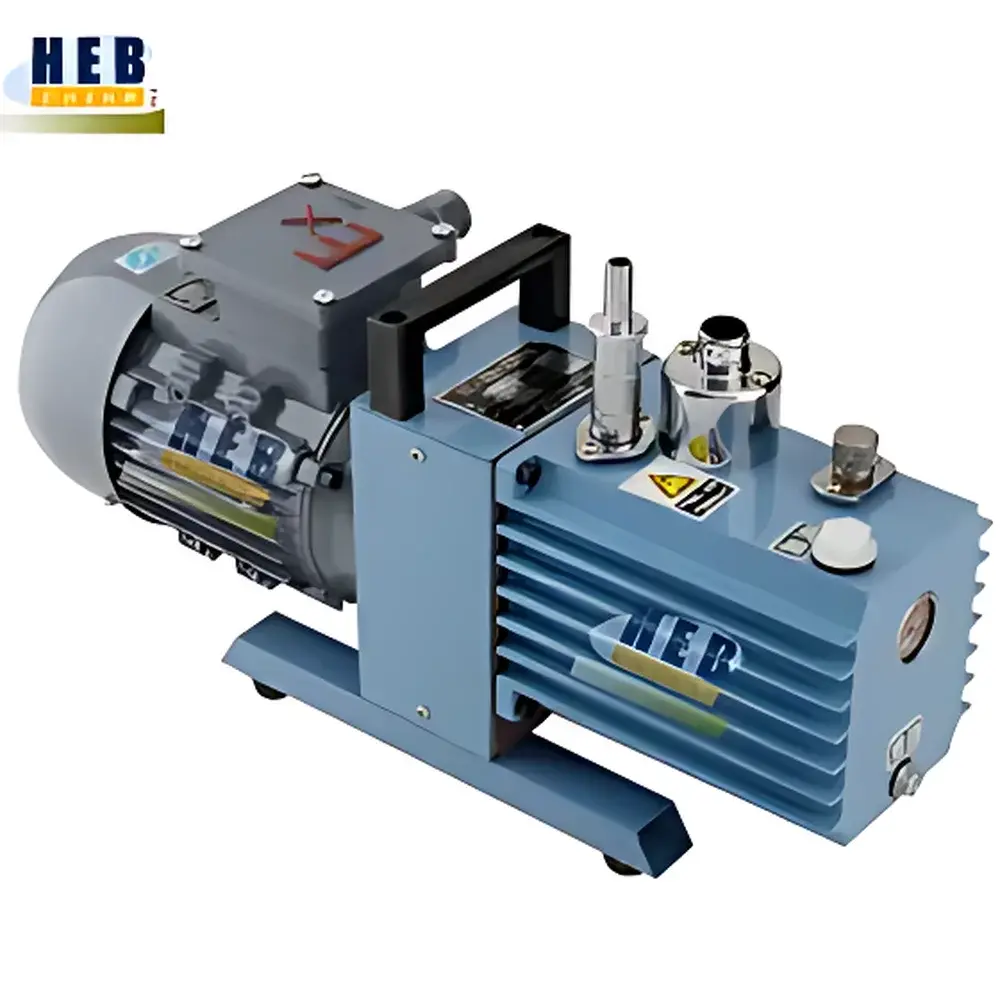
Jihepu 2XZF-4 Explosion-Proof Direct-Coupled Rotary Vane Vacuum Pump
| Brand | Jihepu |
|---|---|
| Origin | Shandong, China |
| Model | 2XZF-4 |
| Pump Type | Oil-Lubricated Rotary Vane Vacuum Pump |
| Explosion Protection Rating | ExdIIT4 |
| Ultimate Pressure (Total) | ≤1.33 Pa |
| Pumping Speed | 4 L/s |
| Motor Power | 0.55 kW |
| Rotational Speed | 1400 rpm |
| Inlet Port | KF-30 (30 mm) |
| Noise Level | 66 dBA |
| Dimensions (L×W×H) | 610×260×340 mm |
| Net Weight / Gross Weight | 40 kg / 48 kg |
| Voltage | 380 V AC, 50 Hz |
| Gas Ballast Valve | Yes |
| Compliance | IEC 60079-1, GB 3836.1–2010, GB 3836.2–2010 |
Overview
The Jihepu 2XZF-4 is an explosion-proof, direct-coupled rotary vane vacuum pump engineered for safe and reliable operation in hazardous environments classified under Group IIA and IIB, with temperature class T1–T4 per IEC 60079-0 and GB 3836 standards. It employs a robust oil-lubricated rotary vane mechanism—where rotating vanes within an eccentrically mounted rotor generate volumetric displacement—to achieve stable, continuous vacuum generation down to ≤1.33 Pa (total pressure). Unlike dry scroll or diaphragm pumps, the 2XZF-4 leverages proven oil-sealed vane technology for higher ultimate vacuum performance and superior tolerance to trace condensables, making it particularly suitable for applications involving mild solvent vapors or residual water vapor. Its integrated gas ballast valve enables controlled admission of atmospheric air during pumping, facilitating the removal of small quantities of condensable gases without oil contamination or performance degradation.
Key Features
- Explosion-proof certification compliant with ExdIIT4 (IEC 60079-1 / GB 3836.1 & GB 3836.2), incorporating flameproof enclosure, intrinsic safety barriers, and encapsulated electrical components.
- Direct-coupled motor-pump architecture eliminates belt slippage and alignment issues, ensuring high mechanical efficiency and long-term rotational stability at 1400 rpm.
- Integrated gas ballast valve allows safe and repeatable handling of low-concentration water vapor or volatile organic vapors—critical for drying, degassing, and vacuum impregnation processes.
- Compact footprint (610 × 260 × 340 mm) and optimized mass distribution (net weight: 40 kg) support benchtop integration in fume hoods, gloveboxes, and mobile analytical platforms.
- Low-noise operation at 66 dBA (1 m distance), achieved via precision-balanced rotor assembly, vibration-damping mounting feet, and acoustic shielding of the oil reservoir.
- Standard KF-30 (ISO-KF, DN30) inlet flange ensures compatibility with common vacuum tubing, valves, and gauges across laboratory and pilot-scale systems.
Sample Compatibility & Compliance
The 2XZF-4 is designed for non-corrosive, non-particulate gas loads typical in vacuum drying ovens, vacuum filtration manifolds, vacuum distillation setups, and sample preparation stations. It is not intended for use with aggressive halogenated solvents, strong acids, alkalis, or abrasive dusts—such media require chemically resistant pumps with specialized seals or dry pumping technologies. All electrical interfaces conform to IP54 ingress protection, and internal wiring complies with Class II insulation requirements. The pump meets national mandatory safety standards GB 3836.1–2010 (general requirements for explosive atmospheres) and GB 3836.2–2010 (flameproof enclosures “d”), and is routinely deployed in facilities requiring adherence to ATEX Zone 1/2 documentation protocols. While not inherently 21 CFR Part 11 compliant (as it lacks digital control or audit trail capability), its mechanical reliability supports GLP-compliant vacuum processes when paired with validated external monitoring systems.
Software & Data Management
The 2XZF-4 operates as a standalone electromechanical device with no embedded microcontroller, touchscreen interface, or digital communication ports (e.g., RS-485, Modbus, or USB). Vacuum level monitoring and process logging must be performed externally using calibrated capacitance manometers (e.g., MKS Baratron series) or Pirani gauges interfaced via analog 0–10 V or 4–20 mA outputs. For automated vacuum sequencing—such as timed pump-down cycles or pressure-triggered valve actuation—integration with programmable logic controllers (PLCs) or LabVIEW-based DAQ systems is recommended. No proprietary software or firmware updates are required or provided; maintenance relies solely on scheduled oil changes (every 500 operating hours), vane inspection, and filter replacement per the manufacturer’s technical manual.
Applications
- Vacuum drying of heat-sensitive pharmaceutical intermediates and fine chemicals in certified Ex-rated ovens (e.g., Jihepu 2XZF-series thermostatic drying cabinets).
- Evacuation of reaction vessels and Schlenk lines in synthetic chemistry labs handling pyrophoric reagents or oxygen-sensitive catalysts.
- Support vacuum for rotary evaporators in pilot-scale API purification where solvent recovery occurs near storage tanks classified as Zone 1.
- Primary vacuum backing for diffusion pumps or turbomolecular pumps in surface analysis instrumentation (e.g., XPS, AES) installed in industrial R&D cleanrooms.
- Gas sampling and blanking in environmental monitoring stations located adjacent to LNG terminals or petrochemical refinery perimeters.
- Vacuum-assisted impregnation of composite preforms in aerospace component manufacturing under ISO 9001-certified production lines.
FAQ
What does “ExdIIT4” mean in practical terms?
It certifies that the pump’s enclosure prevents internal explosions from propagating to the surrounding atmosphere, suitable for environments with propane (IIA), ethylene (IIB), or hydrogen (IIC) gas groups—and surface temperatures remain below 135°C (T4), even under fault conditions.
Can this pump handle water vapor continuously?
Yes—but only at low partial pressures (<5% relative humidity equivalent). Continuous exposure to saturated steam or liquid ingress will cause oil emulsification and rapid vane wear; use only with intermittent gas ballast activation and regular oil changes.
Is oil change required before first use?
Yes. The factory-fill oil is for transit protection only. Drain and replace with ISO VG 68 mineral vacuum pump oil (e.g., Shell Vacuol V68 or equivalent) prior to initial operation.
What is the recommended service interval?
Oil and inlet filter replacement every 500 hours of operation or semiannually—whichever occurs first. Vane inspection and rotor clearance verification are advised at 2,000-hour intervals.
Does it comply with EU CE marking requirements?
The pump meets the essential health and safety requirements of the ATEX Directive 2014/34/EU when supplied with full EU Declaration of Conformity and technical documentation—including risk assessment, test reports from CNEX (China National Explosion Protection Inspection Center), and harmonized standard references.



