
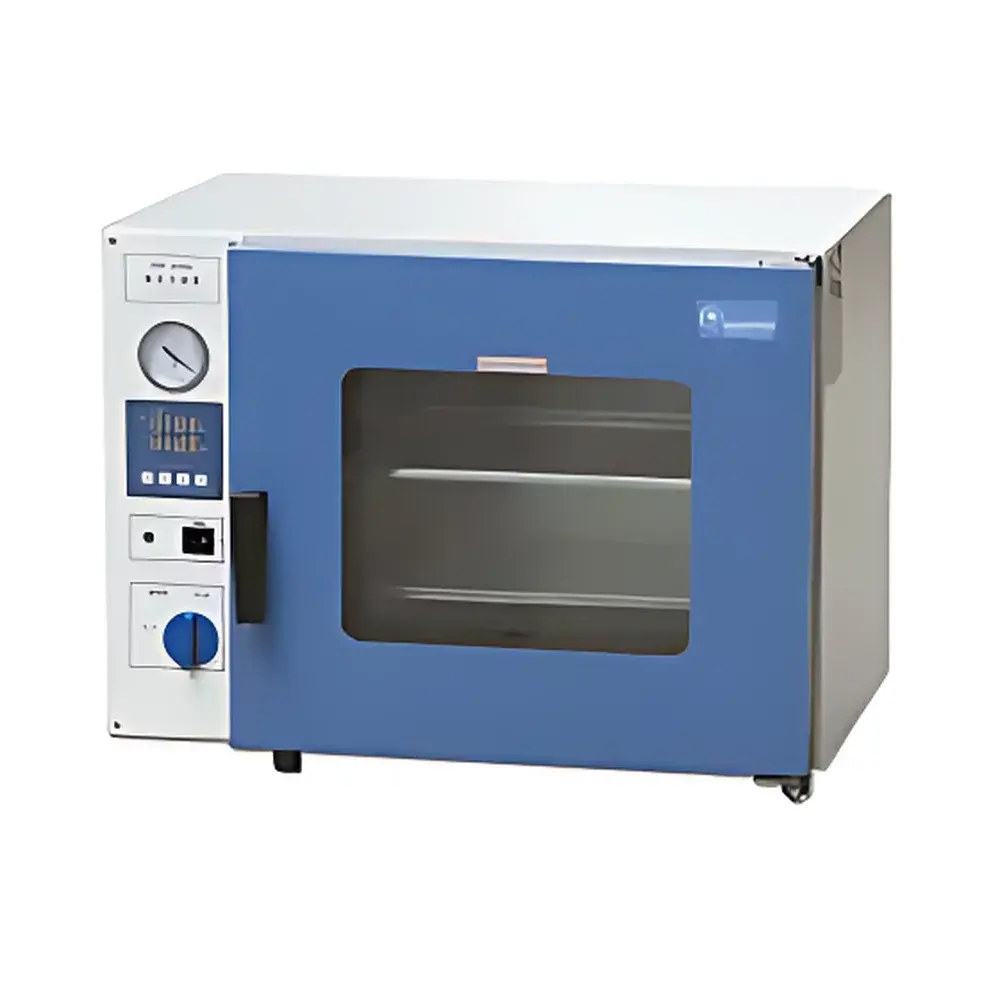
Heilongjiang HEP DZF-6051 Vacuum Drying Oven
| [Brand | Jihepu (Jinan HEP) |
|---|---|
| Origin | Shandong, China |
| Model | DZF-6051 |
| Type | Vacuum Drying Oven |
| Temperature Range | RT+10°C to 200°C |
| Temperature Uniformity | ±1°C |
| Internal Chamber Dimensions | 415 × 370 × 345 mm |
| External Dimensions | 730 × 560 × 550 mm |
| Chamber Material | Stainless Steel or Galvanized Steel |
| Heating Method | Forced Air Circulation |
| Vacuum Level | <133 Pa |
| Power Supply | 220 V, 50 Hz |
| Input Power | 1450 W |
| Timer Range | 1–9999 min |
| Shelf Capacity | 2 adjustable stainless steel shelves] |
Overview
The Heilongjiang HEP DZF-6051 Vacuum Drying Oven is an engineered solution for controlled thermal dehydration under reduced pressure. It operates on the principle of lowering the boiling point of solvents and moisture via vacuum application—enabling effective drying of heat-sensitive, oxidation-prone, or thermally labile materials without structural degradation or chemical decomposition. Unlike conventional convection ovens, this unit integrates a sealed chamber, vacuum-compatible sealing system, and microprocessor-based temperature regulation to maintain stable thermal conditions across the working volume while preserving sample integrity. Designed for routine use in regulated laboratory environments, it supports process reproducibility required in pharmaceutical stability testing, electronic component moisture removal, catalyst activation, and fine chemical synthesis workflows.
Key Features
- Microprocessor-controlled digital temperature regulator with 0.1°C resolution and ±1°C uniformity across the chamber—compliant with ISO 17025 calibration traceability requirements when verified using NIST-traceable probes.
- Reinforced double-layer tempered glass observation window with anti-scratch coating, enabling real-time visual monitoring without compromising vacuum integrity or thermal insulation.
- Custom-molded silicone door gasket with adjustable clamping mechanism ensures consistent vacuum seal performance down to <133 Pa; validated per ASTM E104–22 for humidity-controlled drying protocols.
- Stainless steel (AISI 304 equivalent) or galvanized interior chamber—resistant to corrosion from organic solvents, weak acids, and residual moisture during repeated vacuum cycles.
- Forced-air heating system with rear-mounted centrifugal blower provides uniform convective heat distribution, minimizing thermal gradients and improving drying homogeneity.
- Programmable timer (1–9999 minutes) supports unattended operation and batch process standardization—critical for GLP-compliant documentation in QC labs.
- Optional inert gas inlet port (N₂ or Ar) allows purging prior to vacuum draw-down, essential for oxygen-sensitive compounds such as lithium battery cathode precursors or polymer intermediates.
Sample Compatibility & Compliance
The DZF-6051 accommodates a broad range of sample formats including glass vials, ceramic crucibles, aluminum weighing dishes, and stainless-steel trays—up to two independently positioned shelves (standard). Its chamber geometry supports uniform exposure of samples up to 345 mm in height. The unit complies with general safety standards IEC 61010-1 for electrical equipment used in laboratory settings. While not certified for Class I Div 1 hazardous locations, its construction meets UL 61010-1 equivalency for non-explosive ambient use. For pharmaceutical applications, the oven supports USP guidelines on moisture removal validation and aligns with common practices referenced in FDA’s Process Validation Guidance (2011) when integrated into documented drying protocols.
Software & Data Management
This model features a stand-alone digital controller with no embedded software or network interface. All operational parameters—including setpoint temperature, dwell time, and vacuum status—are displayed on a high-contrast LCD screen. While native data logging is not included, analog output (0–5 V or 4–20 mA) can be added via optional retrofit modules for integration into SCADA or LIMS platforms. Users performing audit-ready procedures may connect external calibrated data loggers (e.g., Omega OM-DAQPRO-5300 series) compliant with 21 CFR Part 11 requirements for electronic records and signatures. The controller retains settings after power interruption and supports password-protected parameter locking to prevent unauthorized modification—a basic safeguard aligned with GMP Annex 11 principles.
Applications
- Pharmaceutical: Residual solvent removal from active pharmaceutical ingredients (APIs), lyophilized product secondary drying, and excipient moisture conditioning per ICH Q5C.
- Electronics: Degassing of printed circuit board (PCB) substrates, desiccation of humidity-sensitive sensors, and pre-bake treatment of encapsulated MEMS devices.
- Chemical R&D: Solvent-free drying of organometallic complexes, catalyst supports, and metal–organic frameworks (MOFs) where thermal decomposition must be avoided.
- Materials Science: Conditioning of ceramic green bodies, polymer film annealing under inert atmosphere, and graphite electrode pre-treatment.
- Academic Research: Sample preparation for SEM/TEM analysis, gravimetric moisture content determination (ASTM D2231), and thermal stability screening of novel biomaterials.
FAQ
Does the DZF-6051 include a built-in vacuum pump?
No—the DZF-6051 requires an externally connected vacuum pump (e.g., dual-stage rotary vane pump rated ≥4 L/min at 50 Hz) to achieve and maintain <133 Pa. Pump selection must consider vapor load and chemical compatibility.
Can the chamber accommodate custom-sized trays?
Yes—within the internal dimensions of 415 × 370 × 345 mm, users may install third-party trays fabricated from stainless steel or borosilicate glass, provided they do not obstruct airflow or impede door closure.
Is temperature calibration performed at the chamber wall or center point?
Factory calibration is conducted at the geometric center of the empty chamber under steady-state vacuum and thermal equilibrium. Users should perform periodic verification using a calibrated PT100 probe placed at multiple spatial locations per ISO/IEC 17025 clause 6.4.
What maintenance intervals are recommended for long-term reliability?
Silicone gasket inspection every 6 months; vacuum hose and valve cleaning quarterly; blower motor lubrication annually (if applicable); and full chamber wipe-down with ethanol after each use involving volatile organics.
How does forced-air circulation function under vacuum conditions?
Air circulation remains active only during atmospheric or partial-vacuum phases (e.g., during initial heating or inert gas purging). Once deep vacuum (<1 kPa) is reached, convective transfer ceases and drying proceeds primarily via molecular diffusion—a fundamental characteristic of vacuum thermal processing.
Related Products



