
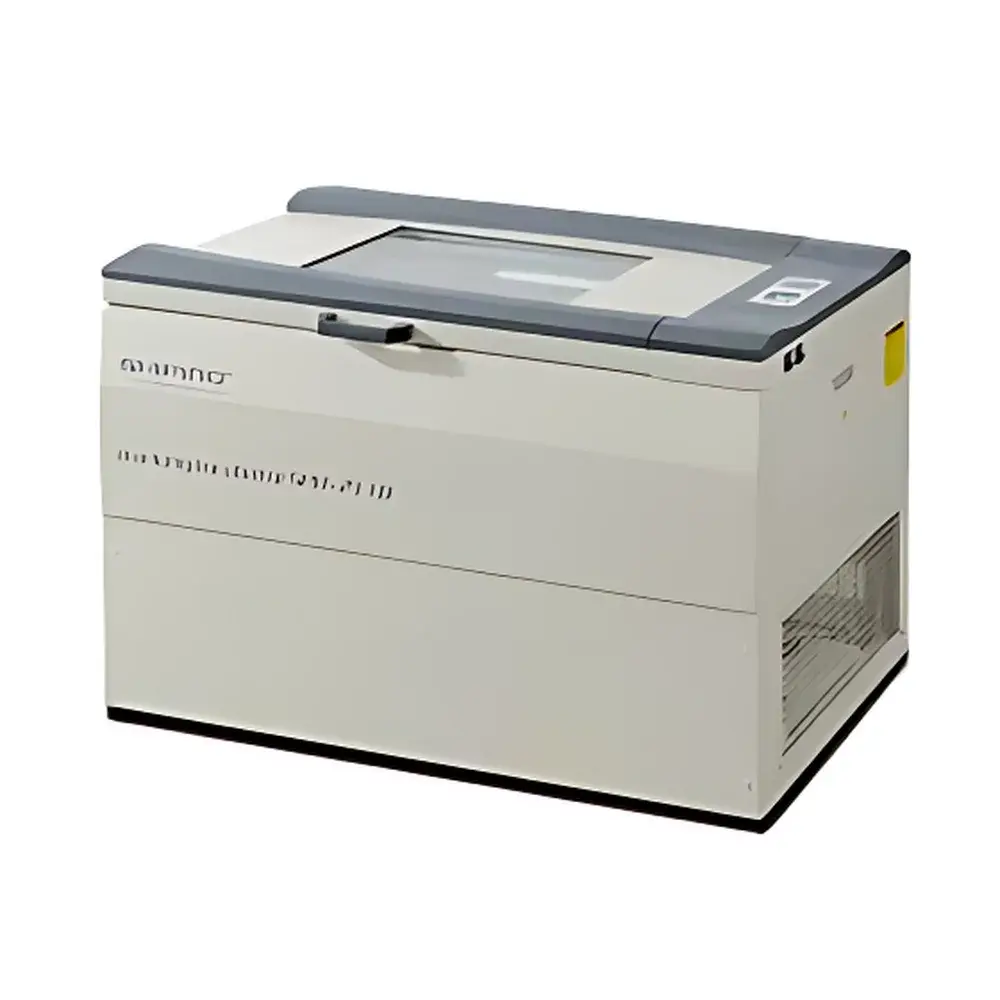
English Product Name
| Brand | Jihepu |
|---|---|
| Origin | Shandong, China |
| Model | SPH-111B |
| Instrument Type | Air-Jacketed Temperature-Controlled Orbital Shaker |
| Timer Range | 0–500 h (continuous operation enabled) |
| Oscillation Speed | 50–300 rpm |
| Orbit Diameter | 25 mm |
| Temperature Range | Ambient +5°C to 60°C |
| Temperature Uniformity | ±0.5°C |
| Temperature Accuracy | ±0.1°C |
| Shelf Capacity | 1 × 890 × 480 mm platform |
| Max Load | 2000 mL × 8 |
| Power Supply | AC 200–240 V, 50–60 Hz |
| Total Power Consumption | 960 W |
| Net Weight | 150 kg |
| Internal Chamber Dimensions | 970 × 550 × 350 mm (W×D×H) |
| External Dimensions | 1250 × 740 × 845 mm (W×D×H) |
| Chamber Material | High-Grade Imported Stainless Steel (Mirror Finish) |
| Enclosure Material | Reinforced Cold-Rolled Steel with Electrostatic Powder Coating |
Overview
The Jihepu SPH-111B Large-Capacity Incubated Orbital Shaker is an engineered solution for controlled, reproducible suspension culture of microbial, mammalian, and hybridoma cells under precise thermal and mechanical conditions. Utilizing orbital shaking motion—characterized by a consistent 25 mm circular orbit—the system ensures homogeneous oxygen transfer and nutrient distribution across large-volume liquid cultures without shear-induced cellular damage. Its air-jacketed temperature control architecture maintains stable thermal environments from ambient +5°C to 60°C, making it suitable for mesophilic bacterial growth (e.g., E. coli, Bacillus spp.), yeast fermentation, enzyme kinetics assays, and recombinant protein expression workflows. Designed for laboratory-scale bioprocess development and QC/QA applications, the SPH-111B complies with fundamental operational requirements outlined in ISO 13485 (for medical device manufacturing support) and supports GLP-compliant documentation through its embedded data logging and parameter retention functions.
Key Features
- Single-axis balanced drive mechanism (Chinese Patent No. ZL2018XXXXXXX)—optimized for low energy consumption, minimal vibration transmission, and acoustic noise reduction (<55 dB(A) at 1 m distance).
- Vertical double-door, double-layer cabinet design maximizing internal volume utilization while minimizing floor footprint (0.93 m²).
- PID-controlled microprocessor with environmental scanning algorithm ensures rapid thermal stabilization and long-term setpoint fidelity (±0.1°C accuracy, ±0.5°C uniformity across chamber).
- LCD backlit dual-display interface simultaneously shows real-time temperature, speed, and timer values alongside user-defined setpoints.
- Intelligent acceleration/deceleration circuitry enables smooth start-up and ramp-down profiles—critical for preserving fragile cell aggregates or sensitive enzymatic complexes.
- CFC-free R134a refrigeration system integrated with 800 W heating element and 200 W cooling capacity, enabling tight thermal regulation even under high-load or ambient fluctuation conditions.
- Fail-safe protection suite includes overtemperature alarm (audible/visual), motor overheating cutoff, power-failure recovery mode, and automatic mains disconnection upon thermal runaway detection.
Sample Compatibility & Compliance
The SPH-111B accommodates standard laboratory vessels ranging from 250 mL Erlenmeyer flasks (up to 36 units) to 2000 mL carboys (up to 8 units) on its single 890 × 480 mm stainless steel shelf. The mirror-finish 304 stainless steel chamber resists corrosion from common microbiological media (e.g., LB, TB, M9), organic solvents, and mild alkaline wash solutions. Structural integrity meets IEC 61010-1:2010 safety standards for laboratory equipment. While not certified to FDA 21 CFR Part 11 out-of-the-box, audit-ready operation is supported via timestamped parameter logs stored in non-volatile memory and manual export capability for external recordkeeping systems used in GMP-aligned facilities.
Software & Data Management
The embedded controller provides non-volatile memory for up to 10 user-defined protocols, each storing temperature, speed, duration, and acceleration profile settings. All operational parameters—including runtime, actual vs. setpoint deviations, and alarm events—are logged with timestamps and retained after power cycling. Data export requires manual transcription or external USB-based capture (no native Ethernet/RS-232 interface). For laboratories requiring electronic records, integration with third-party LIMS platforms is achievable via analog output signals (0–5 V DC) corresponding to real-time temperature and RPM values.
Applications
- Molecular biology: Plasmid amplification, phage propagation, and competent cell preparation.
- Biopharmaceutical development: Seed train expansion, shake flask screening for clone selection, and buffer compatibility studies.
- Environmental microbiology: BOD testing, biodegradation assays, and activated sludge simulation.
- Food & beverage QA: Microbial load monitoring, starter culture propagation, and spoilage organism enrichment.
- Academic research: Kinetic modeling of aerobic metabolism, biofilm dispersion studies, and synthetic biology chassis optimization.
FAQ
Does the SPH-111B support refrigerated operation below ambient temperature?
No. The unit operates within a range of ambient +5°C to 60°C and does not provide sub-ambient cooling.
Is the shaker compatible with CO₂-enriched atmospheres?
Not natively. The chamber is not gas-tight; supplemental CO₂ control requires integration with external incubator-compatible gas manifolds and sealed vessel systems.
Can multiple temperature zones be programmed simultaneously?
No. The SPH-111B features a single-zone thermal control system optimized for uniform chamber-wide conditions.
What maintenance intervals are recommended for the induction motor?
The brushless AC induction motor requires no scheduled maintenance; periodic inspection of belt tension (if applicable) and chamber seal integrity is advised every 12 months.
Is validation documentation (IQ/OQ/PQ) provided with the instrument?
Factory calibration certificates are included. Full qualification packages must be developed per site-specific SOPs and regulatory requirements (e.g., ASTM E2500, EU Annex 15).




