
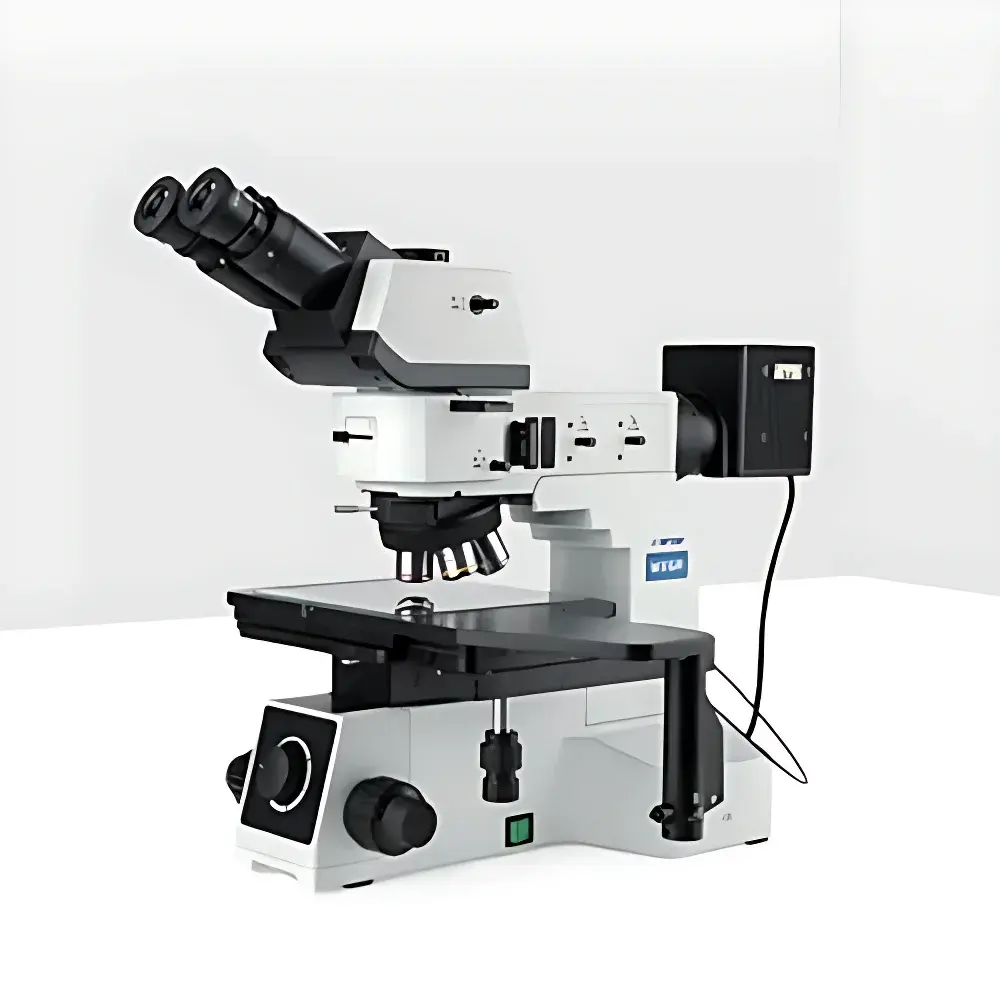
Jihepu MX6R Upright Metallurgical Microscope
| Brand | Jihepu |
|---|---|
| Origin | Shandong, China |
| Model | MX6R |
| Configuration | Upright |
| Total Magnification | 26×–1000× (with PL10X eyepiece and 5X–100X objectives) |
| Eyepiece | Wide-field Plano-eyepiece PL10X/22mm (high-eye-point, field number 22 mm) |
| Objectives | Infinity-corrected, long-working-distance (LWD), achromatic metallurgical objectives for brightfield/darkfield (5X, 10X, 20X, 50X, 100X) |
| Working Distance | 7.9 mm (50X), 2.1 mm (100X), up to 30.5 mm (20X ultra-LWD option) |
| Observation Tube | Ergonomic inclined trinocular tube (30° tilt), infinity-corrected, erect-image, interpupillary adjustment 50–76 mm, beam splitter ratio 100:0 or 0:100 |
| Focus Mechanism | Coaxial coarse/fine focus with 33 mm coarse travel, 1 µm fine step resolution, anti-slip tension control and upper limit stop |
| Stage | 6-inch triple-layer mechanical stage (445 × 240 mm), X/Y coaxial low-position controls, 158 × 158 mm reflection travel range, 100 × 100 mm transmission range, clutch-enabled rapid positioning |
| Illumination | Reflected brightfield/darkfield LED illuminator with adjustable aperture and field diaphragms, centerable, filter slots for polarizers and interference filters |
| Imaging Interface | C-mount camera adapter (0.35X/0.5X/0.65X/1X), focus-adjustable |
| Software | Integrated image analysis system compliant with ISO 9276-2 and ASTM E112 grain size evaluation standards |
| Compliance | Designed for GLP/GMP-aligned metallurgical QA/QC workflows |
Overview
The Jihepu MX6R Upright Metallurgical Microscope is an engineered solution for high-fidelity microstructural analysis of polished metallographic specimens, ceramics, composites, and coated materials. Built upon an infinity-corrected optical architecture, the MX6R employs a fully apochromatically optimized brightfield/darkfield optical path—designed to meet the stringent requirements of ISO 4287 surface roughness assessment, ASTM E3 metallographic specimen preparation verification, and ASTM E112 grain size quantification. Its upright configuration enables direct observation of bulk samples without inversion constraints, while the erect-image trinocular head ensures intuitive spatial correlation between specimen motion and visual feedback—a critical ergonomic advantage during extended QC inspections or failure analysis workflows. The microscope’s optical train integrates semi-apochromatic correction across the full objective set (5X–100X), minimizing chromatic aberration and field curvature across wide fields of view (up to 26.5 mm), thereby supporting both qualitative morphology assessment and quantitative stereological measurements.
Key Features
- Erect-image trinocular observation tube with 30° inclination, interpupillary adjustment (50–76 mm), and dual-beam split capability (100:0 / 0:100) for simultaneous visual inspection and digital imaging
- Long-working-distance (LWD) metallurgical objectives: standard set includes 5X (WD = 22.5 mm), 10X (WD = 15.5 mm), 20X (WD = 7.9 mm), 50X (WD = 7.9 mm), and 100X (WD = 2.1 mm); optional ultra-LWD 20X objective extends working distance to 30.5 mm for tall or topographically complex specimens
- Brightfield/darkfield dual-mode illumination system with centerable aperture and field diaphragms, integrated darkfield brightness enhancement (≥2× gain vs. conventional darkfield optics), and dedicated filter slots for polarizers, retardation plates, and interference filters
- Coaxial coarse/fine focusing mechanism with 33 mm vertical travel, 1 µm fine-step resolution, mechanical upper-limit stop, and adjustable tension control to prevent objective drift during vibration-sensitive acquisitions
- 6-inch triple-layer mechanical stage with low-handled X/Y coaxial controls, 158 × 158 mm reflection travel range, clutch-assisted rapid positioning, and interchangeable glass/steel stage plates for both reflective and transmissive applications
- Integrated 100–240 V AC power management with programmable LED intensity presets, thermal-stable warm-white illumination (5700 K CCT), and independent on/off control for reflected and transmitted light paths
Sample Compatibility & Compliance
The MX6R accommodates standard 25 mm and 30 mm metallographic mounts, as well as oversized specimens up to 100 mm in diameter when using the extended-stage configuration. Its LWD objective suite supports analysis of specimens with raised features—including weld beads, thermal spray coatings, and embedded particles—without risk of objective collision. All optical components comply with ISO 10110 surface quality specifications (scratch-dig ≤ 60–40), and the illumination system meets IEC 62471 photobiological safety Class 1 requirements. The instrument is compatible with ASTM E407 etchant validation protocols and supports traceable calibration via NIST-traceable stage micrometers and graticules. When configured with the optional DIC module and polarization accessories, it satisfies ISO 10816-3 vibration analysis sample preparation verification criteria.
Software & Data Management
The bundled image analysis software provides ISO/IEC 17025-aligned measurement traceability, including automated grain size classification per ASTM E112 and ISO 643, phase fraction quantification via threshold-based segmentation, and inclusion counting per ASTM E1245. Raw image metadata (objective magnification, exposure time, illumination mode, stage coordinates) is embedded in TIFF files and retained through export. Audit trails record user login, measurement parameters, and software version history—supporting FDA 21 CFR Part 11 compliance when deployed with network authentication and electronic signature modules. Export formats include CSV (for statistical process control integration), PDF reports with embedded calibration certificates, and annotated multi-channel overlays for comparative microstructure mapping.
Applications
The MX6R serves core functions across industrial metallurgy, aerospace component certification, additive manufacturing post-process evaluation, and academic materials science laboratories. Typical use cases include: identification and sizing of non-metallic inclusions in steel per ASTM E45; assessment of porosity distribution in aluminum die-castings; verification of heat-affected zone (HAZ) microstructures in welded joints; evaluation of carbide dispersion in tool steels; and characterization of oxide layer thickness and continuity on high-temperature alloys. Its darkfield performance enables high-contrast visualization of micro-cracks and intergranular corrosion features invisible under brightfield, while the optional DIC configuration delivers nanoscale topographic contrast for fatigue striation analysis without staining.
FAQ
Does the MX6R support both brightfield and darkfield imaging on the same objective set?
Yes—the included LWD achromatic objectives are specifically designed for simultaneous brightfield and darkfield operation, with optimized reflectance coatings and internal baffling to suppress stray light.
Is the microscope compatible with third-party camera systems?
Yes—C-mount adapters (0.35X–1X) are provided, and all magnification factors are calibrated against ANSI Z80.10 optical standards for accurate pixel-to-micron conversion.
Can the MX6R be used for polarized light microscopy?
Yes—dedicated polarizer and rotatable analyzer inserts are included, and the optical path maintains stress-free alignment suitable for birefringence quantification per ASTM D4101.
What is the maximum specimen height accommodated by the 100X objective?
With the standard 100X objective (WD = 2.1 mm), specimens up to 2 mm in relief height may be safely imaged; the optional ultra-LWD 20X objective extends this to 30.5 mm.
Does the system include documentation for ISO/IEC 17025 accreditation?
Yes—factory calibration certificates, optical path diagrams, and uncertainty budgets for magnification and stage movement are supplied with each unit.




