
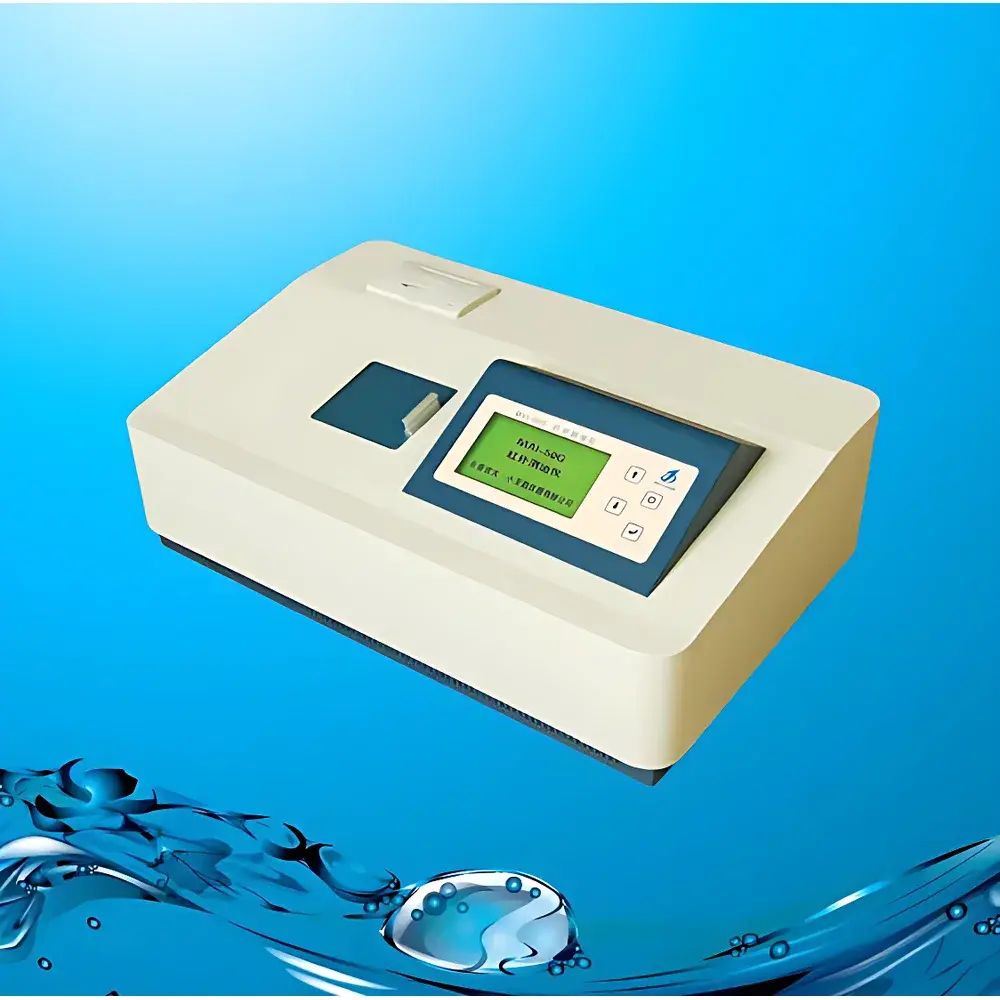
MAI-50G Infrared Oil-in-Water Analyzer
| Brand | Jihepu (Jinan Hepu) |
|---|---|
| Origin | Shandong, China |
| Manufacturer Type | Authorized Distributor |
| Country of Origin | China |
| Model | MAI-50G |
| Instrument Type | Online Water Quality Analyzer |
| Detection Targets | Total Petroleum Hydrocarbons (TPH), Animal & Vegetable Oils, and Total Oil Content in Water, Soil, and Flue Gas (e.g., Cooking Fume) |
| Compliance | GB/T 16488–1996 (Chinese National Standard for Infrared Spectrophotometric Determination of Petroleum and Animal/Vegetable Oils in Water) |
Overview
The MAI-50G Infrared Oil-in-Water Analyzer is a dedicated spectrophotometric instrument engineered for quantitative determination of hydrocarbon-based contaminants in environmental matrices. It operates on the principle of infrared absorption spectroscopy at characteristic C–H stretching vibration bands—specifically near 2930 cm⁻¹ (CH₂ asymmetric stretch), 2960 cm⁻¹ (CH₃ asymmetric stretch), and 2870 cm⁻¹ (CH₂ symmetric stretch)—enabling selective quantification of petroleum hydrocarbons (mineral oil), animal and vegetable oils, and total oil content. Designed in strict accordance with GB/T 16488–1996, the analyzer delivers trace-level sensitivity and high reproducibility for regulatory monitoring applications across water, soil, and gaseous effluent streams—including cooking fume emissions from food service establishments. Its architecture supports both laboratory-based batch analysis and semi-continuous field deployment, making it suitable for municipal water utilities, industrial wastewater treatment plants, environmental inspection agencies, and third-party testing laboratories operating under Chinese environmental quality standards.
Key Features
- Triple-wavelength infrared photometric detection aligned to GB/T 16488–1996 spectral weighting methodology
- Integrated microprocessor control with embedded real-time operating logic for automated calibration, zeroing, and blank subtraction
- Backlit LCD interface with native Chinese character support and intuitive menu navigation for field operators
- Built-in thermal printer for immediate hard-copy generation of measurement reports, including sample ID, date/time stamp, concentration value, and operator code
- Dual-mode operation: standalone mode for rapid on-site screening; PC-coupled mode via RS-232 or USB interface for centralized data aggregation
- Onboard data storage capacity for ≥500 measurement records with timestamp, sample ID, and operator tag
- Modular design accommodating optional accessories such as solid-phase extraction (SPE) cartridges and solvent evaporation modules for soil/sediment extraction workflows
Sample Compatibility & Compliance
The MAI-50G is validated for use with aqueous samples (surface water, groundwater, seawater, domestic sewage, and industrial effluents), soil leachates, and condensed flue gas condensates. Sample preparation follows standardized liquid–liquid extraction using carbon tetrachloride (CCl₄) or alternative non-chlorinated solvents compliant with updated national guidelines. For solid matrices, EPA Method 3550C or GB 17378.5–2007–based Soxhlet or ultrasonic-assisted extraction protocols are applicable. While GB/T 16488–1996 remains the primary reference method, the instrument’s optical configuration allows adaptation to ISO 9377-2:2000 (petroleum hydrocarbons in water by IR) and ASTM D7066–04 (oil and grease by infrared) through user-defined calibration curves. The system meets basic GLP documentation requirements, supporting audit-ready record retention and manual operator signature fields in generated reports.
Software & Data Management
The included PC software provides comprehensive data management functionality: import/export of CSV and Excel-compatible files; generation of calibration curves (linear, quadratic, or multi-point); statistical summary (mean, SD, CV%, recovery %); and customizable report templates compliant with local environmental reporting formats. Audit trail features include user login tracking, parameter change logs, and timestamped measurement history. Although not natively 21 CFR Part 11–compliant, the software supports export of raw absorbance values and metadata required for integration into validated LIMS environments. Data synchronization is performed via serial or USB connection; no cloud dependency or proprietary firmware updates are required.
Applications
- Regulatory monitoring of petroleum hydrocarbons in discharge permits (e.g., China’s Integrated Wastewater Discharge Standard GB 8978–1996)
- Compliance verification for food service油烟 (cooking fume) emission limits per HJ 62–2011
- Soil contamination assessment at brownfield sites and petrochemical facilities
- Process water quality control in metalworking, textile dyeing, and electroplating industries
- Validation of oil–water separator efficiency in industrial pretreatment systems
- Research-grade quantification of lipid content in biofilm or sediment extracts
FAQ
Does the MAI-50G comply with international standards such as ISO or ASTM?
Yes—the optical path and wavelength selection allow method adaptation to ISO 9377-2 and ASTM D7066 when configured with appropriate calibration standards and extraction protocols.
Can the instrument measure oil content in soil without external extraction equipment?
No—soil analysis requires prior solvent extraction (e.g., using the supplied sample prep kit or compatible SPE modules); the MAI-50G performs only infrared quantification of extracted solutions.
Is the built-in printer capable of generating GLP-compliant reports?
It produces traceable hard copies with sample ID, time/date, and measured concentration, but full GLP compliance (e.g., electronic signatures, audit trails) requires integration with validated LIMS software.
What solvents are recommended for sample extraction?
Carbon tetrachloride (CCl₄) is specified in GB/T 16488–1996; however, alternatives such as cyclohexane or Freon-113 substitutes may be used if validated per method equivalency guidelines.
Is remote firmware update supported?
No—firmware is fixed at time of manufacture; all operational parameters are configurable via front-panel menu or PC software without requiring online connectivity.







