
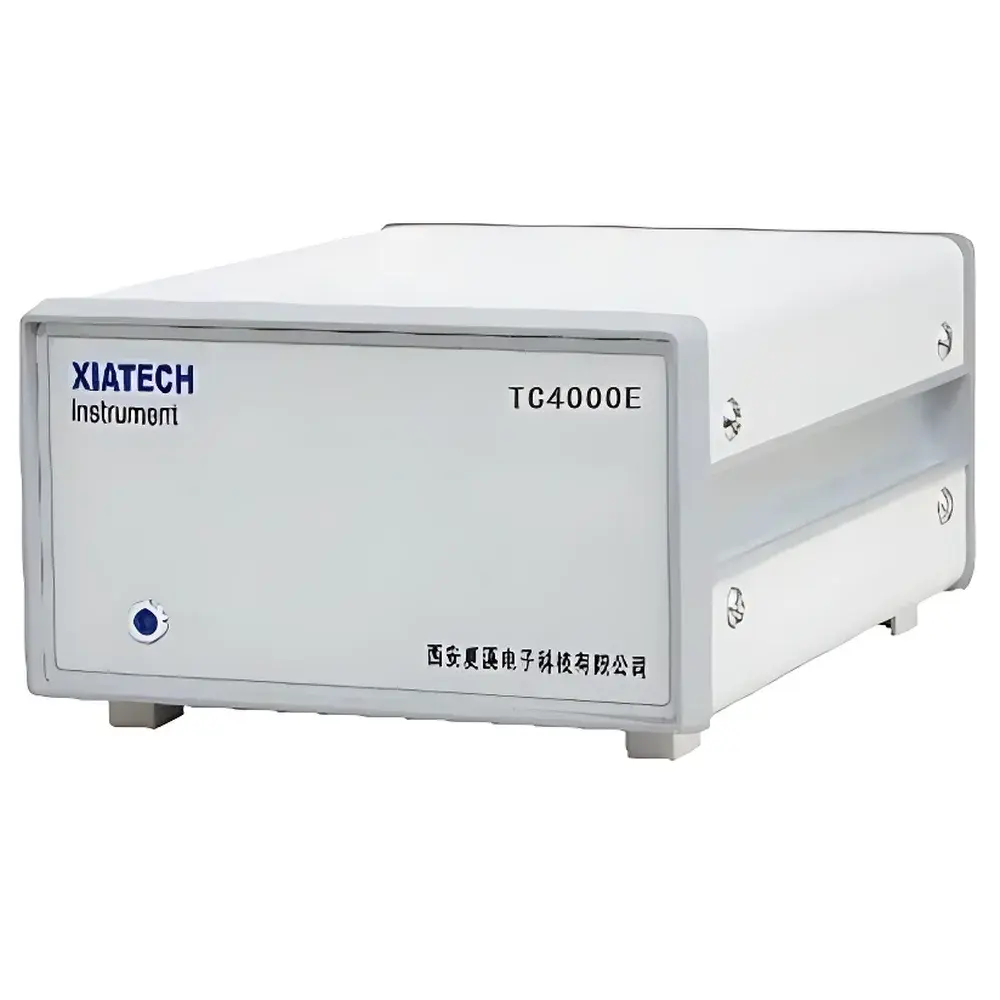
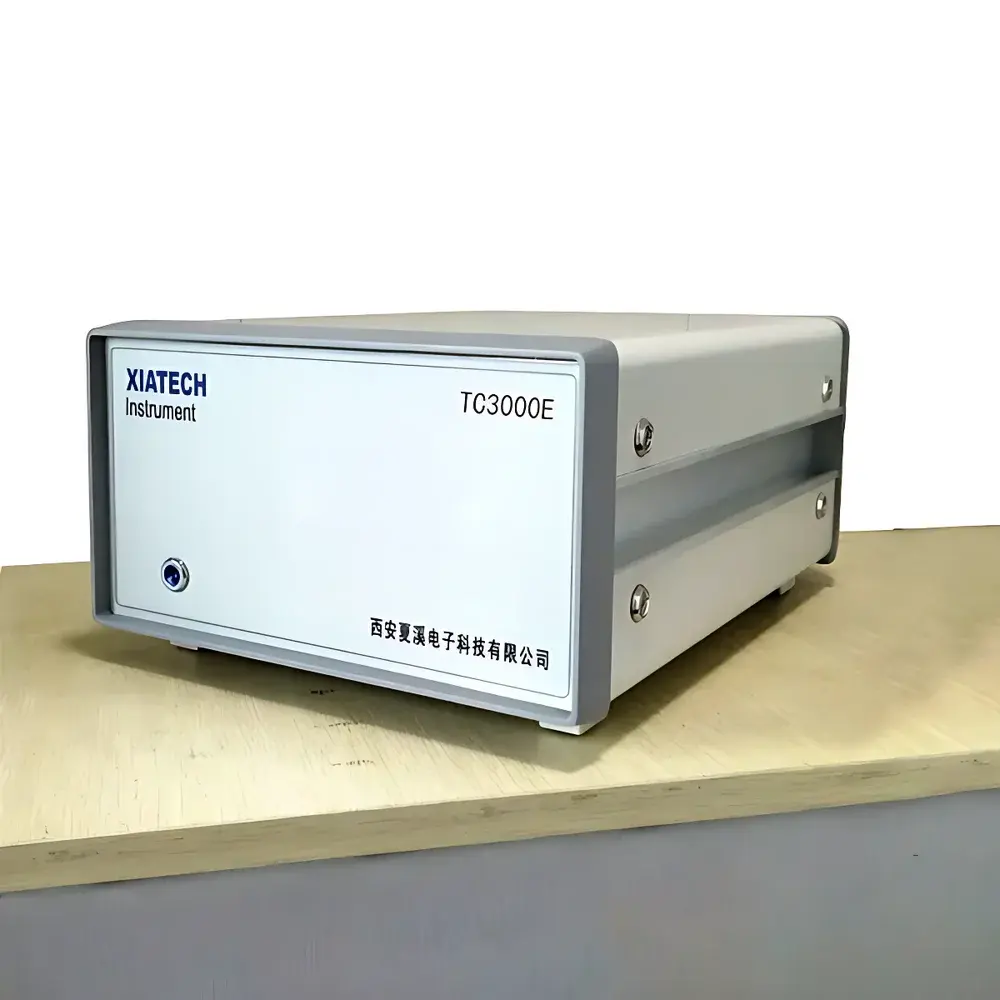

Xiatech TC4000 Transient Hot Wire Thermal Conductivity Analyzer
| Brand | Xiatech |
|---|---|
| Model | TC4000 |
| Measurement Principle | Transient Hot Wire Method |
| Thermal Conductivity Range | 0.02–5 W/(m·K) |
| Accuracy | ±5% |
| Repeatability | ±3% |
| Resolution | 0.01 W/(m·K) |
| Probe Dimensions | Ø1.6 mm × 120 mm insertion depth |
| Operating Temperature Range | −50 to 100 °C |
| Measurement Time | 1–5 min per sample |
| Sample Forms | 膏体/Gels, 胶体/Colloids, Liquids, Powders, Granules, and Friable Solid Blocks |
| Test Atmosphere | Ambient Air |
| Environmental Rating | 0–40 °C, ≤65% RH |
| Power Supply | 220 V, 50 Hz |
| Interface | USB |
| OS Compatibility | Windows |
| Dimensions (L×W×H) | 350×250×150 mm |
| Weight | Approx. 4.2 kg |
Overview
The Xiatech TC4000 Transient Hot Wire Thermal Conductivity Analyzer is a portable, field-deployable instrument engineered for rapid and reliable thermal conductivity measurement of heterogeneous, low-density, and semi-solid materials using the internationally standardized transient hot wire (THW) method. Unlike guarded-hot-plate or laser-flash techniques—which require extensive sample preparation, strict geometry control, and equilibrium conditions—the TC4000 employs a calibrated linear heat source (a thin metallic wire embedded in a stainless-steel probe) inserted directly into the sample. A precisely controlled current pulse heats the wire, and the resulting transient temperature rise is recorded via the wire’s intrinsic resistance change. Thermal conductivity is calculated from the slope of the natural logarithm of temperature versus time plot, following the analytical solution to the infinite-line-source conduction model (IEEE Std 442–1981, ASTM D5334–22). This first-principle, absolute measurement eliminates dependency on reference standards, density, specific heat, or thermal diffusivity—making it especially suitable for soft, compressible, or non-homogeneous media where contact resistance and interfacial voids compromise alternative methods.
Key Features
- True In-Situ Capability: Compact form factor (350 × 250 × 150 mm) and battery-compatible power architecture enable direct measurements in laboratories, production floors, geotechnical field sites, and food processing lines without sample extraction or conditioning.
- Minimal Sample Preparation: No cutting, pressing, or encapsulation required. The 1.6 mm diameter probe inserts cleanly into gels, slurries, granular beds, or pre-drilled holes in low-porosity solids (e.g., cured concrete, sedimentary rock).
- Single-Parameter Output: Delivers thermal conductivity (λ) as a primary physical quantity—no iterative inversion or auxiliary property inputs needed—ensuring traceability to SI units through NIST-traceable probe calibration certificates.
- Robust Thermal Isolation Design: Integrated thermal shielding minimizes lateral heat loss during transient acquisition, maintaining measurement fidelity across low-conductivity regimes (down to 0.02 W/(m·K)) even under ambient airflow or mild vibration.
- Real-Time Diagnostics: On-device validation metrics—including signal-to-noise ratio (SNR), linearity deviation (<0.5%), and probe self-heating stability—flag suboptimal insertions or thermal drift before result export.
Sample Compatibility & Compliance
The TC4000 accommodates a broad spectrum of thermally unstable, rheologically complex, or environmentally sensitive matrices: aqueous colloids (e.g., agarose gels, protein suspensions), high-viscosity fluids (thermal interface pastes, bitumen emulsions), agricultural powders (wheat flour, coffee grounds), geotechnical media (saturated clay, volcanic ash), and porous insulators (phenolic foam, aerogel composites). Its operational envelope complies with ISO 22007-2:2015 for transient hot wire testing and supports GLP-aligned workflows via timestamped, user-annotated test logs. While not intrinsically rated for hazardous area use, the probe meets IEC 61000-4-2 ESD immunity (±8 kV contact discharge) and operates safely within standard laboratory and outdoor environmental limits (IEC 60664-1, Pollution Degree 2).
Software & Data Management
Bundled Windows-based TCSoft v3.2 provides full instrument control, real-time curve visualization, automated baseline correction, and uncertainty propagation per GUM (JCGM 100:2018). All raw voltage-vs.-time datasets are stored in HDF5 format with embedded metadata (probe ID, calibration date, operator ID, ambient T/RH). Export options include CSV (for LIMS integration), PDF reports compliant with ISO/IEC 17025 documentation requirements, and XML schemas compatible with enterprise MES platforms. Audit trails record every parameter modification, data deletion, or firmware update—meeting FDA 21 CFR Part 11 electronic record integrity criteria when deployed with Windows Group Policy–enforced user authentication.
Applications
- Geosciences: In-situ thermal profiling of soil strata, landfill cover layers, and permafrost analogs; validation of numerical heat-transfer models in hydrogeological simulations.
- Building Materials R&D: Quality control of spray-applied cellulose insulation, aerated concrete blocks, and phase-change material (PCM)-infused plasters under variable moisture content.
- Food Science: Monitoring thermal degradation kinetics in fruit pulps, dairy gels, and plant-based meat analogs during thermal processing and cold-chain storage.
- Energy Storage: Characterizing thermal transport in electrode slurries (NMC/LFP cathode pastes), solid-state electrolyte composites, and battery module gap-fillers.
- Petrochemical QA: Field verification of crude oil viscosity–conductivity correlations and thermal stability screening of drilling mud additives.
FAQ
Is the TC4000 suitable for measuring metals or dense ceramics?
No. The THW method assumes infinite medium approximation; highly conductive solids (>10 W/(m·K)) cause excessive radial heat dissipation, violating the line-source model assumptions and yielding non-physical λ values.
Can measurements be performed underwater or in inert gas?
The standard probe is rated for ambient air only. Custom sealed probes with nitrogen-purged housings or IP68-rated variants are available under OEM agreement—contact technical support for application-specific qualification.
How is probe calibration maintained over time?
Each probe ships with a NIST-traceable calibration certificate valid for 12 months. Annual recalibration is recommended; Xiatech offers certified return-to-factory service with post-calibration verification against SRM 1470 (glassy carbon) and SRM 1450 (fiberglass board).
Does the software support automated batch testing?
Yes. TCSoft v3.2 includes scriptable sequence mode for unattended multi-sample runs, with configurable pass/fail thresholds and auto-generated compliance summaries per ASTM D5334 Annex A1.
What safety certifications does the instrument hold?
CE marked per EMC Directive 2014/30/EU and Low Voltage Directive 2014/35/EU; RoHS 2011/65/EU compliant; electrical safety tested to IEC 61010-1:2010 Ed.3.



