
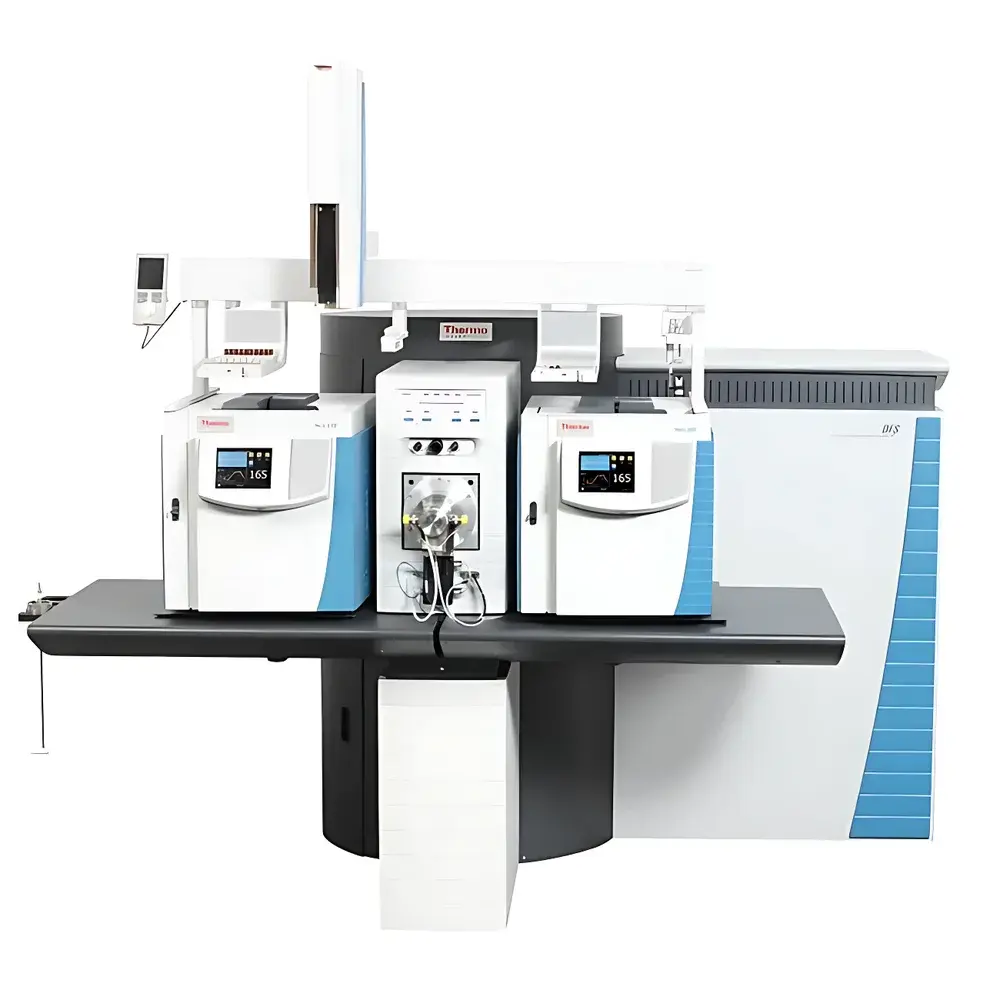
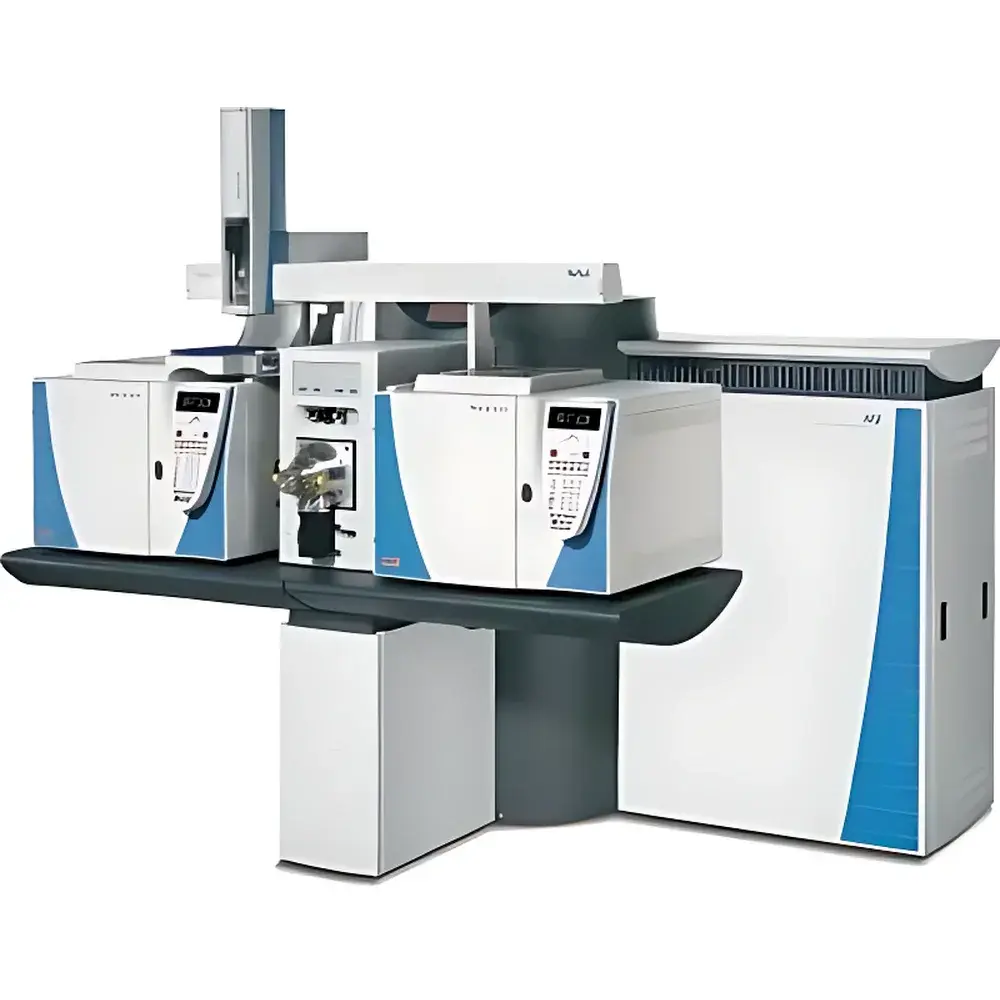
Thermo Fisher DFS High-Resolution Magnetic Sector Gas Chromatography Mass Spectrometer
| Brand | Thermo Fisher |
|---|---|
| Origin | USA |
| Manufacturer Type | Original Equipment Manufacturer (OEM) |
| Origin Category | Imported Instrument |
| Model | DFS High-Resolution GC/MS |
| Instrument Type | Magnetic Sector Mass Spectrometer |
| GC Configuration | Dual-Column, Dual-Trace 1310 GC Integration |
| Automation | TriPlus RSH Autosampler |
| Ion Source | Removable, Vacuum-Lock Ion Box |
| Analyzer Architecture | Double-Focusing Magnetic Sector with Ring-shaped Electrostatic Analyzer (ESA) |
| Calibration | Field-Based Mass Calibration Independent of Scan Speed, Ion Polarity, and Ionization Mode |
| Detection | Dual-Stage Electron Multiplier with Pneumatic Valve Vacuum Lock |
| Regulatory Compliance | Designed for EPA Method 1613/8270, EU Directive 2006/122/EC, WHO IPCS Dioxin Guidelines, USP <1225>, FDA 21 CFR Part 11 Audit Trail Support |
Overview
The Thermo Fisher DFS High-Resolution Magnetic Sector Gas Chromatography Mass Spectrometer represents the pinnacle of sector-based mass spectrometry for trace-level organic analysis. Engineered on the fundamental principles of double-focusing magnetic sector geometry—combining a high-precision ring-shaped electrostatic analyzer (ESA) and a radially laminated permanent magnet—the DFS achieves true mass-resolving power exceeding 10,000 (10% valley definition) across its full mass range (m/z 10–1000). Unlike quadrupole or time-of-flight systems, the DFS delivers mass accuracy better than 0.2 ppm and isotopic fidelity validated under ISO/IEC 17025-accredited laboratory conditions. Its field-calibrated mass scale ensures long-term stability without recalibration during extended unattended runs—a critical requirement for regulatory dioxin/furan analysis per EPA Method 1613 and EU Commission Regulation (EU) No 2017/644. The instrument operates exclusively in electron ionization (EI) mode at 70 eV, with optional chemical ionization (CI) capability via interchangeable ion sources.
Key Features
- Radially segmented permanent magnet design enabling exceptional magnetic field homogeneity and thermal stability over 72-hour continuous operation.
- Field-based mass calibration: eliminates dependency on scan rate, ion polarity, or ionization method—ensuring consistent mass assignment across EI, CI, and negative-ion modes.
- Ring-shaped ESA with dynamically optimized voltage gradients delivering zero image distortion and sub-ppm mass accuracy without real-time tuning adjustments.
- Pneumatic valve vacuum lock system allows rapid ion source exchange (<90 seconds) without venting the main analyzer chamber—maintaining ultra-high vacuum (≤5 × 10⁻⁹ mbar) in the magnetic sector region.
- Dual-Trace 1310 GC integration: two independent capillary GC systems mounted orthogonally to a single ion source, enabling parallel chromatographic separation using columns of differing polarity (e.g., DB-5ms + HT-8) within one autosampler sequence.
- TriPlus RSH autosampler with 160-vial capacity, programmable solvent wash, and dual-needle configuration for cross-contamination mitigation in high-throughput environmental labs.
- Fully automated ion source tuning: resolution, sensitivity, and peak shape optimization executed via preloaded method templates compliant with ASTM D6866 and ISO 17034 reference material protocols.
Sample Compatibility & Compliance
The DFS is validated for solid, liquid, and gaseous matrices following EPA SW-846 Methods 3510C (liquid-liquid extraction), 3540C (Soxhlet), and 5021A (purge-and-trap). It supports derivatized and underivatized analytes—including PCDD/Fs, PCBs, brominated flame retardants (PBDEs, HBCDs), organochlorine pesticides (DDT, chlordane), and emerging contaminants such as PFAS precursors. All data acquisition and processing workflows comply with GLP/GMP requirements per 21 CFR Part 11, including electronic signatures, audit trails, and secure user role management. System suitability tests adhere to USP validation parameters: specificity, linearity (r² ≥ 0.9995 over 5 orders of magnitude), LOD/LOQ verification at sub-fg on-column levels, and intermediate precision ≤3.5% RSD (n = 6).
Software & Data Management
Xcalibur 4.5 software provides complete instrument control, quantitative analysis (AIA format export), and spectral deconvolution via AMDIS. The DFS-specific “DFS Tune Wizard” automates resolution ramping, mass axis alignment, and detector gain optimization without manual voltage manipulation. Raw data files (.RAW) are stored with embedded metadata: column history, tune report timestamps, vacuum logs, and magnetic field current stability metrics. Integrated LIMS connectivity supports ASTM E1578-compliant instrument interface protocols. All calibration files and method templates are digitally signed and version-controlled, enabling full traceability from raw signal to final quantitation report.
Applications
The DFS serves as the reference platform for dioxin congener-specific quantification in food safety (EU Regulation 1881/2006), environmental monitoring (EPA Region 10 QA/QC Plan), and pharmaceutical impurity profiling (ICH Q5A). Its demonstrated detection limit of 0.05 fg I-TEQ for 2,3,7,8-TCDD meets WHO’s provisional tolerable monthly intake (PTMI) requirements. In pesticide residue analysis, it enables simultaneous quantification of tolylfluanid and its degradates with linear dynamic range spanning 0.1–1000 pg injected—validated per SANCO/12571/2013 guidelines. Additional applications include forensic toxicology (designer drug metabolite confirmation), petrochemical biomarker screening (hopanes, steranes), and isotopic ratio measurement (¹³C/¹²C) for origin tracing.
FAQ
What is the maximum achievable mass resolution on the DFS system?
The DFS achieves mass resolution up to 100,000 (10% valley) at m/z 400 when operated in narrow-scan mode with optimized ESA/magnet voltage coupling.
Can the DFS be used for quantitative analysis under ISO/IEC 17025 accreditation?
Yes—its field-calibrated mass scale, documented uncertainty budget (<0.5 ppm mass error), and integrated audit trail functionality satisfy ILAC-G8:2021 requirements for accredited testing laboratories.
Is method transfer possible between DFS instruments across different laboratories?
Method portability is ensured through standardized .MSL method files containing all instrument-specific voltages, dwell times, and calibration coefficients—validated in multi-site interlaboratory studies coordinated by NIST SRM 1945.
Does the DFS support fast GC-MS applications?
While optimized for high-resolution scanning (≥1 sec/decade), the DFS accommodates fast GC methods via segmented acquisition: low-mass region (m/z 100–300) scanned at 0.5 s/decade, high-mass region (m/z 300–600) at 1.5 s/decade, preserving isotopic fidelity without compromising throughput.
How is vacuum integrity maintained during dual-GC operation?
Each Trace 1310 GC features independent differential pumping stages interfaced to the DFS ion source via heated transfer lines (280 °C) and cryo-cooled foreline traps—ensuring base pressure remains stable at ≤3 × 10⁻⁸ mbar during simultaneous elution events.




