
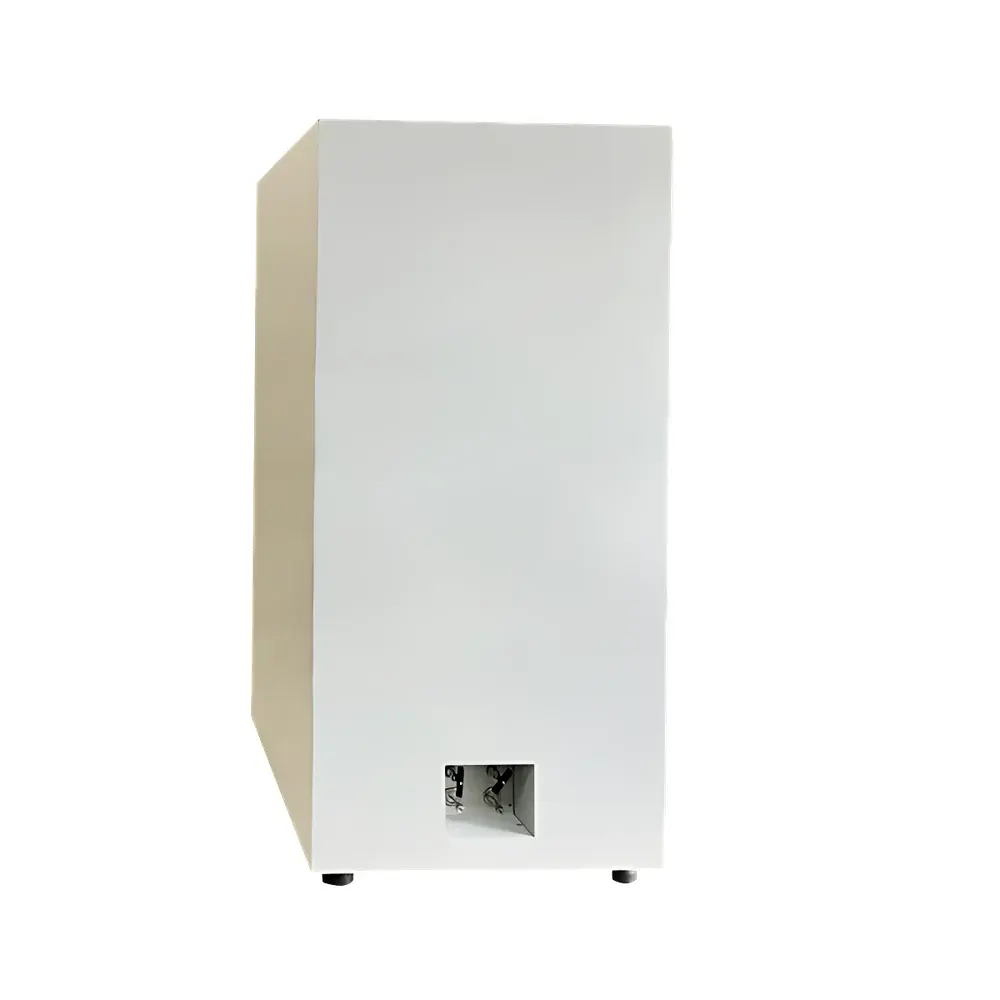
Xiatech TC3400L Cryogenic Liquid Thermal Conductivity Analyzer
| Brand | Xiatech |
|---|---|
| Origin | Shaanxi, China |
| Model | TC3400L |
| Measurement Principle | Transient Hot-Wire Method |
| Temperature Range | −160 °C to Ambient |
| Pressure Range | 0.1–15 MPa |
| Thermal Conductivity Range | 0.0005–2 W/(m·K) |
| Accuracy | ±3 % |
| Repeatability | ±3 % |
| Sample Form | Liquid |
| Dimensions (L×W×H) | 50 cm × 50 cm × 80 cm |
| Measurement Time | ≤2 s |
Overview
The Xiatech TC3400L Cryogenic Liquid Thermal Conductivity Analyzer is a precision-engineered instrument designed for the accurate determination of thermal conductivity in liquid-phase materials under extreme low-temperature and high-pressure conditions. It employs the transient hot-wire (THW) method—a well-established, ASTM-standardized technique (ASTM D7896-20) for absolute thermal conductivity measurement—where a fine metallic wire serves simultaneously as heater and resistance thermometer. A short-duration current pulse induces a controlled temperature rise; the resulting time-dependent voltage response is analyzed to extract thermal conductivity with minimal influence from natural convection, thanks to sub-second measurement duration. The TC3400L extends this principle into cryogenic regimes, enabling reliable characterization from −160 °C (liquid nitrogen boiling point) up to ambient temperature, while maintaining structural integrity and sensor stability at pressures up to 15 MPa. This capability supports fundamental thermophysical property research, refrigerant screening, advanced lubricant development, and qualification of next-generation heat-transfer fluids for aerospace, cryogenics, and energy storage applications.
Key Features
- Ultra-low temperature operation: Stable, calibrated measurements from −160 °C to room temperature using integrated cryostat-compatible cell design and low-drift platinum RTD sensors.
- High-pressure compatibility: Sealed stainless-steel measurement cell rated to 15 MPa, with precision pressure transducer feedback and digital PID-controlled pressure regulation (0.1–15 MPa range).
- Transient hot-wire architecture: Eliminates convective interference through ≤2 s measurement cycles; enables direct, absolute thermal conductivity determination without calibration standards.
- Wide dynamic range: Accurately resolves thermal conductivities from 0.0005 W/(m·K) (e.g., liquid methane or perfluorinated dielectric fluids) to 2 W/(m·K) (e.g., ethylene glycol–water mixtures), covering both insulating and moderately conductive liquids.
- Integrated environmental control: Dual-zone thermal management ensures uniform temperature distribution across the hot-wire and sample volume, critical for reproducibility at cryogenic conditions.
- Rugged benchtop form factor: Compact footprint (50 × 50 × 80 cm) optimized for integration into gloveboxes, cryogenic labs, or high-pressure test stations.
Sample Compatibility & Compliance
The TC3400L is validated for homogeneous, non-reactive liquid samples—including polar and non-polar fluids such as synthetic lubricants, fluorinated coolants (e.g., FC-72, Novec 7100), cryogenic propellants (LOX, LH₂ surrogates), nanofluids, refrigerants (R134a, R245fa), and ionic liquid candidates. Sample volume requirement is minimal (<15 mL), reducing material cost and enabling rapid screening. All wetted parts are electropolished 316L stainless steel or fused quartz, ensuring chemical inertness and vacuum compatibility. The system complies with ISO/IEC 17025 traceability requirements for thermal property instrumentation and supports GLP/GMP-aligned documentation workflows. Pressure and temperature control modules meet PED 2014/68/EU essential safety requirements for pressurized equipment.
Software & Data Management
Xiatech’s proprietary TC-Studio v4.2 software provides full instrument control, real-time data acquisition, and automated curve fitting using inverse Laplace transformation algorithms compliant with the THW theoretical model (Carslaw & Jaeger solution). Users generate dual-parameter datasets—thermal conductivity vs. temperature and thermal conductivity vs. pressure—with synchronized timestamping, metadata tagging (operator, sample ID, atmospheric conditions), and audit-trail logging. Export formats include CSV, MATLAB (.mat), and PDF reports adhering to ASTM E2554 statistical reporting guidelines. Software supports 21 CFR Part 11-compliant user authentication, electronic signatures, and change history tracking for regulated environments.
Applications
- Thermophysical property validation of new refrigerants for low-GWP HVAC systems.
- Performance mapping of dielectric coolants used in immersion cooling for high-power electronics and battery thermal management.
- Fundamental studies on density-dependent thermal transport in supercritical fluids and quantum liquids.
- Quality control of specialty lubricants operating in cryogenic bearings or space mechanisms.
- Supporting NIST SRM development and inter-laboratory round-robin testing programs.
- Input data generation for multiphysics simulation models (e.g., ANSYS Fluent, COMSOL) requiring temperature- and pressure-dependent k-values.
FAQ
What calibration standards are required for the TC3400L?
None—the transient hot-wire method is an absolute technique; calibration is performed via electrical parameter traceability (NIST-traceable multimeter and current source), not reference fluids.
Can the TC3400L measure viscous or nanoparticle-laden liquids?
Yes, provided the suspension remains stable during the <2 s measurement window and does not coat the hot-wire surface; optional ultrasonic agitation module available for pre-test homogenization.
Is the system compatible with inert-atmosphere handling?
Yes—standard configuration includes Swagelok VCR fittings and helium-leak-tested manifolds, enabling integration with dry nitrogen or argon purge lines.
How is temperature uniformity verified across the measurement zone?
Via embedded multi-point RTD array and post-run thermal profile reconstruction using finite-difference modeling within TC-Studio.
Does the instrument support automated temperature/pressure ramping sequences?
Yes—programmable multi-step protocols allow unattended acquisition of k(T,P) surfaces over defined grids, with configurable dwell times and step resolution.
Related Products



