
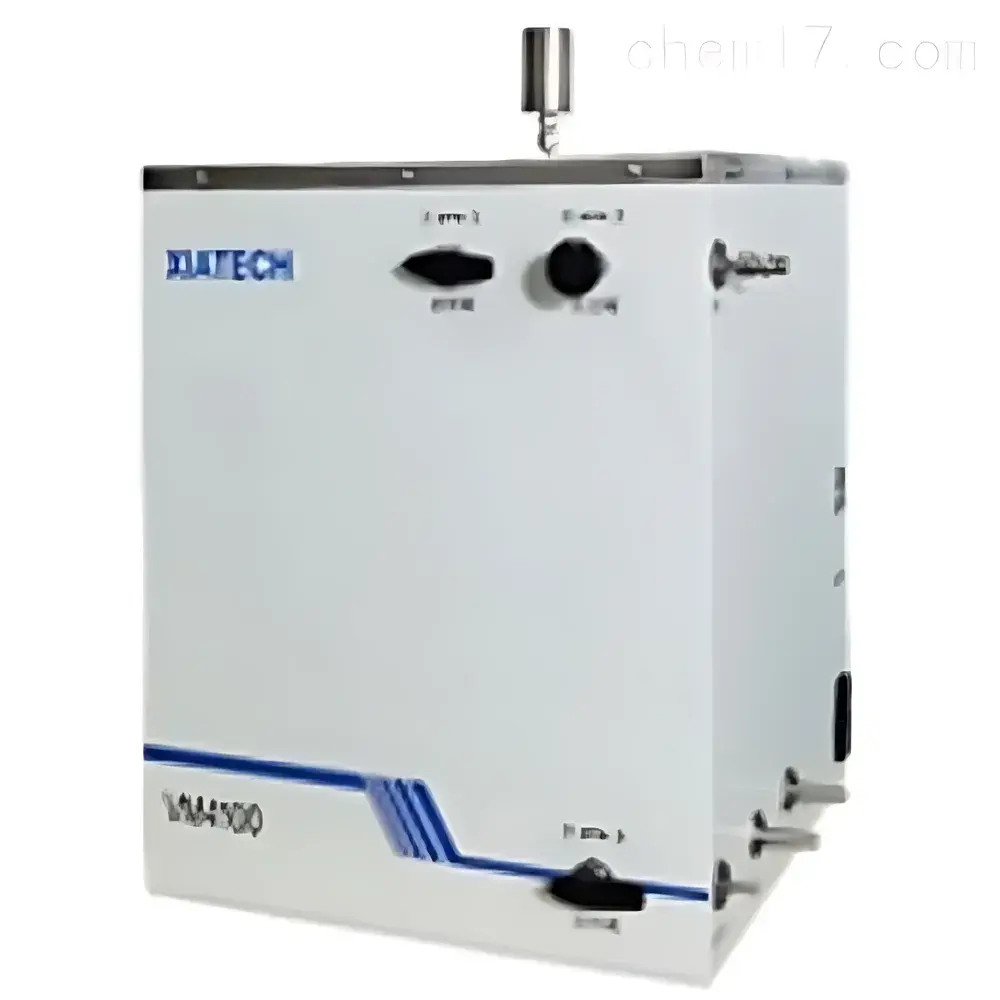
Xiatech VM4300 Cryogenic Viscometer
| Brand | Xiatech |
|---|---|
| Origin | Shaanxi, China |
| Model | VM4300 |
| Viscosity Range | ≤200 µPa·s |
| Temperature Range | 14–300 K |
| Pressure Range | 0.1–4 MPa |
| Accuracy | ±3% |
| Measurement Principle | Vibrating Wire Method |
| Interface | USB |
| Operating System | Windows |
| Power Supply | 220 V, 50 Hz |
Overview
The Xiatech VM4300 Cryogenic Viscometer is a precision-engineered instrument designed for absolute viscosity measurement of Newtonian fluids under extreme cryogenic conditions. It operates on the well-established vibrating wire (or vibrating string) principle—a primary method in metrology for dynamic viscosity determination at low temperatures. In this technique, a thin metallic wire immersed in the test fluid is electromagnetically excited into resonant oscillation; damping of the oscillation amplitude and decay rate are directly correlated to the fluid’s shear viscosity via fundamental hydrodynamic theory (Stokes’ law for cylindrical geometry and Navier–Stokes solutions in the low Reynolds number regime). The VM4300 is specifically calibrated and validated for use with cryogens including liquid hydrogen (LH₂), liquid nitrogen (LN₂), helium mixtures, methane, and other low-boiling-point industrial fluids. Its operational temperature envelope spans from 14 K—near the lambda point of helium—to 300 K, enabling continuous characterization across quantum fluid regimes, supercritical transitions, and ambient-phase reference points. This makes the VM4300 suitable not only for academic cryophysics research but also for aerospace propulsion system development, superconducting coolant qualification, and national metrology institute (NMI) traceability programs.
Key Features
- Primary-standard-grade vibrating wire sensor architecture with temperature-stabilized quartz suspension and low-noise electromagnetic drive/detection electronics
- Integrated high-stability cryostat interface supporting closed-cycle refrigerators (CCR), liquid cryogen dewars, and hybrid pressure-temperature control systems
- Simultaneous acquisition of viscosity vs. temperature (η–T) and viscosity vs. pressure (η–P) profiles within a single experimental setup
- ±3% full-scale accuracy certified against NIST-traceable reference oils and internationally accepted cryogenic standards (e.g., ISO 3104 Annex D for low-viscosity calibration)
- Real-time resonance frequency and Q-factor monitoring to detect onset of non-Newtonian behavior or phase separation during measurement
- Compact, benchtop-fixed configuration with rigid thermal isolation design minimizing parasitic heat load and mechanical drift
Sample Compatibility & Compliance
The VM4300 accepts sealed, inert-gas-purged sample cells compatible with pressures up to 4 MPa and temperatures down to 14 K. It supports both pure-component cryogens and binary/multi-component mixtures relevant to LNG processing, hydrogen storage media, and quantum fluid studies. All wetted parts are constructed from oxygen-compatible stainless steel (ASTM F86/F138) and electropolished to prevent catalytic decomposition or surface adsorption artifacts. The system complies with ISO/IEC 17025 requirements for testing laboratories and supports audit-ready documentation for GLP and GMP environments. When operated with optional pressure transducers and PT100-class cryogenic thermometers, data meets ASTM D7042 and ISO 2555 reporting conventions for dynamic viscosity under variable thermodynamic conditions.
Software & Data Management
The bundled Windows-based control software provides intuitive workflow navigation, automated temperature/pressure ramping, real-time curve fitting (Arrhenius, Vogel–Fulcher–Tammann, and power-law models), and export to CSV, XML, or HDF5 formats. All raw sensor signals—including excitation voltage, resonance amplitude, phase lag, and thermal time constants—are logged with timestamped metadata (including ambient lab conditions, cell ID, operator ID, and calibration certificate expiry). Audit trails comply with FDA 21 CFR Part 11 requirements when configured with user role management and electronic signature modules. Raw data files retain full bit-depth resolution for post-acquisition reprocessing using third-party analysis tools such as MATLAB or Python-based SciPy pipelines.
Applications
- Thermophysical property validation for NASA CEA and ESA PROPULSION databases
- Viscosity benchmarking of liquid hydrogen fuel candidates for reusable launch vehicles
- Development and verification of molecular dynamics (MD) simulation force fields at cryogenic densities
- Quality control of ultra-high-purity cryogenic coolants used in MRI magnets and particle accelerator cavities
- Interlaboratory comparison studies organized by BIPM CCT-WG on transport properties at low temperatures
- Calibration transfer between national metrology institutes (NMIs) and industrial cryogenic test facilities
FAQ
What is the minimum sample volume required for a valid measurement?
Typical cell capacity is 1.2 mL; minimum functional volume is 0.8 mL with full accuracy retention.
Can the VM4300 measure non-Newtonian fluids?
It is optimized for Newtonian behavior; apparent viscosity deviations exceeding ±5% across frequency sweeps indicate structural relaxation or yield stress, requiring complementary rheometry.
Is external vacuum pumping required for operation below 77 K?
No—integrated multilayer insulation and cold-shield design eliminate need for active vacuum maintenance during LN₂/LH₂ operation.
Does the system support automated calibration routines?
Yes—preloaded calibration sequences for standard reference materials (SRMs) 279a, 279b, and 850 are included, with user-definable custom SRM libraries.
How is thermal equilibration verified before data acquisition?
Software enforces a dual-threshold stability criterion: <0.01 K/min drift over 120 s and <5 mK RMS fluctuation in dual-sensor readout prior to trigger.



