
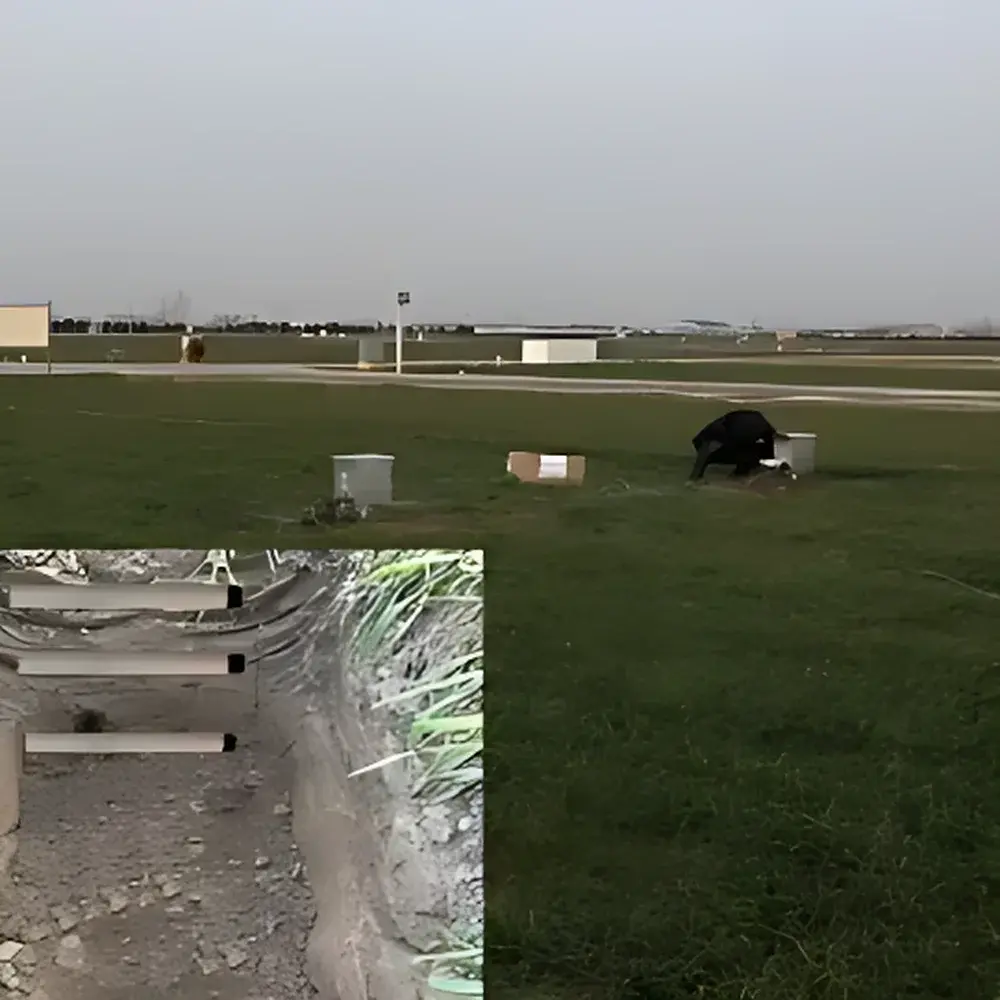
AZ iChamber-G Underground Greenhouse Gas Profile Monitoring System
| Brand | AZ (Beijing Aozuo) |
|---|---|
| Origin | Beijing, China |
| Manufacturer Type | Direct Manufacturer |
| Country of Origin | China |
| Model | iChamber-G |
| Pricing | Upon Request |
| Data Logger CPU | 32-bit FPU processor, 180 MHz |
| Sensor Channels | 40 SDI-12 ports (expandable) |
| Memory | 512 MB |
| Display | 2.54" OLED |
| Connectivity | Integrated 4G module with embedded IoT SIM card |
| CH₄ Range | 0–100 ppm, Accuracy ≤10 ppb |
| N₂O Range | 0–100 ppm, Accuracy ≤10 ppb |
| CO₂ Range | 0–10,000 ppm, Accuracy ≤0.15 ppm |
| NO Range | 0–100 ppm, Accuracy ≤10 ppb |
| H₂O Range | 0–5% v/v, Accuracy ≤1 ppm |
| Soil Gas Probe Pore Size | 0.1 µm |
| Gas Exchange Surface Area | 110 cm² |
| Cavity Volume | 20 mL |
| Probe Diameter | 12 mm |
| Probe Length Options | 150 mm or 300 mm |
| Tubing Length | Standard 3 m (extendable to 5 m) |
Overview
The AZ iChamber-G Underground Greenhouse Gas Profile Monitoring System is a field-deployable, continuous in-situ measurement platform engineered for high-resolution vertical profiling of key greenhouse gases (GHGs) and water vapor within the unsaturated soil zone. It operates on the principle of passive/active equilibrium-driven gas sampling: stainless-steel soil gas probes—installed at discrete depths—are connected via inert tubing to a centralized multi-gas analyzer. A low-pulse diaphragm pump draws equilibrated soil gas from each probe cavity into the analyzer’s optical detection cells, where trace concentrations of CH₄, N₂O, CO₂, NO, and H₂O are quantified using tunable diode laser absorption spectroscopy (TDLAS) and non-dispersive infrared (NDIR) technologies. Designed for long-term unattended operation in heterogeneous field conditions—including wetlands, agricultural soils, and landfill cover systems—the system delivers time-synchronized, depth-resolved concentration data essential for quantifying soil-atmosphere exchange fluxes, identifying biogeochemical hotspots, and validating process-based carbon and nitrogen cycle models.
Key Features
- Modular depth-profiling architecture: Supports up to 8 independently configurable soil gas probes (standard configuration), enabling simultaneous monitoring across 0.1–2.0 m depth intervals.
- High-fidelity gas analysis: Dual-technology detection (TDLAS for CH₄/N₂O/NO; NDIR for CO₂; capacitive sensor for H₂O) ensures sub-ppb sensitivity and minimal cross-interference under variable temperature and humidity.
- Ruggedized field data logger: ARM-based 32-bit processor with floating-point unit (180 MHz), 512 MB internal storage, and real-time clock with GPS-synced timestamping for audit-trail integrity.
- Integrated 4G-LTE connectivity: Pre-provisioned IoT SIM card enables secure, encrypted MQTT/HTTPS transmission of raw and processed data to cloud platforms or on-premise servers—fully compliant with ISO/IEC 27001 data-in-transit requirements.
- Low-power design: Optimized for solar-battery hybrid operation; average power draw 6 months runtime on a 24 Ah LiFePO₄ battery bank.
- Probe-specific calibration traceability: Each soil gas probe includes a serialized calibration certificate referencing NIST-traceable standard gases, aligned with ISO 17025 laboratory practices.
Sample Compatibility & Compliance
The iChamber-G is validated for use in mineral soils, organic-rich peatlands, flooded rice paddies, and compacted landfill caps. Its 12 mm diameter, 0.1 µm hydrophobic membrane probe minimizes biofouling and water ingress while maintaining rapid gas equilibration kinetics (t₉₀ < 120 s in 30% moisture soils). All wetted materials—including FEP tubing, stainless-steel probe bodies, and PTFE-sealed fittings—comply with EPA Method TO-15 and ASTM D5208 for volatile organic compound (VOC)-free sampling. The system meets CE marking requirements for electromagnetic compatibility (EN 61326-1) and environmental robustness (IP67-rated enclosure). Data acquisition workflows support GLP-compliant metadata tagging (depth, soil texture, bulk density, temperature) and are compatible with FDA 21 CFR Part 11–enabled LIMS integration when deployed in regulated environmental monitoring programs.
Software & Data Management
The AZ FieldLink™ software suite provides local configuration, real-time diagnostics, and automated QA/QC flagging (e.g., pressure drift >±0.5 kPa, signal-to-noise ratio 50 ppm at 0.3 m depth triggers SMS/email notification), gap-filling via multiple linear regression (MLR) against auxiliary soil temperature/moisture sensors, and export to CSV, MATLAB, or Python Pandas-compatible HDF5. Audit logs record all user actions, firmware updates, and calibration events with SHA-256 hashing for forensic traceability.
Applications
- Quantification of diffusive and ebullitive CH₄ emissions from permafrost thaw zones and northern peatlands.
- Process-level validation of denitrification and nitrification rates via N₂O/NO co-monitoring across redox gradients.
- Root-zone respiration partitioning studies using dual-isotope (¹³CO₂, ¹⁵N₂O) compatible probe configurations.
- Long-term performance assessment of engineered landfill cover systems under varying precipitation regimes.
- Soil carbon sequestration verification in regenerative agriculture trials (e.g., no-till, cover cropping).
- Calibration and ground-truthing of airborne GHG remote sensing campaigns (e.g., NASA ASCENDS, ESA CO2M).
FAQ
What depth resolution can the iChamber-G achieve?
Standard probe spacing is configurable from 5 cm to 50 cm intervals; minimum practical resolution is limited by probe length (150 mm or 300 mm) and installation precision—not instrument capability.
Can the system operate in saturated soils or shallow groundwater?
Yes—the 0.1 µm hydrophobic membrane prevents liquid water intrusion while permitting full gas-phase diffusion; validated for use in water tables fluctuating ±10 cm around probe depth.
Is factory recalibration required annually?
No—zero/span stability is verified every 90 days via onboard reference gas pulses; full recalibration is recommended only after sensor replacement or exposure to >500 ppm H₂S contamination.
How is data security ensured during wireless transmission?
All 4G transmissions use TLS 1.2 encryption with device-authenticated X.509 certificates; payload payloads are AES-256 encrypted prior to network handoff.
Does the system support third-party sensor integration?
Yes—via SDI-12 interface (40 channels) and optional RS-485 Modbus RTU expansion, enabling synchronized acquisition of soil temperature, matric potential, EC, and O₂.
Related Products







