
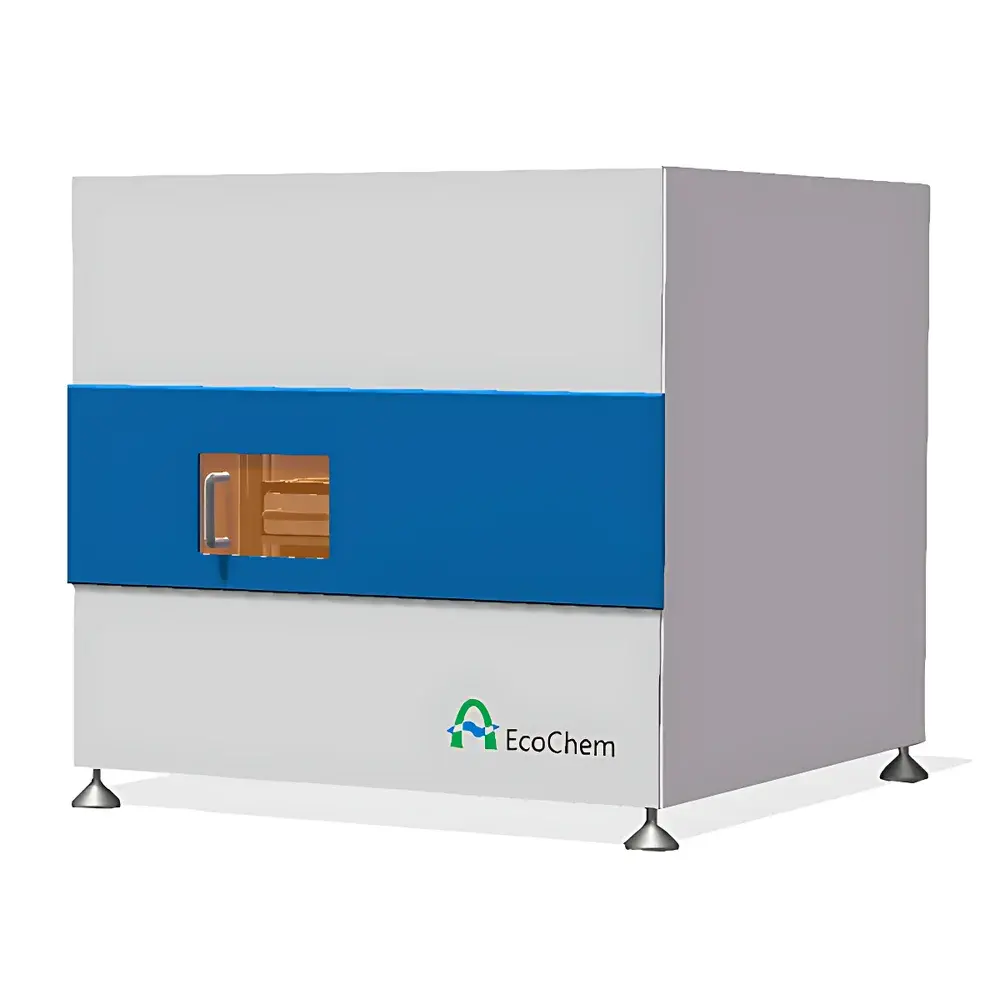
EcoChem AZ Laser-Induced Breakdown Spectroscopy (LIBS) Elemental Analysis System
| Brand | AZ (Beijing Aozuo) |
|---|---|
| Origin | Beijing, China |
| Manufacturer Type | Original Equipment Manufacturer (OEM) |
| Instrument Type | Benchtop |
| Integration | Fully Integrated System |
| Laser Source | Nd:YAG, 200 mJ @ 1064 nm (266 nm optional) |
| Repetition Rate | 20 Hz |
| Pulse Width | <6 ns |
| Spot Size | 20–200 µm (motorized adjustment) |
| Spectral Range | 190–1040 nm |
| Detector | Back-illuminated CCD with auto-height alignment |
| Safety Class | I (interlocked laser enclosure) |
| Software | ElementLIBS & NIST spectral libraries, PLS/PCA modeling, mapping, autofocus, dual-lens control (wide-field + magnified), gas flow regulation, soil/plant calibration databases |
Overview
The EcoChem AZ Laser-Induced Breakdown Spectroscopy (LIBS) Elemental Analysis System is a benchtop, fully integrated analytical platform engineered for rapid, multi-elemental characterization of solid and heterogeneous samples without chemical digestion or vacuum requirements. Based on the fundamental principles of laser-induced plasma emission spectroscopy, the system utilizes a pulsed Nd:YAG laser to ablate micro-volumes of sample surface—generating transient, high-temperature plasma (>10,000 K). As excited atomic and ionic species in the plasma decay to lower energy states, they emit element-specific photons across the UV-VIS-NIR spectrum (190–1040 nm). These emissions are collected via an optimized optical train, dispersed by a high-resolution spectrometer, and detected using a thermoelectrically cooled back-illuminated CCD sensor. The resulting spectra are processed in real time to deliver qualitative identification and quantitative concentration data for elements spanning Li to U—including light elements (C, H, O, N, P, S), major nutrients (Ca, Mg, K), transition metals (Fe, Cu, Zn, Mn), heavy metals (Pb, Cd, As, Cr), and rare earths—without matrix-matched standards in many cases.
Key Features
- Fully integrated benchtop architecture with synchronized control of laser, spectrometer, XYZ motorized stage, dual-lens imaging system (wide-field overview + high-magnification targeting), and regulated purge gas delivery (Ar, He, or ambient air)
- Adjustable laser parameters: 200 mJ pulse energy at 1064 nm (0–100% fine-tuned), <6 ns pulse width, 20 Hz repetition rate; optional frequency-quadrupled 266 nm module for enhanced ablation of transparent or low-absorbing materials
- Precision beam delivery: Motorized spot size control (20–200 µm) with automated focus feedback loop and real-time plasma monitoring for reproducible ablation geometry
- Class-I laser safety compliance: Interlocked enclosure with automatic shutter activation, beam path containment, and fail-safe power cutoff per IEC 60825-1
- High-fidelity spectral acquisition: Broadband coverage (190–1040 nm) with sub-pixel wavelength calibration stability (<0.01 nm/h drift), enabling simultaneous detection of atomic lines (e.g., Ca II 393.37 nm), ionic lines (Mg II 279.55 nm), and molecular bands (CN violet system, C₂ Swan bands)
- Intelligent signal conditioning: Real-time background subtraction, plasma lifetime gating, and adaptive integration timing to suppress continuum radiation and enhance signal-to-noise ratio (SNR)
Sample Compatibility & Compliance
The EcoChem system accommodates diverse unprepared or minimally prepared solid matrices—including soils, sediments, plant tissues (leaves, roots, seeds), mineral specimens, metallurgical alloys, gemstones, forensic trace evidence (paint chips, glass fragments), pharmaceutical botanicals, and coal powders. No conductive coating, vacuum chamber, or pelletization is required. Sample flatness tolerance: ±150 µm over 10 mm²; maximum sample height: 50 mm. The system supports GLP-compliant workflows through audit-trail-enabled software logging (user actions, instrument parameters, spectral metadata), electronic signatures, and secure data export (CSV, HDF5, .spc). While not FDA 21 CFR Part 11 certified out-of-the-box, the software architecture supports validation protocols for regulated environments (e.g., ISO/IEC 17025 testing laboratories, USP method development).
Software & Data Management
Control and analysis are executed via a dedicated Windows-based application featuring bilingual UI (English/Chinese toggle) and modular workflow design. Core capabilities include: hardware orchestration (laser firing, stage motion, lens switching, gas valve actuation); multi-modal sampling (single-shot, line scan, raster mapping, circular pattern); automated focus optimization using contrast-based image analysis; spectral library matching against NIST Atomic Spectra Database and ElementLIBS reference set (≥85 elements); multivariate calibration using Partial Least Squares (PLS) regression for quantitative analysis; Principal Component Analysis (PCA) for unsupervised classification and provenance discrimination; spatial elemental mapping with pixel-level quantification and heat-map visualization (up to 100 × 100 point grids); and embedded regional calibration curves for Chinese agricultural soils and medicinal herbs. All raw spectra, processed results, and metadata are stored in timestamped project files with SHA-256 checksum integrity verification.
Applications
- Agricultural & Environmental Science: Rapid screening of soil macronutrients (N, P, K, Ca, Mg), micronutrients (Fe, Zn, B, Mo), and contaminants (Cd, Pb, As) directly from field-collected samples; spatial mapping of nutrient gradients in plant leaves or seed embryos; classification of cultivars and geographic origin of grains and herbs
- Geosciences & Mining: In-situ mineral phase identification, ore grade estimation, and lithological differentiation without sample dissolution; analysis of drill core fragments and polished thin sections
- Materials Science: Alloy composition verification (stainless steels, Al/Mg/Ti alloys), coating thickness and homogeneity assessment, inclusion analysis in ceramics and composites
- Forensics & Authentication: Discrimination of glass, paint, soil, and metal fragments based on elemental fingerprinting; gemstone origin determination (e.g., ruby vs. synthetic); counterfeit pharmaceutical detection via elemental impurity profiling
- Life Sciences: Mapping of elemental distributions in biological tissues (e.g., Fe accumulation in diseased leaf regions, Zn localization in seed endosperm); viability assessment of seeds via metabolic element ratios (K/Ca, Mg/P)
FAQ
What sample preparation is required prior to LIBS analysis?
Minimal to none: Solid samples require only surface cleaning (e.g., dust removal) and placement on the XYZ stage. No grinding, pressing, or acid digestion is necessary.
Can the system quantify light elements such as carbon, oxygen, and nitrogen?
Yes—unlike many XRF or ICP-based systems, LIBS inherently detects C, N, O, H, and Li due to its broad UV spectral response and direct plasma excitation mechanism.
How does the system handle matrix effects in heterogeneous samples like soil or plant tissue?
Through multivariate calibration (PLS) trained on representative reference materials, combined with internal standardization (e.g., using Ca or Si lines) and spatial averaging across multiple laser shots per measurement location.
Is spectral database matching sufficient for elemental identification, or is quantitative calibration mandatory?
Qualitative identification via peak matching is robust for presence/absence screening; however, accurate quantification requires matrix-matched or empirical calibration models, which the software supports via user-defined or preloaded soil/plant libraries.
What maintenance is required for long-term operational stability?
Annual optical alignment verification, quarterly CCD dark-current characterization, biannual laser energy calibration using a certified pyroelectric sensor, and routine cleaning of collection optics and focusing lenses with spectroscopic-grade solvents.





