
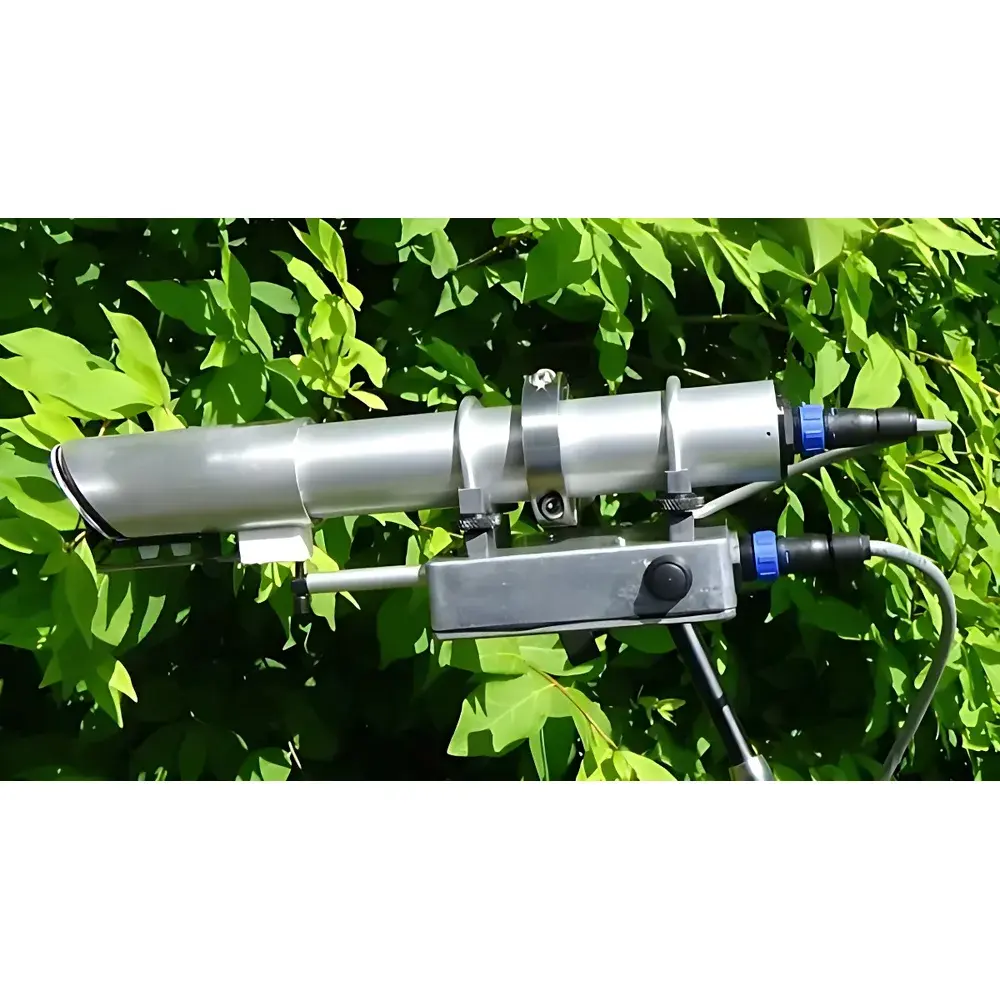
OPTI PSP32 Sunlight-Adapted & Dark-Adapted Chlorophyll Fluorescence Monitoring System
| Brand | OPTI |
|---|---|
| Origin | USA |
| Model | PSP32 |
| Sample Capacity | 32 channels |
| Operating Temperature | −10 °C to +50 °C |
| Light Sources | Blue (455 nm, FWHM 21 nm), Red (640 nm, FWHM 17 nm), Far-Red (for Fo′ induction) |
| Saturation Pulse Intensity | Up to 10,000 μmol·m⁻²·s⁻¹ (blue or red, square-top) |
| Modulated Detection | PIN photodiode with 700–750 nm bandpass filter |
| Sampling Rate | 1–10,000 Hz (auto-selected per protocol) |
| Data Storage | 2 GB internal |
| Connectivity | Wi-Fi (standard), Ethernet, USB, optional cellular/satellite modem |
| Power Options | 12 V DC (battery, solar, or AC adapter) |
Overview
The OPTI PSP32 Sunlight-Adapted & Dark-Adapted Chlorophyll Fluorescence Monitoring System is a field-deployable, multi-channel instrumentation platform engineered for continuous, non-invasive assessment of photosynthetic performance in higher plants under natural environmental conditions. It operates on the principle of pulse-amplitude modulated (PAM) fluorometry, enabling quantitative discrimination between photochemical quenching (qP, qL), non-photochemical quenching (NPQ, qE, qI), and intrinsic PSII quantum efficiency (Y(II), Fv/Fm). Unlike conventional handheld fluorometers limited to single-point, snapshot measurements, the PSP32 supports long-term, autonomous monitoring across up to 32 independent leaf positions—each equipped with programmable light adaptation sequences, dark relaxation protocols, and synchronized environmental co-sensing. Its architecture integrates calibrated actinic illumination, saturating pulses, far-red pre-irradiation (for Fo′ determination), and real-time signal demodulation to resolve transient fluorescence kinetics with high temporal fidelity. Designed for ecological physiology, crop stress phenotyping, and climate-response studies, the system delivers traceable, reproducible datasets compliant with internationally recognized chlorophyll fluorescence reporting conventions (e.g., Maxwell & Johnson, 2000; Kramer et al., 2004; Loriaux et al., 2013).
Key Features
- 32-channel parallel measurement capability with individually addressable optical probes
- Integrated dark-adaptation module enabling automated Fv/Fm, Fv/Fo, and Fo′ acquisition without manual leaf clipping or foil covering
- Multi-wavelength excitation: blue (455 nm) and red (640 nm) actinic sources, plus far-red LED for post-dark-adaptation Fo′ induction
- Configurable measurement protocols—including rapid light curves (RLCs), induction kinetics, and NPQ relaxation series—with user-defined timing, intensity, and repetition intervals
- Ruggedized outdoor enclosure rated for continuous operation from −10 °C to +50 °C, IP65-rated electronics, and corrosion-resistant mounting hardware
- Modular power architecture supporting 12 V DC input from solar panels, deep-cycle batteries, or AC adapters with intelligent charge management
- Onboard 2 GB flash memory with automatic CSV export; data transfer via Wi-Fi (standard), Ethernet, USB, or optional LTE/satellite modem
- Touchscreen controller with intuitive graphical interface for on-site programming, live waveform visualization, and diagnostic feedback
Sample Compatibility & Compliance
The PSP32 accommodates broadleaf, needle, and grass species with minimal leaf distortion, using spring-loaded, low-pressure probe clamps that maintain consistent optical coupling without tissue compression artifacts. Probes are compatible with both standard light-adapted configurations and dark-adaptation units featuring motorized shutter mechanisms and thermal stabilization. All fluorescence parameters adhere to the Minimum Information about a Fluorescence Experiment (MIFE) guidelines and align with ISO 14229-2 (optical sensor calibration traceability) and ASTM E2912-13 (field-deployable plant physiological instrumentation). When paired with optional meteorological sensors (PAR, air temperature, RH), soil moisture/temperature probes, or spectral vegetation indices (NDVI, NDRE, CCCI), the system supports GLP-aligned experimental workflows requiring metadata-rich, time-stamped, and audit-trail-enabled data capture.
Software & Data Management
Data acquisition, scheduling, and remote supervision are managed through OPTI’s proprietary FieldSync™ software suite, accessible via Windows/macOS desktop clients or iOS/Android mobile applications. The embedded controller implements real-time noise reduction algorithms—including 8-point moving average smoothing (25 ms window) for Fm, Fm′, Fo, and Fs—and applies Loriaux (2013) corrections for actinic light interference during Y(II) computation. Exported CSV files contain columnar metadata headers compliant with FAIR principles (Findable, Accessible, Interoperable, Reusable), including timestamp (UTC), probe ID, ambient PAR, leaf temperature, and all derived parameters (e.g., ETR, α, Ik, NPQ(T), qE(T)). Software supports batch processing for rETRmax fitting, qP/qN partitioning, and kinetic modeling using built-in Levenberg–Marquardt solvers. Audit logs record all configuration changes, firmware updates, and user authentication events—meeting FDA 21 CFR Part 11 requirements when deployed in regulated agricultural research environments.
Applications
- Long-term diurnal and seasonal tracking of PSII photochemical efficiency in forest canopies, agroecosystems, and restoration plots
- Drought, heat, cold, and nutrient stress phenotyping in breeding programs—correlating Y(NPQ), qI, and Fv/Fo dynamics with yield traits
- Evaluation of photoprotective capacity across genotypes under elevated CO2 or UV-B exposure scenarios
- Validation of remote sensing vegetation indices (e.g., SIF, NDRE) using ground-truthed fluorescence kinetics
- Controlled-environment facility integration—synchronizing fluorescence outputs with irrigation, lighting, or fertigation actuators via TTL/RS-485 interfaces
- Ecophysiological response modeling, including electron transport rate (ETR) scaling to canopy-level GPP estimates
FAQ
Does the PSP32 require manual dark adaptation before each Fv/Fm measurement?
No—the integrated dark-adaptation module automatically closes its shutter, applies far-red pre-irradiation, and initiates measurement sequences without user intervention.
Can fluorescence data be synchronized with external meteorological or soil sensor networks?
Yes—via RS-485 or analog voltage inputs, the system ingests auxiliary data streams and embeds them into unified timestamped records.
What is the maximum cable length between the main controller and individual probes?
Standard configurations support up to 25 m per channel; extended-range variants (with signal repeaters) accommodate 100 m runs.
Is firmware update capability available over-the-air?
Yes—Wi-Fi-connected units receive signed firmware patches through secure HTTPS endpoints, with rollback and version-locking options.
How is measurement accuracy validated across probe channels?
Each probe undergoes factory calibration against NIST-traceable reference standards; inter-channel drift is monitored via daily zero-fluorescence baseline checks and optional reference leaf validation routines.





