
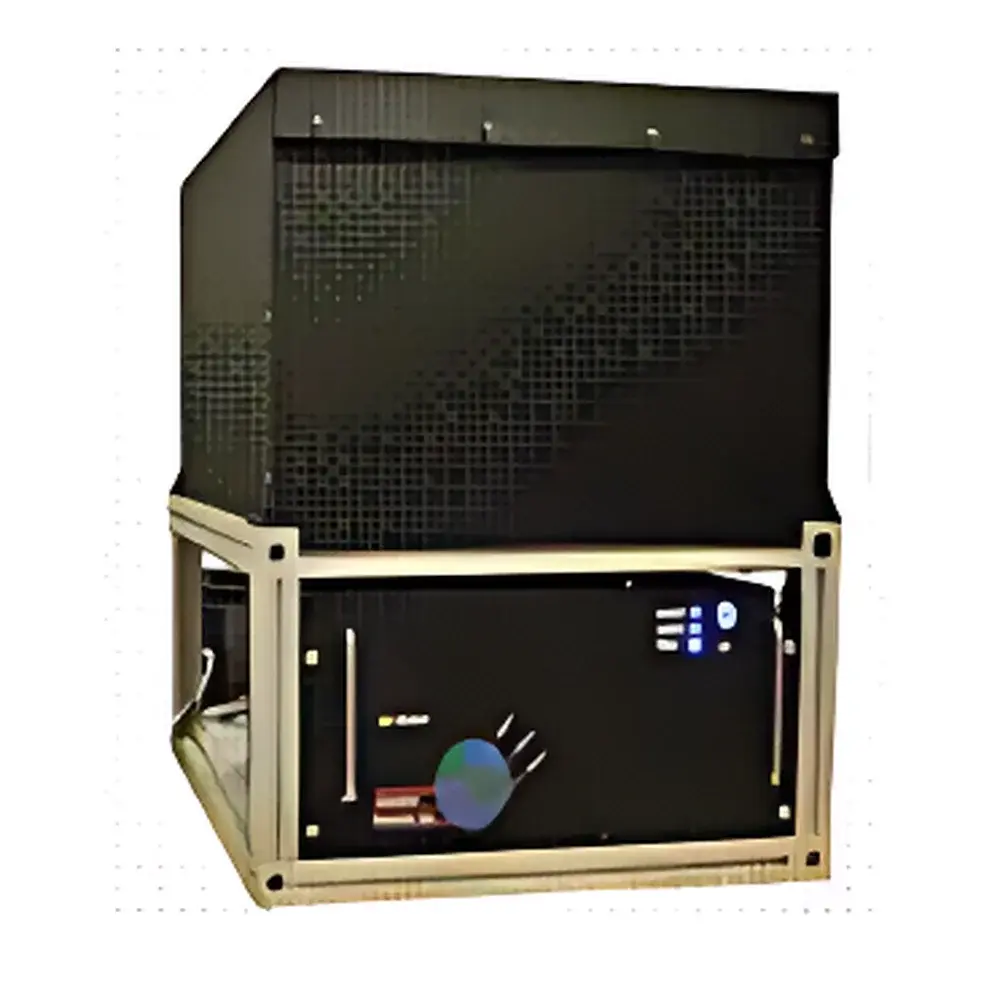
Aerodyne CPEC-AZ Integrated Open-Path Eddy Covariance and Automated Soil Flux Measurement System
| Brand | Aerodyne |
|---|---|
| Model | CPEC-AZ |
| Origin | Beijing, China |
| Manufacturer Type | Authorized Distributor |
| Country of Origin | China |
| Price | USD 1,400 (approx. ¥10,000) |
| Measurement Frequency | 10 Hz (configurable 1–10 Hz) |
| Detection Limit | Sub-ppt Level |
| Temperature-Controlled Enclosure | ±0.07 °C stability, operating range −20 to +40 °C |
| Sample Flow Rate | 0.5–20 SLPM |
| Data Interfaces | RS-232, USB, Ethernet |
| System Weight | 35 kg (core unit) / 75 kg (full configured system) |
| Power Requirement | 250 W, 120/240 V AC, 50/60 Hz |
| TILDAS Analyzer Gas Performance | N₂O (1-s precision: 0.03 ppb), CH₄ (0.25 ppb), CO₂ (100 ppb), NH₃ (40 ppt), H₂O (10 ppm), COS (0.005 ppb), NO (0.15 ppb), NO₂ (0.03 ppb), HONO (0.21 ppb) |
| dynamic range | 0–10,000 ppb (N₂O, CH₄, NH₃, COS, NO, NO₂, HONO), 0–5,000 ppm (CO₂, H₂O, O₃, CO) |
| iChamber Specifications | Footprint options: 1.0 m² × 1.5 m height, 0.3 m² × 0.8 m, or 0.08 m² × 0.5 m |
| sealing integrity | <2 kPa pressure loss over 60 s under −5 kPa differential |
| wind resistance | up to Beaufort Scale 12 |
| operational temperature | −20 to +55 °C |
Overview
The Aerodyne CPEC-AZ Integrated Open-Path Eddy Covariance and Automated Soil Flux Measurement System is an engineered solution for high-temporal-resolution, multi-gas ecosystem flux quantification. It bridges the technical gap between conventional open-path eddy covariance (EC) systems—which are inherently limited in detecting reactive, sticky, or low-abundance trace gases—and rigorous soil-atmosphere exchange studies requiring simultaneous, co-located measurements. By integrating Aerodyne’s quantum cascade laser absorption spectroscopy (QCLAS)-based TILDAS (Tunable Infrared Laser Direct Absorption Spectroscopy) analyzers with a modular open-path CO₂/H₂O and CH₄ sensor suite and a three-dimensional sonic anemometer, the CPEC-AZ enables synchronized, high-fidelity flux calculations for N₂O, NH₃, CH₄, CO₂, CO, H₂O, COS, O₃, NO, NO₂, and HONO—gases critical to biogeochemical cycling, atmospheric chemistry, and climate feedback modeling. The system operates on the fundamental principle of eddy covariance: turbulent fluctuations in gas concentration and vertical wind velocity are cross-correlated at high frequency (1–10 Hz) to compute net vertical flux. Its closed-path architecture eliminates optical path contamination and enables precise, stable calibration traceability—essential for long-term ICOS, FLUXNET, and AmeriFlux-compliant monitoring.
Key Features
- Hybrid open-path/closed-path architecture: Combines industry-standard open-path CO₂/H₂O and CH₄ sensors with Aerodyne’s TILDAS-based closed-path analyzers for trace gas detection beyond open-path capability.
- Active surface passivation module: Chemically inert internal surfaces minimize adsorption/desorption hysteresis for NH₃, HONO, and other polar, condensable species—reducing lag time and improving dynamic response fidelity.
- Inertial particle inlet design: Eliminates secondary aerosol re-suspension and wall losses during sample aspiration, preserving true ambient gas-phase composition.
- Sub-ppt detection sensitivity: Achieved through high-finesse optical cavities and wavelength-scanned QCLAS, enabling robust flux calculation even under low-gradient conditions (e.g., forest understory, agricultural soils).
- Thermally stabilized enclosure: Maintains analyzer core temperature within ±0.07 °C across −20 to +40 °C ambient, ensuring long-term spectral baseline stability and minimizing thermal drift-induced calibration drift.
- Modular iChamber integration: Motorized, height-adaptive soil chambers operate under programmable pressure control, enabling autonomous switching between eddy covariance and chamber-based soil flux modes without manual intervention.
Sample Compatibility & Compliance
The CPEC-AZ system supports continuous, unattended operation in diverse terrestrial ecosystems—including forests, grasslands, croplands, wetlands, and tundra—with full compatibility for both above-canopy turbulent flux and below-canopy soil efflux protocols. Its gas measurement performance meets or exceeds requirements for ISO 14064-1 (GHG inventory verification), ASTM D6348 (trace gas analysis), and US EPA Method TO-15 (VOCs) for analogous species. The TILDAS analyzer complies with NIST-traceable calibration practices, and raw data streams support audit-ready metadata tagging per FAIR (Findable, Accessible, Interoperable, Reusable) principles. All firmware and controller logic adhere to IEC 61131-3 standards for industrial process control reliability. When deployed in GLP/GMP-aligned research environments (e.g., agrochemical impact studies), the system supports 21 CFR Part 11-compliant electronic signatures and full audit trails when paired with certified data acquisition software.
Software & Data Management
Data acquisition, synchronization, and post-processing are managed through Aerodyne’s EddyPro-compatible middleware and custom Python-based flux calculation pipelines. The system outputs time-stamped, high-rate (10 Hz) analog and digital signals via RS-232, USB, and Ethernet interfaces—enabling seamless ingestion into EddyTower, TK3, or custom MATLAB/Python workflows. Raw spectra, calibrated concentrations, and ancillary meteorological parameters (wind vector, temperature, pressure, humidity) are logged in NetCDF-4 format with CF-1.8 metadata conventions. The integrated controller supports programmable duty cycles: e.g., 30-min EC mode followed by 15-min automated iChamber closure sequences across multiple collars. All configuration changes, calibration events, and fault logs are timestamped and stored locally with remote SSH access. Optional cloud sync (AWS S3 or private server) provides real-time QA/QC dashboards and automated alerting for signal dropout, pressure deviation, or temperature excursion.
Applications
- Multi-gas greenhouse gas budgets in managed and natural ecosystems, including N₂O and CH₄ hotspots in rice paddies and fertilized croplands.
- Reactive nitrogen cycling studies: Quantifying NH₃ volatilization from manure application and HONO emissions from soil nitrite photolysis.
- Cosmic-ray neutron sensing (CRNS) and carbonyl sulfide (COS) uptake validation for gross primary production (GPP) partitioning.
- Urban–rural gradient studies of O₃, NOₓ, and CO fluxes at ecosystem boundaries.
- Soil respiration dynamics under climate manipulation experiments (warming, drought, CO₂ enrichment).
- Long-term ICOS-class infrastructure deployments requiring inter-site comparability and metrological traceability.
FAQ
Can the CPEC-AZ measure both eddy covariance and soil flux simultaneously?
No—it alternates between modes using synchronized timing logic. During EC mode, the iChamber remains fully retracted and vented; during soil flux mode, it seals automatically while the sonic anemometer continues logging turbulence statistics for footprint-weighted interpretation.
Is the TILDAS analyzer factory-calibrated for all listed gases?
Yes. Each unit ships with NIST-traceable multi-point calibrations for all target species. Field recalibration is recommended annually using certified standard gases and validated permeation sources.
How does the iChamber minimize microclimate disturbance?
Its low-profile base, non-intrusive mounting, and adaptive height control avoid canopy displacement. Pressure equalization via the column buffer tank prevents artificial drawdown or pressurization that could alter soil gas diffusion pathways.
What level of technical support is provided for flux processing?
Aerodyne partners provide documented Python scripts for spectral correction, time-lag optimization, Webb-Pearman-Leuning (WPL) correction, and u* thresholding—fully compatible with FLUXNET2015 processing guidelines.
Does the system meet requirements for regulatory GHG reporting?
While not a certified emissions monitoring system (CEMS), its metrological rigor, calibration traceability, and uncertainty quantification framework align with IPCC Tier 3 methodologies and are accepted in peer-reviewed carbon accounting studies supporting national inventories.
Related Products







