
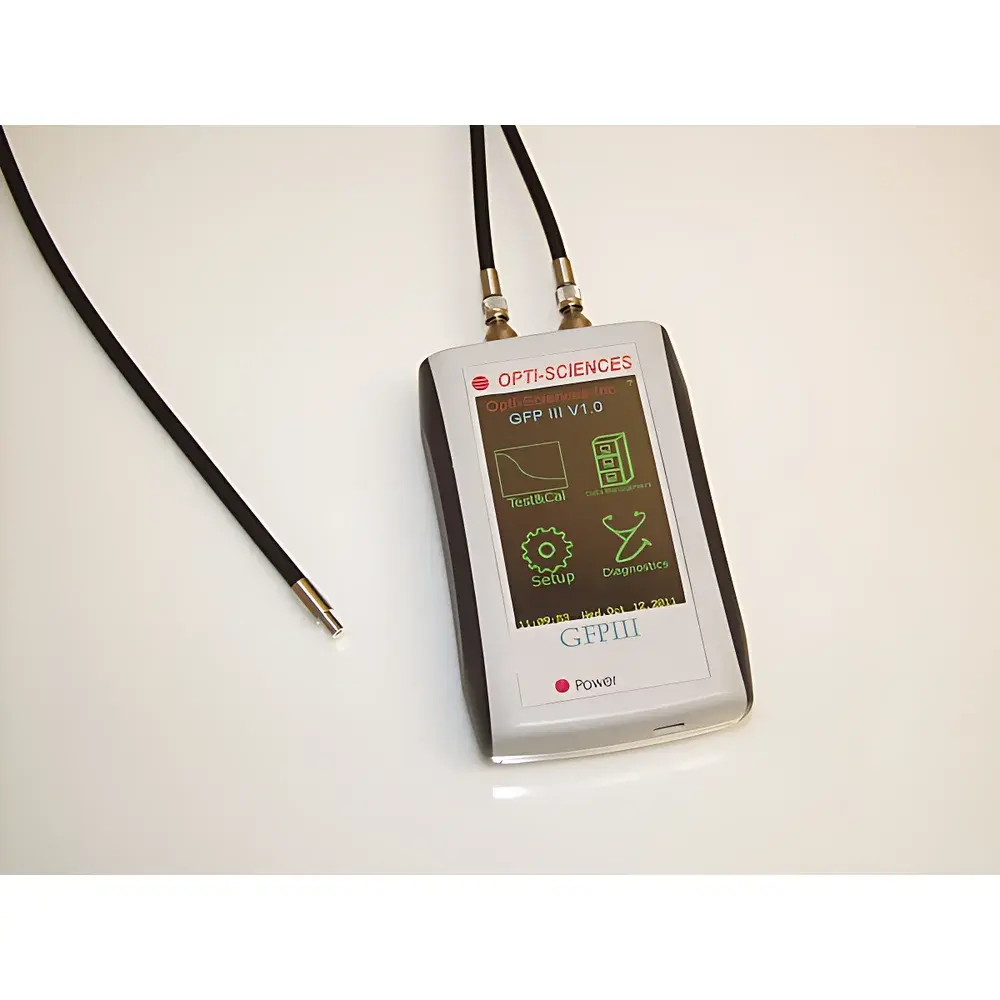
OPTI GFPIII Portable Fluorescence Protein Analyzer
| Brand | OPTI |
|---|---|
| Origin | USA |
| Model | GFPIII |
| Excitation Wavelength Range | 375–660 nm (user-selectable LED sources) |
| Emission Detection Range | 400–750 nm (user-tunable bandpass filters) |
| Detection Limit | ≥10 ppb fluorescein, ≥30 ppb rhodamine in aqueous matrix |
| Resolution | Down to 1 ppb (user-defined calibration) |
| Measurement Modes | Single-point and continuous (1 measurement/sec to 1/min |
| Sensor Head | 3 mm diameter circular area |
| Optical Probe | Branch-type fiber optic sensor (4 mm diameter) |
| Display | 240 × 320 pixel color TFT touchscreen with stylus |
| Memory | 2 GB internal flash storage |
| Power | 2 × rechargeable AA NiMH batteries (8 h continuous operation |
| Operating Temperature | 5–45 °C |
| Dimensions | 12 × 9 × 3 cm |
| Weight | 275 g (0.6 lbs) |
| Interface | USB 2.0 |
| Compliance | Designed for GLP-aligned field deployment |
Overview
The OPTI GFPIII Portable Fluorescence Protein Analyzer is a field-deployable, modulation-based fluorimeter engineered for quantitative detection and monitoring of fluorescent proteins—including green fluorescent protein (GFP), RFP, YFP, CFP, and chimeric variants—as well as conventional fluorophores such as fluorescein, rhodamine B, and proprietary fluorescent tags. Its core optical architecture employs digitally modulated LED excitation (375–660 nm) coupled with wavelength-selective detection (400–750 nm) to suppress ambient light interference and enhance signal-to-noise ratio in variable environmental conditions. Unlike benchtop spectrofluorometers, the GFPIII integrates solid-state fiber-optic sensing with real-time temperature compensation and multi-point calibration routines—enabling reproducible quantification across heterogeneous biological matrices without laboratory infrastructure. The instrument operates on the principle of steady-state fluorescence intensity measurement, where emitted photon flux is linearly correlated to analyte concentration within defined dynamic ranges, validated against NIST-traceable standards in peer-reviewed plant biotechnology studies.
Key Features
- Handheld, ruggedized form factor (275 g) optimized for extended field use in agricultural plots, forest canopies, greenhouse environments, and biosafety containment zones.
- User-configurable excitation/detection modules: interchangeable LED sources and bandpass filters enable method-specific optimization for GFP (ex: 470 nm / em: 510 nm), mCherry (ex: 587 nm / em: 610 nm), or custom fusion proteins.
- Temperature-compensated photodetector and thermal-stabilized LED driver ensure measurement stability across 5–45 °C operational range—critical for diurnal field campaigns.
- High-resolution 240 × 320 color TFT touchscreen with stylus interface supports intuitive navigation, on-device calibration curve generation, and real-time plot rendering of kinetic fluorescence traces.
- Dual operational modes: single-point acquisition for rapid screening or time-series continuous monitoring (programmable interval from 1 sec to 60 sec per reading; up to 4 hours of autonomous data logging).
- 2 GB embedded flash memory stores raw intensity values, calibration coefficients, metadata (GPS-optional via external module), and system configuration—fully accessible via USB 2.0 without host PC dependency.
Sample Compatibility & Compliance
The GFPIII accepts solid, liquid, and semi-solid samples without preprocessing: intact leaves (using included metal leaf clip), excised tissue sections, cell suspensions, soil leachates, water extracts, and microplate wells (with optional adapter). Its 3 mm diameter sensing area ensures spatially resolved measurements suitable for mapping expression gradients across leaf surfaces or root zones. Instrument design adheres to principles aligned with Good Laboratory Practice (GLP) and Good Agricultural Practice (GAP) frameworks: all calibrations are timestamped and stored with operator ID; temperature logs accompany every dataset; and firmware enforces audit-trail integrity for regulatory submissions. While not FDA 21 CFR Part 11-certified out-of-box, the GFPIII’s deterministic calibration workflow and immutable data export format (CSV/TSV) support validation under ISO/IEC 17025-accredited quality systems.
Software & Data Management
Data acquisition, visualization, and export occur entirely onboard—no external software required. The embedded OS permits creation of up to 10 independent calibration curves per session using standard solutions (e.g., serial dilutions of purified GFP or rhodamine). Each curve stores slope, intercept, R², and uncertainty estimates derived from triplicate reference measurements. Real-time graphs display fluorescence intensity vs. time or position; derivative plots assist in identifying induction kinetics or decay profiles. Exported datasets include full metadata headers (instrument ID, firmware version, ambient temperature, filter IDs, user notes) and conform to MIAME-compliant annotation conventions. USB transfer enables direct ingestion into MATLAB, R, or Python-based analysis pipelines—facilitating integration with transcriptomic or phenotypic databases in transgenic crop development workflows.
Applications
- Quantitative assessment of GFP reporter expression in transgenic poplar, Arabidopsis, maize, and rice under field conditions—validated in multi-season trials (Li et al., Tree Physiology, 2009).
- Monitoring promoter activity dynamics in response to abiotic stressors (drought, UV-B exposure, heavy metals) via time-resolved fluorescence imaging of leaf sectors.
- Detection of genetically modified organisms (GMOs) in seed lots or processed food matrices at ≤30 ppb rhodamine-equivalent sensitivity.
- Residue analysis of fluorescently tagged pesticides or agrochemicals in plant tissues and irrigation runoff—supporting EPA Method 8081B-aligned screening protocols.
- In situ validation of CRISPR-Cas9 editing efficiency through co-expression of GFP-linked repair templates in protoplast assays.
- Ecophysiological studies of photosynthetic apparatus integrity via chlorophyll a fluorescence (Fv/Fm) when equipped with red-edge excitation (635 nm) and far-red emission filtering (720–750 nm).
FAQ
What fluorescent proteins can the GFPIII detect?
The GFPIII detects GFP, EGFP, BFP, CFP, YFP, RFP, mCherry, tdTomato, and other variants with excitation maxima between 375–660 nm and emission maxima between 400–750 nm. Sensitivity is analyte-specific and depends on quantum yield and extinction coefficient.
Does the GFPIII require connection to a computer during operation?
No. All functions—including calibration, measurement, graphing, and data storage—are fully autonomous. A computer is only needed for bulk data export or firmware updates.
How is temperature drift corrected during long-term field measurements?
The instrument integrates dual-sensor thermal feedback: one monitors LED junction temperature, the other tracks detector housing ambient. Firmware applies real-time gain and offset corrections derived from factory-characterized thermal response curves.
Can the GFPIII be used for chlorophyll fluorescence analysis (e.g., Fv/Fm)?
Yes—when configured with 635 nm excitation and 720–750 nm emission filtering, it complies with established protocols for dark-adapted PSII quantum yield assessment per ASTM E2515-16.
Is calibration traceable to international standards?
Calibration is performed against user-supplied reference standards. While the GFPIII itself does not hold NIST certification, its linearity and repeatability have been verified against NIST SRM 1932 (fluorescein in water) in third-party interlaboratory studies cited in published plant biotechnology literature.
Related Products




