
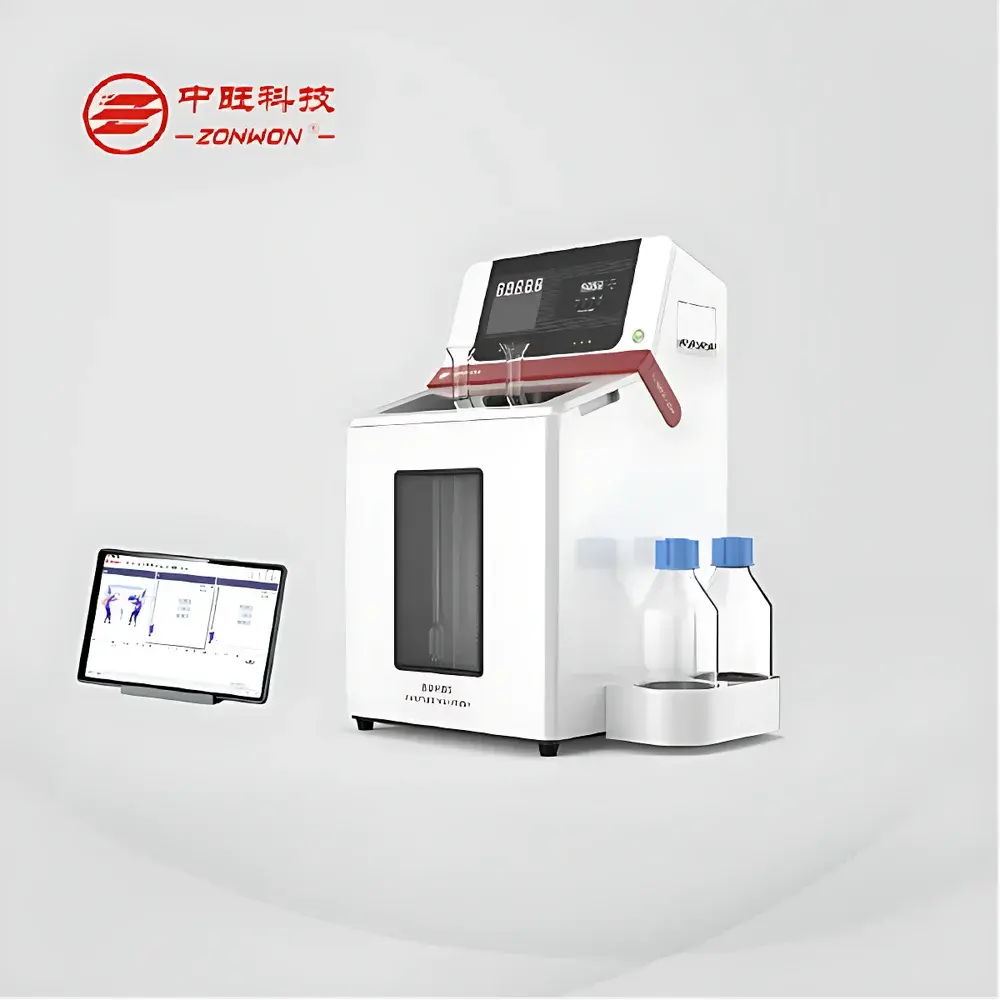
ZONWON IVS200H Miniature High-Temperature Automatic Viscometer
| Brand | ZONWON |
|---|---|
| Origin | Zhejiang, China |
| Manufacturer Type | Direct Manufacturer |
| Instrument Category | Domestic |
| Model | IVS200H |
| Instrument Kind | High-Temperature Viscometer |
| Instrument Type | Benchtop Fixed Unit |
| Operating Environment | High-Temperature Laboratory |
| Viscosity Range | 0.3–100,000 mm²/s |
| Temperature Range | 40–120 °C |
| Temperature Accuracy | ≤ ±0.05 °C |
| Timing Range | 0.001–9999.999 s |
| Timing Resolution | 0.001 s |
| Temperature Field Uniformity | ≤ ±0.05 °C |
| Sample Stations | 2 |
| Bath Volume | 7.5 L |
| Wireless Control Distance | 30 m |
| Dimensions (W×D×H) | 360 × 362 × 615 mm |
| Power Supply | 220 V / 50 Hz / 1500 W |
Overview
The ZONWON IVS200H Miniature High-Temperature Automatic Viscometer is a benchtop capillary viscometer system engineered for precise, automated measurement of kinematic viscosity, intrinsic viscosity, and derived polymer parameters under controlled elevated temperatures. It operates on the principle of gravity-driven capillary flow—compliant with ASTM D445, ISO 3104, and GB/T 265—where sample efflux time through standardized capillaries (e.g., Ubbelohde, dilution Ubbelohde, or micro-Ubbelohde) is recorded and converted to kinematic viscosity using calibrated constants. Designed specifically for thermally stable organic solvents, petroleum fractions, and synthetic polymers—including PVF, PET, PA, and acrylic resins—the IVS200H maintains tight thermal regulation (±0.05 °C) across its 40–120 °C operating range, ensuring high reproducibility in viscosity determinations critical for quality control, polymer characterization, and R&D validation.
Key Features
- Benchtop compact footprint (360 × 362 × 615 mm) enables seamless integration into fume hoods or constrained lab spaces without compromising thermal stability or mechanical rigidity.
- Fully automated workflow: auto-sampling, timed efflux measurement, post-run capillary rinsing with solvent, nitrogen-assisted drying, and waste fluid evacuation—eliminating manual handling and inter-operator variability.
- Dual-station configuration supports parallel or sequential analysis of two samples or concentration series, improving throughput for intrinsic viscosity extrapolation protocols.
- High-precision temperature control via PID-regulated oil bath (7.5 L capacity), achieving uniformity ≤ ±0.05 °C across the full 40–120 °C range—validated per ISO 17025 calibration traceability requirements.
- Sub-millisecond timing resolution (0.001 s) with quartz-crystal oscillator reference ensures compliance with ASTM D445 repeatability criteria (≤ 0.35% RSD for duplicate runs).
- Wireless operation up to 30 m eliminates cable clutter and allows remote monitoring during extended thermal equilibration or multi-hour polymer dissolution cycles.
Sample Compatibility & Compliance
The IVS200H accommodates standard capillary types including Ubbelohde, dilution Ubbelohde, and micro-Ubbelohde viscometers—enabling determination of kinematic viscosity (mm²/s), relative viscosity, specific viscosity, inherent viscosity, intrinsic viscosity (limiting viscosity number), and Mark–Houwink-derived molecular weight parameters. It is routinely deployed for QC testing of lubricants, transformer oils, biofuels, and synthetic polymer solutions (e.g., in formic acid, phenol, or o-chlorophenol). The system supports regulatory workflows aligned with USP , ISO 1628-1/3, and ASTM D1243, and its audit-trail-capable software meets GLP documentation standards. All thermal and timing subsystems are factory-calibrated against NIST-traceable references; optional IQ/OQ documentation packages are available for GMP environments.
Software & Data Management
Viscobee™ control software provides bilingual (English/Chinese) interface support for Windows 7 through Windows 11. It implements intelligent outlier detection: if measured efflux time deviates beyond user-defined tolerance (e.g., ±0.5%), the system automatically triggers a retest. The software natively supports single-capillary multi-concentration serial extrapolation (e.g., Huggins, Kraemer, Schulz–Blaschke), automatic calculation of Fickentscher’s K-value, viscosity-average molecular weight (Mv), and degree of polymerization. Each measurement unit operates independently with configurable formula sets; custom equations (e.g., non-standard Mark–Houwink coefficients) can be added at no cost. Data export options include timestamped PDF reports, Excel (.xlsx) spreadsheets with raw timing and calculated values, and PNG/JPEG image captures of real-time efflux curves. Role-based access control (administrator, technician, viewer) enforces data integrity and aligns with FDA 21 CFR Part 11 principles for electronic records.
Applications
- Quality assurance of industrial lubricants and hydraulic fluids across temperature grades (ISO VG 32 to VG 680).
- Intrinsic viscosity monitoring during polymer synthesis and batch release testing (e.g., PET melt-phase reactions).
- Stability assessment of thermally aged transformer oils per IEC 60296.
- Research-scale characterization of biodegradable polyesters (PLA, PCL) and fluoropolymers (PVF, PVDF) in high-boiling solvents.
- Educational laboratories requiring robust, low-maintenance capillary viscometry platforms compliant with undergraduate and graduate curriculum standards.
FAQ
What capillary types are supported by the IVS200H?
Ubbelohde, dilution Ubbelohde, and micro-Ubbelohde viscometers—compatible with standard ASTM D445 and ISO 3104 capillary dimensions and calibration protocols.
Does the system comply with 21 CFR Part 11 for electronic records?
Yes—Viscobee software includes audit trail logging, electronic signatures, and role-based permissions required for regulated pharmaceutical and medical device environments.
Can the instrument perform intrinsic viscosity extrapolation automatically?
Yes—it supports single-capillary multi-concentration serial dilution with automated Huggins, Kraemer, and Schulz–Blaschke linear regression and limit viscosity number calculation.
Is external calibration verification possible?
Yes—users may load NIST-traceable viscosity standards (e.g., Cannon-Manning certified oils) to verify system performance at defined temperatures; calibration certificates are provided with each instrument shipment.
What maintenance is required for long-term reliability?
Routine cleaning of solvent lines and capillary holders; annual verification of temperature sensor accuracy and timing module drift—both supported by ZONWON’s global service network and remote diagnostic tools.



