
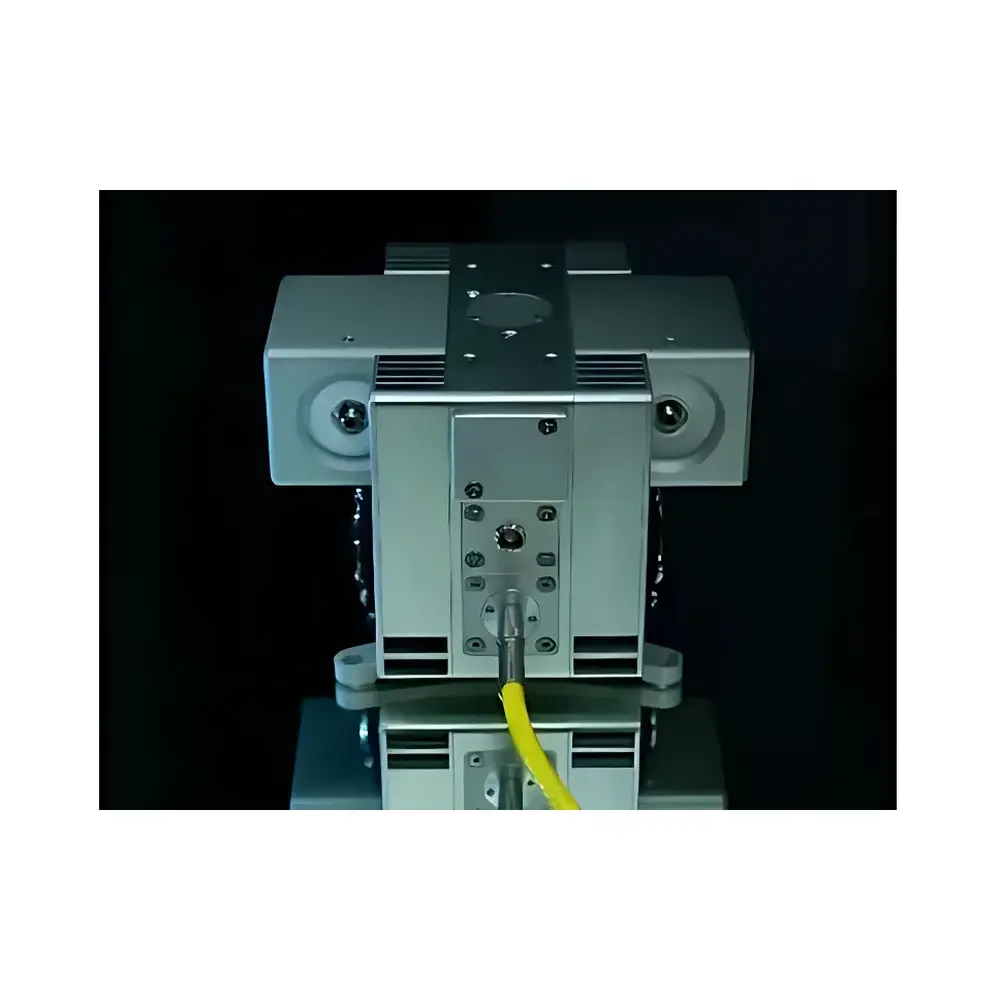
ISTEQ XWS-Dual Port Laser-Driven Plasma White Light Source
| Brand | ISTEQ |
|---|---|
| Origin | Netherlands |
| Model | XWS-Dual Port |
| Spectral Range | 190–2500 nm (UV configuration), 250–2500 nm (OFR configuration) |
| Spectral Radiance | up to 50 mW/(mm²·sr·nm) |
| Free-Space Output Power | up to 3 W |
| Fiber-Coupled Output Power | up to 0.5 W per port |
| Emitter Size | 250 × 500 µm |
| Lifetime | 10,000 hours |
| Intensity Stability (STD) | < 0.15% |
| Fiber Interface | SMA or FC |
Overview
The ISTEQ XWS-Dual Port is a high-brightness, laser-driven plasma white light source engineered for demanding optical metrology and spectroscopic applications requiring simultaneous, spectrally matched illumination from two independent output ports. Unlike conventional arc lamps or LED-based broadband sources, the XWS-Dual Port utilizes a focused high-repetition-rate pulsed laser to generate a transient, high-temperature plasma within a xenon gas environment—producing continuum emission spanning the deep ultraviolet through the near-infrared (190–2500 nm). This plasma-based mechanism eliminates electrode degradation and spectral drift inherent in traditional xenon or mercury arc lamps, delivering superior spatial coherence, temporal stability, and long-term radiometric reproducibility. The dual-port architecture is derived from the proven XWS-65 platform, with both outputs rigorously balanced in spectral radiance, divergence, and intensity stability—enabling true common-path referencing in differential measurements such as absorption ratio analysis, dual-beam ellipsometry, or ratiometric fluorescence detection.
Key Features
- Dual-output design with identical spectral radiance (up to 50 mW/(mm²·sr·nm)) and intensity stability (STD < 0.15%) across both ports—critical for noise-cancellation in comparative optical measurements.
- Laser-driven plasma emitter with no electrodes or consumable components, ensuring consistent spectral output over its rated lifetime of 10,000 hours without recalibration.
- Compact, air-cooled architecture optimized for integration into OEM instruments and benchtop laboratory systems—including vacuum-compatible variants upon request.
- Flexible coupling options: free-space output (up to 3 W total) or fiber-coupled delivery via SMA or FC connectors (up to 0.5 W per fiber port).
- Two spectral configurations available: UV-optimized (190–2500 nm) with enhanced deep-UV throughput, and OFR (Optical Filtering Ready) version (250–2500 nm) designed for seamless integration with bandpass or notch filters in fluorescence or Raman setups.
- Emitter source size of 250 × 500 µm enables efficient coupling into single-mode and multimode fibers while preserving étendue-limited brightness.
Sample Compatibility & Compliance
The XWS-Dual Port is compatible with standard optical breadboards, kinematic mounts, and modular spectroscopy platforms. Its stable, low-noise output supports quantitative measurements compliant with ISO/IEC 17025-accredited laboratory practices. When operated with traceable calibration standards (e.g., NIST-traceable radiometric detectors), the system supports GLP-compliant documentation workflows. While not intrinsically certified for medical device use, its radiometric stability and repeatability meet the foundational requirements for method validation under USP , ASTM E275, and ISO 13406-2 for optical source characterization. No hazardous materials are present beyond standard xenon gas containment; operation conforms to IEC 61000-6-3 (EMC) and IEC 60825-1 (laser safety Class 1 enclosure).
Software & Data Management
The XWS-Dual Port operates as a standalone hardware module with analog monitoring outputs (0–10 V) for real-time intensity tracking and TTL-triggered synchronization with external detectors or gated cameras. Optional USB-controlled power management firmware enables remote on/off, pulse rate adjustment (for noise reduction in lock-in applications), and internal diagnostics logging. All operational parameters—including cumulative runtime, thermal status, and plasma ignition count—are accessible via ASCII serial protocol for integration into LabVIEW, Python (PySerial), or MATLAB automation frameworks. Audit trails generated by host software may be structured to satisfy FDA 21 CFR Part 11 requirements when deployed in regulated QC environments—provided the host system implements electronic signatures, access controls, and immutable record retention.
Applications
- Absorption and transmission spectroscopy—especially in dual-beam configurations where path-length or detector response differences must be compensated in real time.
- Fluorescence excitation with ratiometric detection, including FRET and lifetime-insensitive intensity referencing in live-cell imaging and microfluidic cytometry.
- Ellipsometry and scatterometry for thin-film metrology in semiconductor process control, where spectral consistency between reference and sample beams directly impacts delta psi/delta delta accuracy.
- High-resolution optical component testing—including lens MTF, filter edge steepness, and anti-reflection coating uniformity—leveraging the source’s spatial homogeneity and broadband coverage.
- Chromatography detector illumination (e.g., diode array or photodiode-based UV-Vis detectors) requiring stable, flicker-free continuum output across variable scan rates.
- Wafer-level inspection and defect mapping systems, where synchronized dual-port illumination enables shadow-free topography reconstruction and particle contrast enhancement.
FAQ
Is the XWS-Dual Port compatible with standard monochromators and spectrographs?
Yes—the source’s high étendue and smooth spectral profile ensure efficient coupling into f/4 and f/6 monochromators; optimal alignment requires a 1:1 imaging relay for maximum throughput.
Can the two output ports be independently modulated or gated?
No—both ports share the same plasma emission event and cannot be temporally decoupled; however, external acousto-optic or mechanical shutters may be used for asynchronous control.
What is the recommended warm-up time before radiometric stability is achieved?
Full spectral and intensity stabilization occurs within 15 minutes of cold start; drift remains below ±0.05% after 30 minutes under constant ambient conditions.
Does ISTEQ provide NIST-traceable spectral irradiance calibration certificates?
Yes—calibration services are available per ISO/IEC 17025 accredited procedures, covering absolute irradiance (W/m²/nm) and radiance (W/m²/sr/nm) at specified distances and apertures.
How is maintenance performed, and what consumables are required?
No routine maintenance is required; the xenon gas fill is sealed for life. The only scheduled replacement is the laser diode module after 10,000 hours—performed by ISTEQ-certified service centers.




