
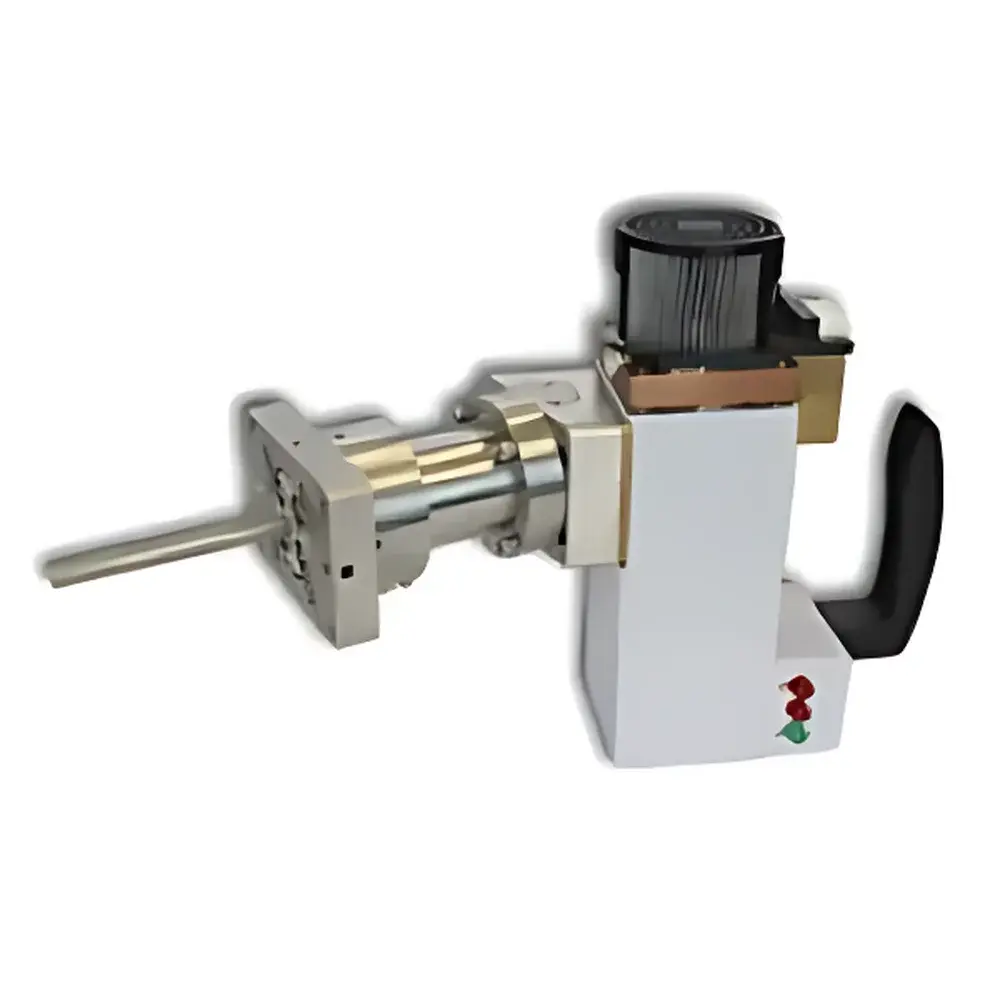
XOS DCC X-Beam™ Monochromatic Microfocus X-ray Source
| Brand | XOS |
|---|---|
| Origin | USA |
| Manufacturer Type | Authorized Distributor |
| Origin Category | Imported |
| Model | DCC X-Beam |
| Price Range | USD 42,000 – 70,000 |
| Cooling | Integrated Air-Cooling System |
| Beam Delivery | Focused Monochromatic Ka Radiation |
| Monochromaticity (Ka/Kb Ratio) | ≥1000:1 |
| Optical Configuration | Double-Curved Crystal Monochromator |
| Compliance | PTB-certified, Oil-Free Vacuum Enclosure |
| Control Interface | PC-based Software with Safety Interlock & Shutter Mode |
| Optional Power Supply | PCS50 High-Stability HV Generator |
Overview
The XOS DCC X-Beam™ is a compact, air-cooled monochromatic microfocus X-ray source engineered for high-fidelity excitation in laboratory and industrial analytical systems. Unlike conventional polychromatic or filtered X-ray tubes, the DCC X-Beam integrates a low-power sealed-tube X-ray generator with a double-curved crystal (DCC) monochromator — a precision optical element that selects and focuses only the characteristic Cu Kα (or other anode-material-specific Ka) radiation while suppressing Kb and bremsstrahlung background. This physical architecture delivers a highly collimated, spatially coherent, and spectrally pure beam with intrinsic Ka/Kb ratios exceeding 1000:1. The system operates without oil-based vacuum pumps or liquid cooling infrastructure, relying instead on a robust, maintenance-free oil-free vacuum enclosure and integrated forced-air thermal management. Designed for seamless OEM integration, the DCC X-Beam functions as a turnkey excitation module — eliminating the need for external monochromators, beam conditioning optics, or complex alignment procedures. Its performance is traceable to PTB (Physikalisch-Technische Bundesanstalt) calibration standards, ensuring metrological consistency across installations.
Key Features
- Monochromatic output centered at Cu Kα (8.04 keV), with optional anode configurations (e.g., Mo, Cr, Co) available upon request
- Micron-scale focal spot size enabling high spatial resolution in mapping and micro-XRF applications
- Integrated fast electromechanical shutter supporting time-resolved and pulsed acquisition protocols
- Real-time software-controlled beam enable/disable with hardware-enforced safety interlocks compliant with IEC 61010-1
- Plug-and-play USB/Ethernet interface with vendor-supplied control suite supporting scriptable automation (Python API available)
- Compact footprint (≤250 mm × 180 mm × 120 mm) optimized for integration into custom goniometers, vacuum chambers, or benchtop analyzers
- Stable output intensity (<0.5% RMS drift over 8 h) enabled by PCS50 high-voltage power supply option (50 kV, 1 mA, <10 ppm ripple)
Sample Compatibility & Compliance
The DCC X-Beam is compatible with solid, powdered, thin-film, and multi-layer samples across diverse sample geometries — including transmission, reflection, and grazing-incidence configurations. Its monochromatic nature eliminates spectral overlap artifacts common in energy-dispersive XRF (ED-XRF) and improves peak-to-background ratios in wavelength-dispersive XRF (WD-XRF), X-ray diffraction (XRD), and X-ray reflectivity (XRR). The system meets electromagnetic compatibility (EMC) requirements per EN 61326-1 and carries CE marking for use within the European Economic Area. All vacuum and high-voltage subsystems are designed and tested to comply with ISO 14001 environmental controls and ISO 9001 quality assurance protocols. For regulated environments, audit-ready electronic log files (including runtime parameters, shutter actuation timestamps, and interlock status) support GLP/GMP documentation requirements under FDA 21 CFR Part 11 when paired with validated software configurations.
Software & Data Management
Control is executed via XOS’s native DCC Control Suite — a Windows-based application offering real-time monitoring of tube voltage/current, shutter state, temperature sensors, and vacuum level. The software supports batch parameter loading, scheduled acquisition sequences, and export of metadata-rich ASCII or HDF5 files compatible with third-party analysis platforms (e.g., PyMCA, GSAS-II, Reflex). An open communication protocol (TCP/IP socket interface) enables integration into LabVIEW, MATLAB, or Python-driven automated workflows. All operational events — including emergency shutdowns, interlock triggers, and firmware updates — are timestamped and archived with SHA-256 checksum integrity verification. Optional validation packages include IQ/OQ documentation templates aligned with ASTM E1318 and ISO/IEC 17025 laboratory accreditation frameworks.
Applications
- High-sensitivity micro-XRF elemental mapping of geological thin sections and semiconductor wafers
- Quantitative thin-film thickness and density profiling via XRR in advanced packaging R&D
- Phase identification and strain analysis in polycrystalline materials using monochromatic XRD
- Benchtop medical imaging research requiring low-dose, high-contrast radiography
- In-line process monitoring in additive manufacturing where spectral purity minimizes absorption artifacts
- Reference material certification workflows requiring traceable, stable excitation conditions
FAQ
What anode materials are supported beyond copper?
Standard configurations include Cu, Mo, Cr, and Co targets; custom anodes (e.g., Ag, Fe) can be implemented subject to vacuum and thermal design review.
Is the DCC X-Beam compatible with existing XRD goniometers?
Yes — mechanical mounting interfaces and beam-height alignment specifications are provided in the OEM Integration Manual; standard flange options include CF-35 and ISO-KF40.
Does the system require external water cooling or high-vacuum pumps?
No — it operates with integrated air cooling and a permanently sealed, oil-free vacuum envelope rated for >10-year service life.
Can beam intensity be modulated during acquisition?
Yes — the PCS50 power supply option enables programmable current ramping and pulse-width modulation with sub-millisecond timing resolution.
How is monochromaticity verified and maintained over time?
Each unit undergoes spectral characterization using a calibrated silicon drift detector (SDD); long-term stability is monitored via periodic reference measurements against NIST-traceable fluorescence standards.
Related Products





