
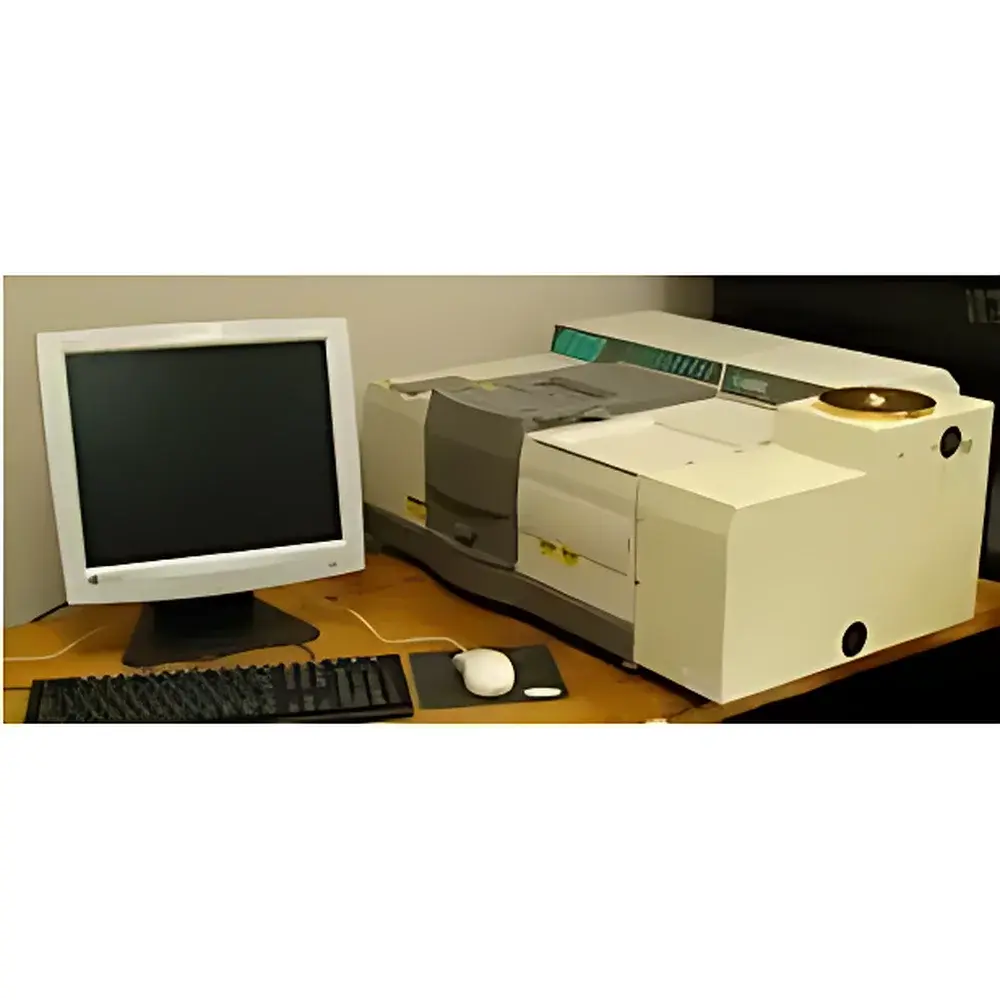
AZ Technology SPECTRAFIRE Far- and Mid-Infrared Spectral Reflectometer
| Brand | AZ Technology |
|---|---|
| Origin | USA |
| Manufacturer Type | Authorized Distributor |
| Origin Category | Imported |
| Model | SPECTRAFIRE |
| Pricing | Available Upon Request |
| Spectral Range | 2.5–40 µm (4000–250 cm⁻¹) |
| Spectral Resolution | 0.5–32 cm⁻¹ |
| Sample Diameter Requirement | ≥8.3 mm |
| Footprint (FTIR + SPECTRAFIRE) | 33 × 25 in |
| Height at Sample Port | 13.5 in |
| Electrical Requirement | 120 VAC, 60 Hz |
| Warranty | 1 year parts and labor |
Overview
The AZ Technology SPECTRAFIRE is a purpose-engineered far- and mid-infrared spectral reflectometer designed as a modular accessory for Thermo Scientific Nicolet Fourier Transform Infrared (FTIR) spectrometers. Unlike conventional integrating sphere-based reflectance accessories—whose internal diffuse coatings inherently absorb significant radiant energy in the 2.5–40 µm range—the SPECTRAFIRE employs a patented ellipsoidal collection geometry to achieve near-unity optical throughput. This architecture eliminates parasitic absorption losses while preserving signal-to-noise integrity across the full operational spectral window (4000–250 cm⁻¹). The system performs hemispherical reflectance measurements at near-normal incidence using collimated FTIR output, enabling quantitative determination of spectral reflectance (ρλ) without reliance on empirical calibration standards for absolute mode operation. Derived quantities—including total hemispherical emissivity (εh) and absorptance (αλ)—are computed via Kirchhoff’s law (ελ = 1 − ρλ − τλ, with τλ ≈ 0 for opaque samples) and integration against Planck’s blackbody distribution. Critically, the SPECTRAFIRE supports non-gray body analysis and variable-temperature emissivity characterization beyond 300 K, making it suitable for thermal radiation modeling in aerospace materials testing, high-temperature coating qualification, and infrared signature simulation.
Key Features
- Patented ellipsoidal optical collector replaces integrating spheres, minimizing photon loss and enhancing radiometric accuracy in the 2.5–40 µm range
- Dual measurement modes: absolute reflectance (self-referenced via integrated calibration arm) and differential (background-subtracted) reflectance
- Gold-coated optical surfaces throughout—non-protective Au films optimized for >98% reflectance from 2.5 to 40 µm
- Integrated beam-deflection mechanism for in-situ background acquisition; deflector reflectance spectrally matched to collector
- Optimized purge path design: fully evacuable optical chamber minimizes atmospheric H2O and CO2 absorption bands during acquisition
- Modular mechanical interface compatible with standard Thermo Nicolet FTIR platforms (e.g., iS50, Nexus, Avatar series) without hardware modification
- Supports both opaque and semi-transparent specimens—including ground glass, polymer films, ceramics, and sintered metal oxides—without sample thinning or coating
Sample Compatibility & Compliance
The SPECTRAFIRE accommodates solid, flat, or slightly curved samples ≥8.3 mm in diameter and up to 25 mm in thickness. Its top-access sample port enables rapid loading of irregular or fragile substrates, including matte-finished optics, anodized aluminum, and textured thermal barrier coatings. All optical components comply with ISO 11377:2017 (optical properties of materials) and ASTM E1933-19 (standard test methods for measuring and compensating for emissivity using FTIR). Data acquisition workflows support GLP/GMP-aligned documentation when paired with Thermo’s OMNIC software configured for 21 CFR Part 11 audit trails. The system’s traceable reflectance scale is established through NIST-traceable gold reference mirrors calibrated at the National Institute of Standards and Technology.
Software & Data Management
SPECTRAFIRE operates natively within Thermo Scientific OMNIC spectroscopy software (v10.5+), leveraging its built-in spectral math engine for real-time calculation of εh, αλ, and directional-hemispherical reflectance. Raw interferograms are processed using phase-corrected Mertz apodization and zero-filling to maintain resolution fidelity at low wavenumbers. Export formats include ASTM E131-compliant .SPA files, CSV matrices with wavelength/wavenumber indexing, and XML metadata bundles containing instrument configuration, purge status, and detector linearity corrections. Batch processing scripts support automated emissivity mapping across multi-sample trays. Optional Python SDK access enables integration into custom thermal modeling pipelines (e.g., MATLAB Radiative Transfer Toolbox, COMSOL Multiphysics® IR modules).
Applications
- Thermal control material validation for spacecraft thermal management systems (per ECSS-Q-ST-70-08C)
- High-temperature emissivity characterization of ceramic matrix composites (CMCs) under inert atmosphere
- Quality assurance of selective solar absorber coatings (e.g., Ni-Al2O3, TiNOx) for concentrated solar power receivers
- Non-destructive evaluation of oxide layer growth kinetics on stainless steel and superalloys
- Development and verification of infrared camouflage textiles and low-emissivity paints
- Reference-grade reflectance data generation for radiative heat transfer model inputs in ANSYS Fluent and STAR-CCM+
FAQ
Does the SPECTRAFIRE require external calibration standards for absolute reflectance measurements?
No. The absolute mode uses an internal calibration arm with spectrally matched gold-coated optics, eliminating dependence on user-provided reference standards.
Can the system measure transmission through semi-transparent films?
Yes—when used with appropriate sample mounting fixtures and optional transmittance mode firmware patches, though primary design emphasis remains on reflection/emission metrology.
Is purge gas compatibility limited to dry nitrogen?
The chamber accepts any inert, desiccated gas (N2, Ar, He); residual moisture content must remain below 1 ppmv to avoid rotational water vapor lines below 600 cm⁻¹.
What is the minimum detectable reflectance change in differential mode?
At 4 cm⁻¹ resolution and 128 scans, the system achieves Δρ/ρ ≈ 0.003 (3σ) across 5–20 µm for polished metallic references.
Does the ellipsoidal collector introduce angular bias in hemispherical collection?
No—the geometry is rigorously modeled using ray-tracing simulations (Zemax OpticStudio v23) and validated against NIST SRM 2036 hemispherical reflectance data, confirming <±0.5% deviation from ideal Lambertian integration.
Related Products




