
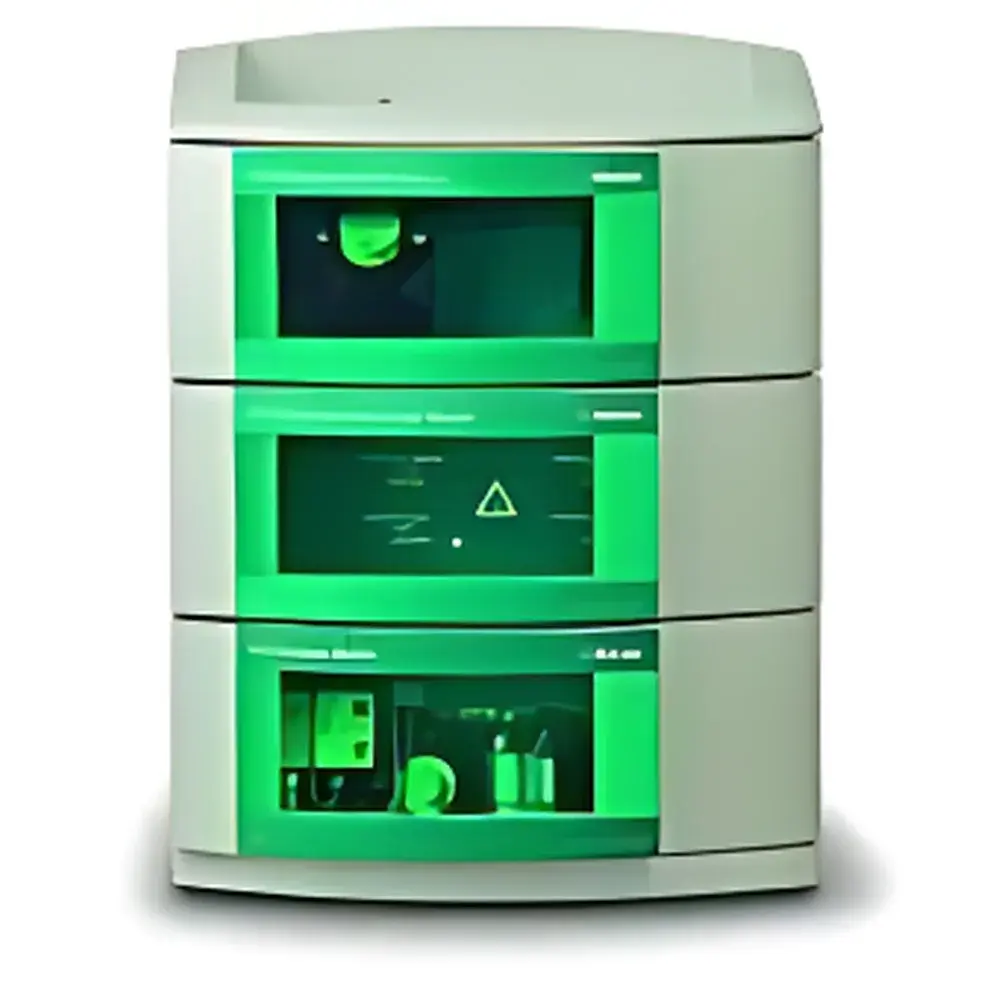
Metrohm 887 Intelligent UV/Vis Ion Chromatograph
| Brand | Metrohm |
|---|---|
| Origin | Switzerland |
| Model | 887 |
| Detection Principle | Integrated post-column derivatization with diode-array UV/Vis detection |
| Flow Path | Non-metallic (PEEK, PTFE, sapphire) |
| Column Oven Temperature Range | Ambient to 150 °C |
| Wavelength Selection | Up to 8 user-defined wavelengths simultaneously |
| Spectral Acquisition | Full-spectrum recording (190–800 nm), variable slit width, adjustable integration time |
| Derivatization Modes | Fully automated pre- or post-column, single- or multi-step, residence time programmable |
| Software Platform | MagIC Net™ v4.x (21 CFR Part 11 compliant, audit trail enabled) |
| System Integration | Compatible with Metrohm modular IC platforms (e.g., 940 Professional IC Vario, 930 Compact IC Flex) for serial/parallel multi-channel configuration |
| Regulatory Compliance | Designed for GLP/GMP environments |
Overview
The Metrohm 887 Intelligent UV/Vis Ion Chromatograph represents a foundational advancement in ion analysis methodology — the world’s first commercially integrated ion chromatography system combining high-resolution anion/cation separation, programmable chemical derivatization, and diode-array UV/Vis spectrophotometric detection within a single, unified fluidic architecture. Unlike conventional approaches that couple standalone derivatization modules with external UV detectors — introducing inter-system dead volume, timing drift, and calibration instability — the 887 embeds a thermally controlled, low-dead-volume intelligent derivatization reactor directly in-line with its non-metallic flow path and dual-beam DAD detector. This co-located design ensures precise reaction kinetics control, reproducible residence time delivery, and real-time spectral verification of derivative formation, thereby eliminating chromatographic misalignment and signal attenuation typical of segmented configurations. Its core application domain spans trace-level quantification of ions lacking intrinsic chromophores (e.g., nitrite, sulfite, iodide, transition metal cations such as Fe²⁺/Cu²⁺, and small organic acids), where selective derivatization significantly enhances molar absorptivity and spectral discrimination.
Key Features
- Integrated intelligent derivatization reactor with programmable temperature (up to 150 °C), residence time, and reagent injection sequence — supporting both pre- and post-column chemistries including diazotization, complexation, and redox-coupled reactions
- Diode-array UV/Vis detector (190–800 nm) enabling simultaneous monitoring at up to eight independently defined wavelengths, variable optical slit width (1–8 nm), and adaptive integration time per peak
- Full-spectrum acquisition capability: captures and stores complete absorbance spectra for every data point, facilitating post-run peak purity assessment, library matching, and method development optimization
- Entirely non-metallic fluidic path constructed from PEEK, PTFE, sapphire, and ceramic components — ensuring compatibility with aggressive reagents (e.g., strong oxidants, chelating agents) and eliminating metal-induced catalytic degradation or adsorption artifacts
- Modular architecture compliant with Metrohm’s Intelligent IC ecosystem: seamless serial or parallel coupling with other 900-series instruments (e.g., 940 Professional IC Vario for suppressed conductivity detection) to construct hybrid multi-detection workflows
- MagIC Net™ v4.x software with embedded method wizards, automatic baseline correction, peak deconvolution algorithms, and full 21 CFR Part 11 compliance including electronic signatures, role-based access control, and immutable audit trails
Sample Compatibility & Compliance
The 887 is validated for aqueous matrices across environmental, pharmaceutical, food safety, and industrial process control applications. It routinely analyzes anions (F⁻, Cl⁻, NO₂⁻, Br⁻, NO₃⁻, PO₄³⁻, SO₄²⁻), cations (Li⁺, Na⁺, NH₄⁺, K⁺, Mg²⁺, Ca²⁺, transition metals), and derivatizable organics (e.g., carbonyl compounds via DNPH, thiols via Ellman’s reagent). Its hardware and software meet ISO/IEC 17025 requirements for testing laboratories and support validation per USP , EP 2.2.46, and ASTM D4327/D6919. All derivatization protocols are documented in accordance with ICH Q2(R2) guidelines for analytical procedure validation. The system’s non-metallic construction complies with FDA recommendations for elemental impurity control in pharmaceutical excipients (ICH Q3D).
Software & Data Management
MagIC Net™ v4.x serves as the central operational interface, providing intuitive sequence setup, real-time spectral overlay, and dynamic wavelength switching during gradient runs. Raw spectral data (absorbance vs. wavelength at each retention time) are stored in vendor-neutral .cdf format, fully exportable for third-party chemometric analysis. The software includes built-in tools for spectral library creation, peak tracking across wavelength channels, and automatic derivative stoichiometry verification. Audit trail functionality records all user actions, parameter changes, and calibration events with timestamps and operator IDs — satisfying GLP documentation standards and enabling full traceability during regulatory inspections.
Applications
- Environmental monitoring: Quantification of trace nitrite and bromate in drinking water using cadmium reduction and triiodide formation, respectively
- Pharmaceutical QC: Simultaneous assay of sulfate counterions and residual sulfite preservatives in biologics formulations
- Food & beverage: Determination of iodide in dairy products via catalytic cerimetric oxidation with UV endpoint detection
- Electroplating bath control: Speciation of Cu²⁺, Ni²⁺, and Co²⁺ using 1,10-phenanthroline derivatization and multivariate spectral deconvolution
- Chemical manufacturing: Monitoring of chloride and acetate impurities in high-purity solvents using post-column Ag⁺ complexation and visible absorbance at 450 nm
FAQ
Is the 887 compatible with existing Metrohm ion chromatography columns and eluents?
Yes — it accepts all Metrohm IC columns (e.g., Metrosep A Supp 5, Metrosep C 4, Metrosep Organic Acids) and standard eluents (e.g., NaOH/KOH gradients, carbonate/bicarbonate buffers), with flow rate compatibility up to 2.0 mL/min.
Can derivatization chemistry be customized beyond preloaded methods?
Absolutely — MagIC Net™ allows full scripting of reagent delivery timing, pump stroke volume, reactor temperature ramp profiles, and wavelength switching logic, enabling user-defined reaction schemes.
Does the system support unattended overnight operation with auto-calibration?
Yes — equipped with autosampler-integrated standard addition, bracketing calibration, and periodic system suitability checks, all governed by scheduler-driven sequences.
How is spectral data handled during peak integration?
Each peak is assigned a reference spectrum; the software applies weighted least-squares fitting across all monitored wavelengths to reject co-eluting interferents and improve quantitation accuracy in complex matrices.
What validation documentation is supplied with the instrument?
Factory IQ/OQ documentation, Metrohm Certificate of Conformance, and a comprehensive User Requirement Specification (URS) template aligned with Annex 11 and ALCOA+ data integrity principles.




